
Video editors need more than basic drive storage: they need dependable copies, broad drive compatibility, and enough speed to keep footage moving. The right duplicator can simplify project backups, drive upgrades, and disaster recovery without requiring a computer.
We selected 10 models ranging from compact dual-bay docking stations to higher-capacity multi-drive and tower duplicators. This guide focuses on interface support, offline cloning, throughput, usability, and the practical needs of editing workflows.
Best 10 Hard Drive Duplicators for Video Editing Picks for 2026
Best Value SATA Dock
Sabrent Dual-Bay HDD/SSD Cloner

- Supports 2.5-inch and 3.5-inch SATA drives
- Offline cloning requires no computer
- USB 3.0 supports up to 5Gbps transfers
Best For: Budget-minded editors using standard SATA drives
Best Professional SATA Copier
StarTech Dual-Bay Duplicator Dock
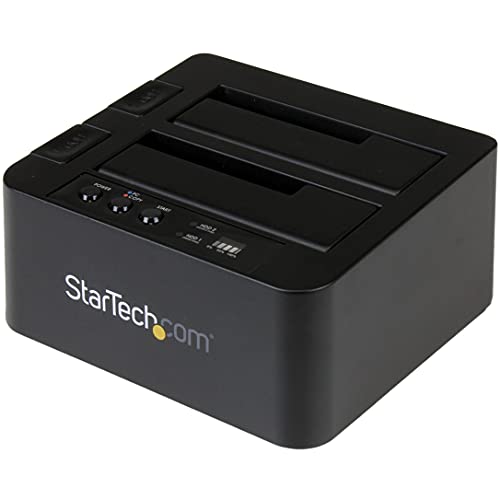
- Copies SATA drives sector by sector
- Supports 4Kn and SATA drives of any capacity
- USB 3.2 Gen 2 reaches 10Gbps
Best For: Frequent SATA cloning and drive migration
Best Three-Bay Versatility

- Supports M.2 NVMe and SATA storage
- Provides three bays for flexible workflows
- USB 3.2 Gen 2x1 supports up to 10Gbps
Best For: Editors working with mixed drive formats
Best Advanced Sanitizer

- Clones M.2 and 2.5/3.5-inch SATA drives
- Includes configurable duplication modes
- Provides NIST 800-88 erase support
Best For: Technical teams needing cloning and secure erasure
Best Standalone Pick

- Up to 600MB/s SATA duplication
- Four copy modes for flexible workflows
- Standalone operation with secure erase options
Best For: Studios needing computer-free SATA drive duplication
Best Budget Dock
ORICO Dual-Bay Hard Drive Cloner

- Offline cloning without a computer
- Supports SATA HDDs and SSDs up to 44TB total
- USB 3.0 dock with UASP and TRIM
Best For: Editors wanting cloning plus everyday drive access
Best for Batch Work

- Duplicates up to three drives at once
- Supports SATA and IDE/PATA media
- Includes case, write blocker, and work logs
Best For: Studios and labs handling repeatable multi-drive jobs
Best Overall

- Offline one-key cloning with LED progress indicators
- Supports 2.5-inch and 3.5-inch SATA drives
- 5Gbps transfers and up to 40TB across both bays
Best For: SATA-based video editing backups and drive migration
Best for Bulk Duplication

- Copies to up to four SATA drives at 600MB/s
- Offers four duplication and seven erase modes
- Standalone operation requires no computer or software
Best For: Production teams duplicating multiple SATA media drives
Best for Mixed Drive Workflows

- Supports two NVMe SSDs plus one SATA drive
- Clones NVMe-to-NVMe or SATA-to-NVMe offline
- USB 3.2 Gen 2 offers up to 10Gbps transfers
Best For: Editors combining NVMe upgrades with SATA project storage
Best Value SATA Dock – Sabrent Dual-Bay HDD/SSD Cloner
For editors building a practical set of hard drive duplicators for video editing, the Sabrent EC-HD2B is a straightforward dual-bay option for standard 2.5-inch and 3.5-inch SATA hard drives or SSDs. It supports offline cloning without a computer and connects over USB 3.0 for file access and transfers.
Best For: Video editors who need an affordable dock for SATA drive cloning, reading, and basic storage management.
Pros:
- Supports both 2.5-inch and 3.5-inch SATA HDDs and SSDs.
- Offline cloning works without drivers or a host computer.
- Supports drives up to 10TB and USB 3.0 transfer speeds up to 5Gbps.
Cons:
- Limited to SATA drives rather than M.2 NVMe storage.
- Offline cloning is listed at up to 60Mbps, slower than its USB transfer rating.
The EC-HD2B is a sensible choice when your editing workflow relies on conventional SATA media. Its plug-and-play design keeps routine drive access simple, while the dual-bay layout makes direct duplication convenient.
Best Professional SATA Copier – StarTech Dual-Bay Duplicator Dock
The StarTech SDOCK2U313R is designed for editors and IT users who want a more capable entry in a lineup of hard drive duplicators for video editing. It performs standalone, sector-by-sector copies of 2.5-inch and 3.5-inch SATA drives, then doubles as a USB-connected SATA dock.
Best For: Professionals who need sector-by-sector SATA cloning, 4Kn support, and a fast USB 3.2 Gen 2 connection.
Pros:
- Clones SATA drives without a computer at speeds up to 28GB per minute.
- Supports 2.5-inch and 3.5-inch SATA HDDs and SSDs of any capacity, including 4Kn drives.
- Offers USB 3.2 Gen 2 connectivity, TRIM support, and tool-less drive mounting.
Cons:
- The target drive must be equal to or larger than the source drive.
- IDE drives require the separately sold SAT2IDEADP adapter.
With sector-by-sector copying and broad SATA compatibility, this StarTech dock is well suited to repeatable backup and migration tasks. Its eject buttons, status LEDs, included cables, and two-year warranty add practical value for frequent use.
Best Three-Bay Versatility – Rosewill M.2 and SATA Cloner
The Rosewill RS-N2S-CL brings M.2 NVMe, SATA SSD, and 2.5-inch or 3.5-inch HDD support to a compact three-bay design. For video editors comparing hard drive duplicators for video editing, it offers offline cloning plus a USB 3.2 Gen 2×1 connection for high-speed access from Windows, Mac, Linux, Android, or iOS systems.
Best For: Editors managing a mixed collection of M.2, SATA SSD, and traditional hard drives.
Pros:
- Supports M.2 NVMe, SATA SSDs, and 2.5-inch or 3.5-inch HDDs.
- Three-bay design supports flexible docking and cloning workflows.
- Tool-free operation and USB transfer speeds up to 10Gbps.
Cons:
- The supplied notes do not specify a maximum supported drive capacity.
- Its plastic enclosure may be less robust than a metal professional duplicator.
This Rosewill model stands out for format flexibility rather than a single-drive specialty. It is a useful option when an editing workstation moves between newer M.2 storage and legacy SATA media and you want one compact device for both.
Best Advanced Sanitizer – StarTech M.2/SATA Duplicator
The StarTech SM2DUPE11 is the most feature-rich option here for editors who need more than basic copying. It combines standalone duplication of M.2 NVMe, M.2 SATA, and 2.5-inch or 3.5-inch SATA drives with configurable copy modes, on-screen controls, and secure erasure.
Best For: Production teams and technical users who need mixed-format cloning plus documented drive-erasure options.
Pros:
- Duplicates between M.2 NVMe, M.2 SATA, and 2.5-inch or 3.5-inch SATA drives.
- Offers System/File, All Partitions, Whole Drive, and Percentage Duplication modes.
- Includes five erase modes, HPA controls, and NIST SP 800-88 Rev. 1 secure-erase support.
Cons:
- The listed cloning speed is up to 7.5GB per minute, slower than some USB-connected docks.
- Its advanced controls and larger metal enclosure may be more than casual users need.
- Some IDE and mSATA compatibility requires separately sold adapters.
If your video workflow includes drive retirement, reuse, or mixed M.2 and SATA media, the SM2DUPE11 offers unusually broad control. Its standalone operation and full on-screen display make it a strong choice for repeatable technical workflows without cloning software.
Best Standalone Pick – EZ DUPE H01PROHSATB
For editors who need a dedicated tool among hard drive duplicators for video editing, the EZ DUPE H01PROHSATB offers standalone SATA drive copying at up to 600MB per second, without requiring a computer or host connection.
Best For: Video professionals and studios that need secure, computer-free duplication of one 2.5-inch or 3.5-inch SATA HDD or SSD.
Pros:
- Copies SATA HDDs and SSDs at up to 36GB per minute.
- Supports quick, full, partition-area, and percentage-based copy modes.
- Includes multiple erase options, including secure and enhanced SSD erase.
- Standalone operation improves workflow security and convenience.
Cons:
- Supports SATA drives only; no IDE/PATA compatibility is listed.
- Duplicates one target drive at a time.
- It is a dedicated duplicator rather than a computer-connected storage dock.
This is a strong fit when reliable SATA duplication and flexible copy modes matter more than multi-drive throughput or computer connectivity. Its one-year warranty and lifetime technical support add useful reassurance for production workflows.
Best Budget Dock – ORICO Dual-Bay Hard Drive Cloner
The ORICO Dual-Bay Docking Station is a practical option for hard drive duplicators for video editing when you want both offline cloning and everyday computer access. It handles 2.5-inch and 3.5-inch SATA drives and connects over USB 3.0.
Best For: Editors who need an affordable dual-bay dock for drive cloning, backups, file transfers, and cross-device access.
Pros:
- Offline clone function works without connecting to a computer.
- Supports 2.5-inch and 3.5-inch SATA HDDs and SSDs up to a stated 44TB total capacity.
- USB 3.0, UASP, and TRIM support provide up to 5Gbps interface speeds.
- Works with Windows, Mac, Linux, iPad OS, Android, and several device types.
Cons:
- The target disk must be larger than the source disk for offline cloning.
- Offline cloning requires pressing the CLONE button for about three seconds, so it offers fewer copy controls than a dedicated tower duplicator.
- The dock will not power on without a hard drive inserted.
Choose this model if versatility is a priority. It can clone drives offline, then serve as a USB-connected dock for file access and transfers, although its stated cloning requirements are less flexible than those of higher-end duplicators.
Best for Batch Work – EZ Dupe HD Pal Pro 1-to-3
For production teams handling several copies, the EZ Dupe HD Pal Pro is one of the more capable hard drive duplicators for video editing. Its 1-to-3 design duplicates SATA or IDE/PATA HDDs and SSDs at up to 600MB per second per channel.
Best For: Studios, labs, and traveling production crews that need simultaneous multi-drive duplication, source protection, and project documentation.
Pros:
- Copies to up to three drives simultaneously with independent bandwidth design.
- Supports SATA and IDE/PATA drives with included cables and adapters.
- Offers four copy modes, including partition-area and percentage-based copying.
- Includes source write blocking, downloadable log files, label printing, and a rugged protective case.
Cons:
- Its broader feature set may be unnecessary for occasional single-drive copying.
- Label printing does not use the downloadable log file.
- The product is a standalone unit and does not connect to other devices as a general-purpose dock.
This deluxe kit is the strongest choice here for repeatable batch duplication and field use. The protective case, legacy IDE/PATA support, write blocker, and reporting features make it especially useful for organized production or analysis workflows.
Best Overall – Dual-Bay SATA Cloning Dock
For shoppers comparing hard drive duplicators for video editing, this dual-bay SATA dock offers a straightforward way to clone and access 2.5-inch or 3.5-inch drives. Its 5Gbps USB connection, offline cloning, and 40TB combined capacity make it practical for managing large project archives and backups.
Best For: Video editors working with SATA HDDs or SSDs who want a simple desktop backup and cloning station.
Pros:
- Clones drives offline without a computer and includes LED progress indicators.
- Supports two 2.5-inch or 3.5-inch SATA drives, with up to 20TB per bay.
- Offers USB 3.2 Gen 1 speeds plus UASP, TRIM, and S.M.A.R.T. support.
Cons:
- Limited to SATA drives; it does not support M.2 NVMe SSDs.
- Its 5Gbps interface is slower than the 10Gbps connection on some newer docks.
This is a versatile choice for SATA-based editing workflows, especially when you need quick drive swaps and standalone duplication rather than a multi-drive professional duplicator.
Best for Bulk Duplication – EZ Dupe HD Cyclone 600
Among hard drive duplicators for video editing, the EZ Dupe HD Cyclone 600 is aimed at users who need to copy several SATA drives without connecting a host computer. Its standalone design, independent bandwidth, and multiple copy modes suit production teams handling repeated media-drive duplication.
Best For: Studios, businesses, and IT users duplicating multiple 2.5-inch SATA drives at once.
Pros:
- Copies to up to four SATA drives with a stated speed of 600MB per second.
- Provides system/file, full-drive, partitioned-area, and percentage-copy modes.
- Includes seven erase modes, including DoD 3-pass and DoD 7-pass options.
- Operates standalone without software, a computer, or a host connection.
Cons:
- Supports 2.5-inch SATA drives without an adapter, but the supplied notes do not indicate M.2 NVMe support.
- Its flatbed format is less compact than a simple two-bay desktop dock.
The HD Cyclone 600 is the most capable option here for repeatable, multi-drive SATA duplication and secure erasing, though it is more specialized than a general-purpose editing dock.
Best for Mixed Drive Workflows – FIDECO 3-Bay NVMe/SATA Dock
For video editors using both NVMe and SATA storage, this FIDECO dock combines two M.2 NVMe bays with a 2.5-inch/3.5-inch SATA bay. It supports offline NVMe-to-NVMe or SATA-to-NVMe cloning, while USB 3.2 Gen 2 provides a stated 10Gbps connection for file access.
Best For: Editors upgrading from SATA drives to M.2 NVMe SSDs while maintaining access to older project disks.
Pros:
- Reads two M.2 PCIe NVMe SSDs and one 2.5-inch/3.5-inch SATA drive simultaneously.
- Supports offline NVMe-to-NVMe and SATA-to-NVMe cloning without software.
- Provides USB 3.2 Gen 2 transfer speeds up to 10Gbps.
- Includes a foldable cooling fan to help manage heat during extended use.
Cons:
- Offline cloning requires the target drive to be equal to or larger than the source.
- It does not list NVMe-to-SATA cloning in the supplied modes.
- New drives must be initialized before they are recognized by a computer.
This is the strongest fit for mixed-storage editing systems and NVMe upgrades. Its broader compatibility and faster USB interface make it more flexible than SATA-only duplicators, provided the cloning direction matches your workflow.
How We Picked the Best Hard Drive Duplicators for Video Editing
We compared these Hard Drive Duplicators for Video Editing by looking at the drive formats they support, advertised transfer rates, cloning method, bay count, connection standard, and intended workload. Models that handle both 2.5-inch and 3.5-inch SATA drives are useful for general studio storage, while M.2 NVMe support matters for newer cameras, workstations, and high-speed scratch disks.
We also considered whether each unit can clone drives offline, read source and destination disks through a computer, erase media, or duplicate several drives at once. Advertised speeds are maximum figures; actual results depend on the source drive, destination drive, file system, capacity, and thermal conditions.
Quick Comparison
- Best for basic two-drive cloning: Sabrent and Orico dual-bay docks.
- Best for mixed SATA and NVMe media: Rosewill, StarTech, and FIDECO multi-format docks.
- Best for faster SATA duplication: StarTech and EZ DUPE models rated around 28GB/min to 36GB/min.
- Best for multiple copies: EZ DUPE 1-to-3 and 1-to-4 tower or flatbed duplicators.
- Best for older media: The EZ DUPE HD Pal Pro, which supports SATA and IDE/PATA drives.
Key Buying Factors for Hard Drive Duplicators for Video Editing
Drive and Interface Compatibility
Check whether the duplicator supports the drives used in your editing system. SATA docks cover many conventional 2.5-inch SSDs and 3.5-inch hard drives, but M.2 NVMe and M.2 SATA are different standards. A bay that accepts one does not necessarily accept the other.
Offline Cloning Versus Computer-Based Copying
Offline cloning copies one drive to another without editing software or a host computer, which is convenient for replacing a boot drive or making a sector-level backup. For selective project transfers, a computer-connected dock is usually more flexible because you can choose folders and verify files.
Speed and Sustained Workload
High advertised rates can reduce duplication time, but video projects often involve very large transfers. Look for USB 3.2 or faster host connectivity where applicable, and use drives capable of matching the dock. Keep ventilation in mind during long sessions, especially with NVMe media.
Capacity, Cloning Limits, and Safety
Confirm that the destination drive is at least as large as the source when using offline cloning. Some devices copy sectors rather than only occupied files, so a destination with the same nominal capacity may still be required. Never place the wrong drive in the source or destination bay, and verify important footage before erasing the original.
Who Should Buy Which Hard Drive Duplicators for Video Editing?
Choose a compact dual-bay dock if you mainly clone one SATA drive at a time, connect disks for file access, or need an affordable backup tool. Choose a mixed-format dock if your workflow combines NVMe project drives with SATA archive disks. A multi-drive duplicator is better for production teams, IT departments, and facilities that create several identical working or delivery drives. For legacy recovery, select a model with IDE/PATA support rather than relying on adapters. Finally, prioritize a tower or flatbed unit with multiple targets when turnaround time matters more than desk space or portability.