
The best engineering building sets for middle school students turn abstract STEM concepts into projects kids can build, test, troubleshoot, and improve. This lineup spans motorized construction, electronics, robotics, mechanical vehicles, and architectural models.
Whether you are shopping for a classroom, a curious beginner, or an advanced young maker, compare each kit’s age range, project variety, building style, and technical demands before choosing.
Best 10 Engineering Building Sets for Middle School Students Picks for 2026
Best for Motorized Construction
Meccano Super Construction Set

- 638 parts with metal construction pieces
- Builds 25 vehicle designs
- Includes a working 6V motorized crane
Best For: Middle school students interested in mechanical vehicles and hands-on STEAM building
Best for Architectural Structures
Engino Eiffel Tower & Sydney Bridge Set

- Includes 11 architectural model options
- Provides theory, experiments, and a quiz
- Focuses on structural engineering concepts
Best For: Students interested in landmarks, architecture, and guided STEM learning
Best for Introductory Design Challenges
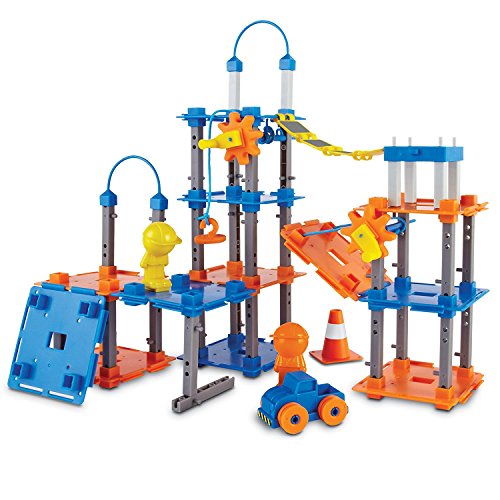
- Includes 89 pieces and engineering activity cards
- Builds towers, bridges, and city structures
- Teaches a five-step design process
Best For: Young beginners, classrooms, and foundational engineering practice
Best for Electronics Exploration

- Supports over 750 electronic projects
- Includes advanced circuit components
- Provides guided study and waveform exploration
Best For: Students interested in electrical engineering and hands-on circuit experiments
Creative Foundations
K'NEX 40-Model Engineering Set

- 141 snap-fit pieces and 40 guided models
- Builds spatial reasoning and basic STEM skills
- Portable suitcase-style storage
Best For: Beginner builders who enjoy hands-on model construction
Advanced Robotics

- Arduino-compatible open-source platform
- Supports app, knob, and offline controls
- Expansion ports enable sensor projects
Best For: Older learners and makers pursuing serious robotics practice
Aerospace Exploration

- Build up to 10 aircraft-inspired models
- 139 snap-fit pieces support rebuilding
- Explores lift, thrust, and aircraft design
Best For: Ages 9+ students interested in flight and mechanical STEM
Hands-On Robotics Pick

- Combines wooden construction with motors and circuits
- No soldering required; six AA batteries needed
- Builds problem-solving and mechanical engineering skills
Best For: Beginning robotics learners ages 8 and up
Automotive Engineering Choice

- Builds up to 10 car and machine-inspired models
- Includes 140 reusable snap-fit pieces
- Explores physics and mechanical principles through experiments
Best For: Vehicle-focused STEM learners ages 9 and up
Detailed Mechanical Build

- Includes 391 metal parts and assembly tools
- Approximate five-hour project for patient builders
- Creates a realistic truck with movable features
Best For: Vehicle fans ages 8 to 16 who enjoy extended builds
Best for Motorized Construction – Meccano Super Construction Set
For shoppers seeking engineering building sets for middle school students, the Meccano Super Construction Set offers a substantial hands-on challenge with 638 metal parts, real tools, and a 6V motor. Builders can follow vehicle designs or combine parts into original creations.
Best For: Middle school students who enjoy mechanical construction, vehicles, and guided-to-open-ended building projects.
Pros:
- Supports 25 construction vehicle designs, including a crane, buggy, and helicopter.
- Includes a 6V motor for a working rotary crane with an extendable hook.
- Provides 638 parts and three real tools for hands-on construction practice.
- Connects building play with STEAM concepts and construction skills.
Cons:
- Models can be built one at a time.
- Requires four AA batteries for motorized operation.
- The supplied instructions cover 11 models, despite the broader 25-model claim.
This is a strong choice when the goal is mechanical building rather than simple block assembly. Its metal parts, tools, and motor add realism, though younger or less experienced builders may need patience with the detailed construction process.
Best for Architectural Structures – Engino Eiffel Tower & Sydney Bridge Set
This Engino set is a thoughtful option among engineering building sets for middle school students who are curious about architecture and structural design. It combines 11 model options with theory pages, experiments, facts, and a revision quiz.
Best For: Students who want guided architectural projects that connect landmark models with basic engineering principles.
Pros:
- Features landmark-inspired builds such as the Eiffel Tower and Sydney Bridge.
- Offers 11 model options for extended building variety.
- Includes 14 pages of theory, four pages of experiments, and a revision quiz.
- Encourages structural thinking, problem-solving, and construction techniques.
Cons:
- The 1,050-piece set may require considerable sorting and organization.
- Construction is manual and does not include a motorized component.
- Its educational material may feel more structured than open-ended building.
With a large piece count and dedicated learning materials, this set works well for students who prefer architecture-focused challenges. It is especially suitable for independent or classroom building sessions where the accompanying theory and experiments can be used.
Best for Introductory Design Challenges – City Engineering Building Set
The Learning Resources City Engineering & Design Building Set introduces basic engineering ideas through towers, bridges, and city structures. While its recommended age range is 5 to 8, it can suit younger learners or beginners looking for accessible engineering building sets for middle school students.
Best For: Preschool and early elementary builders, classroom use, or older beginners who benefit from simple guided design challenges.
Pros:
- Uses activity cards based on ask, imagine, plan, create, and improve.
- Supports tower, bridge, and city-structure building.
- Includes 89 pieces, cards, and stickers for guided or open-ended play.
- Requires no batteries and works well for tabletop activities.
Cons:
- Its 5-to-8 recommended age range makes it less advanced for typical middle school students.
- Provides introductory rather than complex engineering challenges.
- The supplied components are plastic and geared toward early learners.
This set is best viewed as an entry-level design kit rather than a demanding middle school engineering project. Its clear design-process cards make it useful for foundational instruction, remediation, or younger siblings.
Best for Electronics Exploration – Snap Circuits Extreme SC-750R
For students drawn to electrical engineering, the Snap Circuits Extreme SC-750R offers a project-based alternative to traditional construction kits. Its 80-plus-piece system supports more than 750 electronic projects, including radios, sound controls, a lie detector, and circuits that demonstrate waveforms and frequencies.
Best For: Middle school students who prefer circuitry, electronics experiments, and guided STEM study over physical structure building.
Pros:
- Supports more than 750 electronic project combinations.
- Includes advanced components such as an electromagnet, power amplifier, vibration switch, analog meter, and solar cell.
- Features a computer interface for observing waveforms and frequencies.
- Comes with a colorful instruction book and student training program with study guide.
Cons:
- Focuses on electronics rather than mechanical building or architectural structures.
- The large number of projects may feel overwhelming without a planned progression.
- Uses a rechargeable NiMH battery system rather than a simple no-battery setup.
This is one of the more advanced choices for engineering building sets for middle school students when the learner is interested in how circuits work. The guided materials make it suitable for home learning, while the broad project range leaves room for continued exploration.
Creative Foundations – K'NEX 40-Model Engineering Set
For shoppers comparing engineering building sets for middle school students, this K’NEX set offers an approachable introduction to construction, spatial reasoning, and moving mechanisms. Its 141 snap-fit pieces and illustrated instructions support both guided projects and creative rebuilding.
Best For: Younger or beginner builders who want a portable set with many model options.
Pros:
- Includes 141 rods and connectors for building 40 instructed models.
- Supports hands-on practice with fine motor skills, spatial relations, and basic engineering concepts.
- Models such as cars, airplanes, windmills, and robots can include moving parts.
- Suitcase-style storage makes cleanup and portability convenient.
Cons:
- The manufacturer-recommended age is 5–8, so it may feel basic for advanced middle school students.
- The set focuses on manual construction rather than coding or electronics.
This is a practical entry-level choice for children developing construction confidence. Older or more experienced students may want a more technically demanding robotics or mechanism-focused kit.
Advanced Robotics – miniArm Arduino Robotic Arm
Among engineering building sets for middle school students, this miniArm stands out as an advanced robotics project centered on Arduino programming and hardware experimentation. It is better suited to older learners with programming experience or adult supervision than to beginners.
Best For: Advanced robotics learners, makers, and older students interested in coding and sensor expansion.
Pros:
- Built on the Atmega328 platform and compatible with Arduino programming.
- Open-source programs, tutorials, and secondary-development examples support experimentation.
- Offers app control, knob-based control, and offline action editing.
- Includes expansion ports for optional sensors and modules such as an ESP32 Cam and accelerometer.
Cons:
- The manufacturer-recommended age is 17 years and up, making it unsuitable for many middle school students.
- The starter kit does not include the listed ultrasonic, touch, acceleration, or ESP32 Cam modules.
- Its 1.28 kg aluminum construction and programming focus create a steeper learning curve.
This is the most technically ambitious option in the group, but its age guidance matters. Choose it only when the learner has the maturity, coding interest, and support needed for open-ended robotics work.
Aerospace Exploration – Engino How Aircrafts Work
This Engino set is a focused option for engineering building sets for middle school students who are curious about aircraft and machine technology. With 139 snap-assembly pieces, it combines model building with introductory ideas about lift, thrust, structure, and cause and effect.
Best For: Students ages 9 and up who want guided aerospace-themed construction and STEM exploration.
Pros:
- Supports up to 10 aircraft-inspired models from one 139-piece set.
- Snap-fit components can be assembled, taken apart, and rebuilt.
- Introduces basic physics and mechanical concepts related to how aircraft work.
- Encourages concentration, creative thinking, critical thinking, and engineering skills.
Cons:
- The subject is specifically aircraft, so it offers less variety than a general construction set.
- It uses manual building and does not include coding or electronic components.
- The product has no manufacturer warranty listed.
For learners drawn to flight, this provides a clear connection between construction and aerospace concepts. It is more focused than the K’NEX set while remaining accessible to children beginning structured STEM projects.
Hands-On Robotics Pick – Wooden Robot Arm Kit
For students exploring engineering building sets for middle school students, this wooden robot arm kit offers a practical introduction to circuits, motors, and mechanical movement. Assembly requires no soldering, though six AA batteries are needed and sold separately.
Best For: Beginners ages 8 and up who want a robotics-focused STEM project combining a 3D puzzle with basic electrical engineering.
Pros:
- Introduces motors, circuit boards, wires, and mechanical control.
- Wooden construction provides a detailed, hands-on building challenge.
- Supports problem-solving, patience, creative skills, and motor skills.
- No soldering is required, and the kit includes the assembly components.
Cons:
- Six AA batteries are required but not included.
- The project may require patience during precise assembly.
This is a strong choice when the goal is to make engineering concepts tangible through a working model. It is especially suitable for learners interested in robotics, although adult assistance may be useful for younger builders.
Automotive Engineering Choice – Engino How Cars Work
Among engineering building sets for middle school students, Engino’s How Cars Work set stands out for its reusable snap-fit system and automotive focus. The 140-piece kit supports up to 10 car and machine-inspired models, letting students build, test, take apart, and rebuild.
Best For: Learners ages 9 and up who prefer structured vehicle projects and want to explore basic physics, mechanical principles, movement, and efficiency.
Pros:
- Offers up to 10 different vehicle and machine-inspired models.
- Includes 140 durable snap-assembly pieces.
- Encourages experimentation through building, testing, and observation.
- Supports spatial awareness, fine motor skills, critical thinking, and problem-solving.
Cons:
- The set uses plastic components rather than metal parts.
- It is a manual building system, without powered operation noted in the supplied details.
The multi-model format gives students more opportunities to practice design thinking than a single-build kit. It is a practical pick for families or classrooms seeking an accessible introduction to automotive engineering.
Detailed Mechanical Build – Metal Model Truck Set
For students ready for a longer project, this metal model truck is one of the more involved engineering building sets for middle school students. Its 391 parts include nuts, bolts, a screwdriver, and a wrench, with assembly taking about five hours according to the supplied product notes.
Best For: Patient builders ages 8 to 16 who enjoy mechanical assembly, realistic vehicles, and a substantial STEM project.
Pros:
- Uses metal parts designed to withstand rough play better than comparable full-plastic versions.
- Includes 391 pieces plus assembly tools.
- Clear diagrams and marked steps help builders follow the instructions.
- Finished truck has movable wheels, a steering wheel, two seats, and a spare tire.
Cons:
- The approximately five-hour assembly may be demanding for younger or less experienced builders.
- Small nuts, bolts, and tools require careful handling and supervision.
- The completed model is primarily a manual display and play vehicle.
This set is a good match for middle school students who value detailed construction over quick results. The metal components, realistic features, and extended build time make it particularly appealing to truck fans and DIY enthusiasts.
How We Picked These Engineering Building Sets for Middle School Students
We selected kits that encourage active problem-solving rather than simple assembly. The roundup includes products with multiple projects, working mechanisms, electronics, programmable or robotic elements, and clear STEM connections. We also considered age guidance, part variety, opportunities for repeat builds, and how well each set can support independent exploration or guided instruction.
Because middle school learners have varied experience levels, the list ranges from accessible construction systems to more advanced Arduino-based and robotics projects. Always review the included instructions, required tools, batteries, software, and adult-supervision recommendations before buying.
Quick Comparison
| Kit type | Best for | What to look for |
|---|---|---|
| Motorized construction | Mechanical design and motion | Part count, motors, gears, and model variety |
| Architecture sets | Structures and visual design | Scale, stability, and rebuild potential |
| Electronics kits | Circuits and experimentation | Component range, project count, and connection method |
| Robotics kits | Automation and coding | Controller compatibility, programming support, and assembly complexity |
| Vehicle-building sets | Mechanisms and engineering principles | Snap-fit quality, moving parts, and guided explanations |
Key Buying Factors
Age, Skill Level, and Support
Age labels are useful starting points, but prior experience matters just as much. Beginners typically benefit from snap-fit parts, visual instructions, and structured projects. More experienced students may prefer open-ended builds, programmable controllers, or kits that explain how machines work.
Project Variety and Reusability
A kit with several models can maintain interest longer than a single display build. Check whether parts can be disassembled easily and reused, and whether the instructions progress from simple challenges to more complex designs.
Engineering Depth
Look for meaningful opportunities to explore gears, torque, balance, structural strength, circuits, sensors, control systems, or mechanical advantage. A high part count is not automatically a sign of better learning value.
Power, Software, and Supervision
Motorized, electronic, and robotic sets may require batteries, a computer, a compatible board, an app, or coding knowledge. Confirm what is included. Small parts, wiring, tools, and troubleshooting may also make adult guidance useful, especially for younger students.
Who Should Buy Which Engineering Building Sets for Middle School Students?
Choose a motorized construction or vehicle kit for a student who enjoys gears, motion, and hands-on mechanical challenges. Architecture sets suit builders interested in bridges, towers, stability, and landmark designs. Electronics kits are a strong choice for experimenting with circuits and following progressive projects.
For students ready to explore automation, a robot arm or Arduino-compatible robotics kit offers greater technical depth, but it may require more patience and setup. If you want an accessible gift with broad appeal, a multi-model construction set provides creative building without the learning curve of advanced programming. For classrooms, prioritize durable parts, repeatable projects, clear documentation, and enough complexity to support collaboration.