
The best engineering building sets for high school students turn abstract STEM concepts into projects students can see, test, and improve. This roundup covers structural engineering kits, robotics platforms, electronics labs, physics-focused builds, and detailed construction models.
Whether the goal is exploring bridges, coding robots, studying motion, or building circuits, these sets offer different levels of complexity and learning value. Use the guide below to match each type of kit with the student’s interests, experience, workspace, and project goals.
Best 10 Engineering Building Sets for High School Students Picks for 2026
Architectural Design Pick
Architectural Engineering Model Kit

- Build 26 structural and building models
- Explores trusses, arches, domes, and steel frames
- Includes a 44-page full-color guide
Best For: Beginning architectural and structural design exploration
Robotics Coding Pick

- Builds in about 15 minutes
- Teaches Scratch and Arduino programming
- Supports expansion with Makeblock and LEGO-compatible parts
Best For: Beginning robotics, electronics, and coding projects
Structural Physics Pick
Bridges & Skyscrapers Engineering Set

- Build 20 structural models
- Explores force, load, compression, and tension
- Includes over 285 pieces and a 36-page manual
Best For: Hands-on bridge and skyscraper mechanics
Space Engineering Pick
LEGO Technic Mars Rover Perseverance

- Includes 1,132 pieces and a buildable helicopter
- Features steering, suspension, arms, and instruments
- Adds an augmented-reality mission experience
Best For: Detailed mechanical builds for space enthusiasts
Best Introductory Electricity Kit

- Builds series and parallel circuits
- English instructions included
- Storage box keeps parts organized
Best For: Grades 7–9 electricity projects and STEM activities
Best Structural Engineering Set
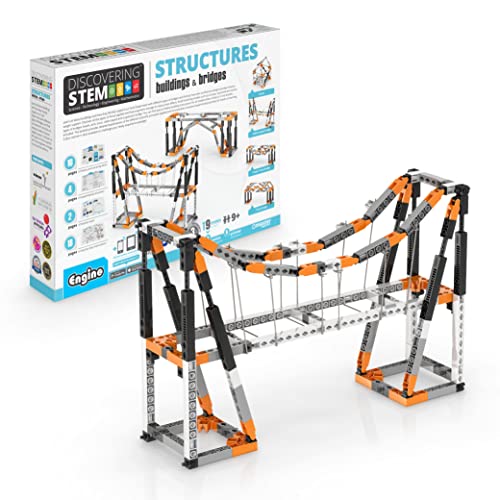
- Builds nine structures and bridges
- Includes theory, experiments, and quizzes
- Multi-directional 3D building system
Best For: Architecture, bridge design, and structural STEM projects
Best Advanced Electronics Kit

- Offers 750+ electronic projects
- Includes advanced circuit components
- Comes with training materials and computer interface
Best For: Hands-on electronics, homeschool learning, and circuit exploration
Physics Explorer

- Build eight working physics models
- Includes theory, experiments, quizzes, and a 3D app
- Recommended for ages 9 and up
Best For: Hands-on exploration of motion, inertia, and energy
Classic Builder

- Contains 236 durable metal pieces
- Includes updated step-by-step instructions
- No batteries required
Best For: Mechanical construction and open-ended tinkering
Motion Lab
Inertia and Circular Motion Kit

- Build six working physics models
- Explores inertia, friction, and circular motion
- Includes experiments, quizzes, and a 3D app
Best For: Guided motion and physics projects
Architectural Design Pick – Architectural Engineering Model Kit
For families comparing engineering building sets for high school students, the Thames & Kosmos Architectural Engineering kit offers a hands-on introduction to structural design. Builders can create 26 models, beginning with trusses, arches, and domes before moving to scaled-down real-world buildings.
Best For: Aspiring architects and engineers interested in structures, planning, and building materials.
Pros:
- Includes projects covering trusses, arches, domes, and real-world buildings.
- Flexible pieces mimic steel frames for exploring modern construction concepts.
- A 44-page, full-color manual guides experiments and encourages original designs.
- Plastic parts are compatible with other Thames & Kosmos engineering and physics kits.
Cons:
- The manufacturer recommends it for ages 8–14, so older high school students may find it introductory.
- The kit focuses on architectural structures rather than electronics or programming.
Its broad model selection and guided manual make this a strong choice for learning structural basics, though advanced students may want a more specialized challenge.
Robotics Coding Pick – Makeblock mBot STEM Robot Kit
Among engineering building sets for high school students, the Makeblock mBot stands out for combining construction, electronics, robotics, and programming. It can be assembled in about 15 minutes and then programmed through Scratch or Arduino for functions such as line following and obstacle avoidance.
Best For: Students who want an approachable entry into robot building and coding.
Pros:
- Supports step-by-step learning with Scratch, Arduino, coding cards, and lessons.
- Offers remote-control play plus line-following and obstacle-avoidance functions.
- Compatible with more than 100 electronic modules and 500 Makeblock parts.
- The open-source system can connect with LEGO parts.
Cons:
- Four AA batteries for the robot are not included.
- The CR2025 battery for the remote controller is also not included.
- The listed recommended age is 8 and up, so experienced students may outgrow the introductory lessons.
The mBot is a practical starting point for students who want visible results quickly, with expansion potential for more ambitious robotics projects.
Structural Physics Pick – Bridges & Skyscrapers Engineering Set
For learners seeking engineering building sets for high school students with a focus on structural mechanics, Thames & Kosmos Bridges & Skyscrapers provides 20 model-building challenges. The projects introduce force, load, compression, tension, and building materials through interchangeable plastic components.
Best For: Students exploring bridges, skyscrapers, and foundational mechanical physics.
Pros:
- Builds 20 different structural models.
- Addresses force, load, compression, and tension through hands-on experiments.
- Includes more than 285 interchangeable building pieces.
- The illustrated 36-page manual includes experiments and assembly guidance.
Cons:
- The manufacturer lists the skill level as intermediate, which may require guidance for some builders.
- The recommended age range is 8–14, so advanced high school students may want additional challenges.
- It concentrates on structural engineering rather than coding or electronics.
This is a focused option for understanding how structures handle forces. Its intermediate level and experiment manual make it more analytical than a basic construction set.
Space Engineering Pick – LEGO Technic Mars Rover Perseverance
For students drawn to aerospace and mechanical design, the LEGO Technic NASA Mars Rover Perseverance is one of the more advanced engineering building sets for high school students in this roundup. The 1,132-piece model includes a buildable Ingenuity helicopter, articulated suspension, movable arms, scientific instruments, and an augmented-reality experience.
Best For: Space enthusiasts who enjoy detailed mechanical builds and display-worthy models.
Pros:
- Includes 1,132 pieces for a detailed, extended building project.
- Features 360-degree steering, movable arms, and articulated suspension.
- Includes a buildable NASA Ingenuity helicopter and scientific instruments.
- The accompanying AR app explores the rover and its mission.
Cons:
- The manufacturer recommends it for ages 10 and up, so it may not provide advanced engineering theory by itself.
- The kit is centered on one Mars rover model rather than multiple independent experiments.
- Its educational objective is listed as creative thinking, not formal programming or structural analysis.
This set is best viewed as a detailed mechanical and space-themed project rather than a complete engineering curriculum. Its working features and mission context add depth to the build.
Best Introductory Electricity Kit – EUDAX Basic Circuit Lab
For students exploring engineering building sets for high school students, the EUDAX Basic Circuit Lab offers a focused introduction to electricity. It lets learners assemble series and parallel circuits while connecting textbook concepts with hands-on experiments.
Best For: Grades 7–9 science projects, science fairs, STEM clubs, summer camps, and homeschool electricity units.
Pros:
- Supports series and parallel circuit experiments.
- Includes English instructions for guided assembly.
- Encourages hands-on ability, creative thinking, and electrical awareness.
- Accessories store in the included plastic box.
Cons:
- AA batteries are not included.
- Its scope is centered on introductory electricity rather than broader structural engineering.
This is a compact choice for learners who want a practical foundation in current and basic electrical rules. Its limited focus makes it less versatile than larger electronics or construction systems, but useful for a targeted science unit.
Best Structural Engineering Set – Engino Buildings & Bridges
Among engineering building sets for high school students, the Engino Structures, Buildings & Bridges kit is a strong option for hands-on structural concepts. Students can construct nine models, including multiple bridge designs, while learning through theory, experiments, and quizzes.
Best For: Learners ages 9 and up who enjoy architecture, bridge design, science fairs, and introductory structural engineering.
Pros:
- Offers nine real-world building and bridge models.
- Includes theory pages, experiments, and a quiz book.
- Multi-directional snap-fit components support complex 3D builds.
- Designed for storage and made from non-toxic ABS plastic.
Cons:
- It focuses on structures and bridges rather than electronics or physics experiments.
- The recommended starting age is 9+, so advanced students may want a more specialized engineering system.
This kit combines guided instruction with open-ended construction, making it suitable for learners who want to see engineering principles represented in physical models. The nine-model format also provides more variety than a single-project building set.
Best Advanced Electronics Kit – Snap Circuits Extreme SC-750R
For students seeking engineering building sets for high school students with a strong electronics focus, the Snap Circuits Extreme SC-750R provides more than 750 project possibilities. Its guided study materials and computer interface support experimentation with circuits, waveforms, and frequencies.
Best For: Ages 8–15, homeschool instruction, electronics exploration, and learners ready to move beyond basic circuit building.
Pros:
- Supports over 750 electronic projects with more than 80 pieces.
- Includes advanced components such as a solar cell, electromagnet, analog meter, and power amplifier.
- Projects include an AM radio, lie detector, sound-activated switch, and light controller.
- Student training materials and the CI-73 computer interface add structured learning.
Cons:
- Its large project range may feel overwhelming without guided use.
- The kit is intended for ages 8–15, which may limit its appeal for older high school students seeking advanced engineering coursework.
This is the most feature-rich electronics option in the roundup, especially for learners who benefit from building functional projects. It offers substantial variety, though students looking specifically for architectural or structural design should choose a construction-focused kit instead.
Physics Explorer – Newton's Laws Engineering Kit
For shoppers comparing engineering building sets for high school students, this Engino kit offers a structured introduction to motion, inertia, and energy through hands-on construction. It includes eight working model options, such as a ballistic catapult, crash-test car, and balloon-powered plane, with supporting theory and experiments.
Best For: Students ages 9 and up who learn best by building and testing physics concepts.
Pros:
- Includes eight working physics models.
- Covers Newton’s laws, kinetic energy, and potential energy.
- Provides instructions, theory, experiments, quizzes, and a free 3D building app.
- Includes a two-year manufacturer warranty.
Cons:
- Recommended for ages 9 and up, so advanced high school students may want a more complex kit.
- AA batteries are required.
This is a strong choice for guided STEM learning rather than an open-ended construction set. Its combination of physical models and educational materials makes scientific principles easier to explore through experimentation.
Classic Builder – 236-Piece Metal Erector Set
This metal construction set is a practical option for shoppers seeking engineering building sets for high school students that emphasize mechanical assembly and hands-on problem-solving. Its 236 pieces can be used with the included step-by-step guide, while the metal components support model-building and experimentation.
Best For: Advanced children, teens, and adults who enjoy manual construction, tinkering, and mechanical projects.
Pros:
- Includes 236 metal pieces for hands-on building.
- Supports fine-motor skills, logical thinking, creativity, and problem-solving.
- Step-by-step assembly instructions are included and updated.
- Requires no batteries and can be cleaned easily.
Cons:
- The listing does not specify the number of model options.
- Manual assembly may be less suitable for students seeking electronics or powered builds.
Compared with themed physics kits, this Erector set focuses more on physical construction and open-ended tinkering. Its advanced-kids, teens, and adults age description makes it a flexible choice for collaborative or independent building.
Motion Lab – Inertia and Circular Motion Kit
For buyers researching engineering building sets for high school students, this Engino kit provides a focused way to investigate inertia, friction, and circular motion. Builders can create six working models, including a rocket launcher, crash-test rig, and sharpening wheel, while using the included theory, experiments, and quizzes to reinforce the concepts.
Best For: Students ages 9 and up who want guided physics projects with multiple motion-based models.
Pros:
- Offers six working model options.
- Explains inertia, friction, and circular motion through practical projects.
- Includes instructions, theory, facts, experiments, quizzes, and a free 3D app.
- Comes with a two-year limited warranty.
Cons:
- Recommended age range starts at 9, which may make it less challenging for older advanced students.
- The models are focused specifically on physics laws and motion.
This kit suits learners who prefer a clear curriculum over an unstructured parts box. Its six models and educational materials provide repeated opportunities to connect construction with real-world motion principles.
How We Picked the Best Engineering Building Sets for High School Students
We selected kits that support active learning through construction, experimentation, problem-solving, or programming. The lineup includes dedicated engineering sets for structures and bridges, robotics and coding platforms, circuit-building systems, physics experiment kits, and mechanical model sets. We also considered the quality of the learning pathway: strong kits should provide clear instructions while leaving room for testing, redesign, and independent projects.
Age labels are useful starting points, but they do not perfectly measure difficulty. A motivated high school student may outgrow a basic kit quickly, while a beginner may benefit from a more guided system before moving to open-ended designs.
Quick Comparison
- Best for structural engineering: Architectural engineering, bridges, skyscrapers, and structures kits.
- Best for robotics and coding: Makeblock mBot.
- Best for electronics fundamentals: EUDAX circuit lab and SNAP CIRCUITS Extreme.
- Best for physics demonstrations: Engino Newton’s Laws and Physics Laws kits.
- Best for mechanical construction: Erector Set and LEGO Technic NASA Mars Rover.
Key Buying Factors for Engineering Building Sets for High School Students
Learning Focus
Start with the subject the student wants to explore. Structural kits are appropriate for load distribution, balance, bridges, and towers. Robotics sets add sensors, motors, and coding. Circuit kits focus on electricity and component behavior, while physics sets make concepts such as inertia, friction, energy, and circular motion easier to visualize.
Difficulty and Room to Grow
Look for a kit that offers more than one build or experiment. Multiple projects help students progress from following instructions to modifying designs and investigating “what if” questions. A platform with reusable parts can provide better long-term value than a single display model.
Tools, Safety, and Supervision
Check whether the kit requires batteries, a computer, a phone, special tools, or additional materials. Circuit and robotics projects may need closer supervision, particularly when students are learning how to connect components. Metal construction sets may also involve small parts and hand tools.
Build Quality and Organization
Durable connectors, clearly labeled components, and reliable instructions reduce frustration. Storage is also important: kits with many small pieces are easier to use when parts can be sorted and returned after each project.
Who Should Buy Which Engineering Building Sets for High School Students?
Choose a structural engineering set for students interested in architecture, civil engineering, bridges, or skyscrapers. Select the mBot for learners who want a practical introduction to programming and robotics. Electronics-focused students should consider a circuit kit, with the SNAP CIRCUITS system favoring guided modular experimentation and the EUDAX set offering a more traditional lab-style approach.
For students drawn to motion and scientific principles, the Engino physics kits provide focused experiment themes. The Erector Set suits hands-on mechanical builders who enjoy open-ended construction, while the LEGO Technic rover is a strong choice for students who want a detailed, recognizable model with engineering-inspired mechanisms.