
The best engineering building sets for elementary students turn abstract STEM ideas into something kids can build, test, revise, and explain. The options in this roundup range from guided bridge and structure kits to open-ended construction sets that encourage experimentation.
To choose well, consider the child’s age, preferred building style, piece complexity, and whether adult guidance is available. The guide below highlights the practical differences so you can match a set to the learner, classroom, or play space.
Best 10 Engineering Building Sets for Elementary Students Picks for 2026
Best Starter City Builder
City Engineering & Design Building Set
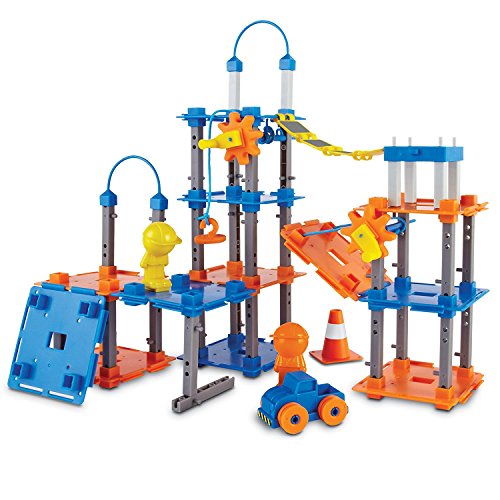
- 89-piece city-themed STEM kit
- Activity cards teach the design process
- Designed for ages 5–8
Best For: Young beginners who enjoy guided city-building challenges
Best Bridge-Focused Set
K’NEX Intro to Structures: Bridges

- 207 classic K’NEX construction pieces
- Build 13 real-world bridge replicas
- Includes teacher guide and storage tray
Best For: Grades 3–5 classroom or small-group bridge lessons
Best Physics Project Kit
Engino Physics Laws: Motion Engineering Kit

- Build six working physics models
- Covers inertia, friction, and circular motion
- Includes experiments, quizzes, and 3D app
Best For: Learners 9+ who enjoy hands-on physics projects
Best Structural Engineering Set
Bridges & Skyscrapers Engineering Set

- Build 20 structural models
- Explore compression, tension, and load
- Includes 285+ pieces and 36-page manual
Best For: Intermediate builders ages 8–14 studying structural forces
Creative Starter

- 600 colorful interlocking pieces
- Supports early STEM and spatial skills
- Suitable for solo or group building
Best For: Young builders practicing open-ended construction
Guided Engineering Lab
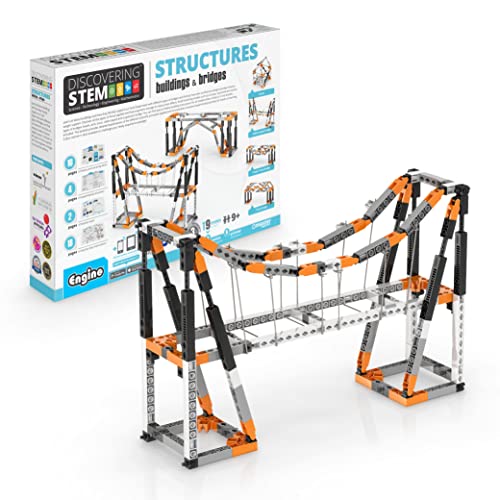
- Builds nine structure and bridge models
- Includes theory, experiments, and a quiz
- Designed for builders ages 9 and up
Best For: Structured bridge and construction learning
High-Volume Builder
1054-Piece Educational Building Set

- Large assortment with 130 shapes
- Encourages creative and geometric exploration
- Includes storage box and idea booklet
Best For: Open-ended building and shape discovery
Best Overall
600-Piece STEM Straw Constructor Set

- 600 straws and connectors for open-ended builds
- Supports logic, motor skills, and spatial reasoning
- Suitable for ages 3 through 12
Best For: Flexible individual or group STEM projects
Best for Group Play
Ggiibro 1200-Piece Straw Constructor

- 1,200 pieces for three to five children
- Encourages teamwork and engineering skills
- Includes storage box and safety certifications
Best For: Classrooms and cooperative building sessions
Best with Storage
600-Piece Engineering Straw Kit

- Adds wheels and multi-directional connectors
- Storage box supports easy cleanup
- Builds encourage engineering and creative thinking
Best For: Organized home or classroom construction play
Best Starter City Builder – City Engineering & Design Building Set
For younger children seeking engineering building sets for elementary students, this 89-piece city-themed kit offers an approachable introduction to designing towers, bridges, and other structures. Activity cards organize the process around asking, imagining, planning, creating, and improving, while open-ended pieces leave room for independent builds.
Best For: Preschool and early elementary children ages 5–8 who enjoy guided STEM challenges and creative city building.
Pros:
- Introduces basic engineering and problem-solving concepts through hands-on play.
- Includes activity cards, stickers, and 89 pieces for guided or open-ended projects.
- Works well at home, in classrooms, or in homeschool spaces.
Cons:
- Designed for younger builders, so older elementary students may want a more advanced challenge.
- No batteries or electronic components are included.
This is a practical entry point for children who are new to engineering activities. Its city theme and structured design process make it especially useful when you want a simple, engaging STEM project rather than a highly technical construction set.
Best Bridge-Focused Set – K’NEX Intro to Structures: Bridges
Among engineering building sets for elementary students, this K’NEX Education kit is a strong choice for grades 3–5 because it connects construction play with real-world bridge design. Its 207 rods, stems, and connectors can be assembled into 13 functioning bridge replicas, with educational materials supporting classroom or small-group use.
Best For: Students in grades 3–5, particularly pairs or small groups exploring bridge types and structural concepts.
Pros:
- Builds 13 bridge models, including truss, arch, suspension, beam, and cable-stayed designs.
- Includes a teacher’s guide and building instructions for structured learning.
- Snap-fit pieces can be reassembled, and the storage tray simplifies cleanup.
- Can also be used to build towers, houses, and other structures.
Cons:
- The set is geared toward collaborative work with two to three students, rather than solo play only.
- Its bridge-focused lessons may feel less open-ended than a general construction kit.
Choose this set when the goal is to study how different bridge designs work rather than simply build free-form models. The real-world focus, reusable parts, and educator materials make it particularly suitable for classrooms and guided STEM lessons.
Best Physics Project Kit – Engino Physics Laws: Motion Engineering Kit
For older elementary learners comparing engineering building sets for elementary students, this Engino kit combines model building with introductory physics. Children ages 9 and up can construct six working models while exploring inertia, friction, and circular motion through theory pages, experiments, quizzes, and an interactive 3D app.
Best For: Children 9 and up who want engineering projects tied to motion, experiments, and scientific explanations.
Pros:
- Builds six working models, including a rocket launcher, crash test rig, and sharpening wheel.
- Explains physics concepts with 12 pages of theory, experiments, and a quiz section.
- Includes an interactive 3D app for virtual building support.
- Targets concentration, critical thinking, construction, and other STEM skills.
Cons:
- Its 9+ age recommendation makes it unsuitable for younger elementary builders.
- The physics focus may be more instructional than purely free-form.
This kit suits children ready to connect what they build with why it works. It is a particularly good pick for families looking for a project-based STEM activity with experiments and explanations, not just a collection of construction pieces.
Best Structural Engineering Set – Bridges & Skyscrapers Engineering Set
This Thames & Kosmos set is a solid option for engineering building sets for elementary students ages 8–14 who are ready to study how structures handle forces. With more than 285 interchangeable pieces, children can build 20 models while investigating load, compression, tension, and related mechanical physics concepts.
Best For: Intermediate builders ages 8–14 interested in bridges, skyscrapers, structural forces, and guided experiments.
Pros:
- Offers 20 different structural models to build and compare.
- Explores force, load, compression, tension, and building materials.
- Includes more than 285 pieces plus a 36-page illustrated experiment manual.
- Interchangeable parts support repeated construction and experimentation.
Cons:
- Intermediate skill level may be challenging for younger or first-time builders.
- The manual and models focus primarily on structural engineering rather than broad STEM topics.
Pick this set when structural principles are the main learning goal. Its wide selection of models and experiment-based manual give older elementary students a way to compare designs and see how forces influence bridges and skyscrapers.
Creative Starter – 600-Piece Construction Blocks
For families seeking engineering building sets for elementary students, this 600-piece interlocking block kit offers an accessible way to explore structures, colors, and simple 3D construction. The pieces are designed for easy handling and firm connections, making it suitable for open-ended building at home or in group play.
Best For: Young builders developing spatial reasoning, fine-motor coordination, creativity, and early STEM skills.
Pros:
- Includes 600 colorful pieces for extensive imaginative building.
- Easy for small hands to connect with minimal pressure.
- Supports spatial reasoning, problem-solving, hand-eye coordination, and creative thinking.
- Works for solo or group play and includes easy storage.
Cons:
- The open-ended design may provide less structured engineering instruction.
- Its recommended age range begins at 36 months, so older elementary students may want more advanced challenges.
This is a flexible introductory set rather than a guided structural-engineering course. Choose it when you want a large assortment of colorful pieces that encourages children to invent and rebuild their own designs.
Guided Engineering Lab – Structures and Bridges Kit
Among engineering building sets for elementary students, this Engino kit is geared toward children 9 and older who are ready to study how real structures work. It guides builders through nine models, including houses, pyramids, beam bridges, arch bridges, truss bridges, cable-stayed bridges, and suspension bridges.
Best For: Older elementary students who prefer structured projects and hands-on lessons about bridges and structural engineering.
Pros:
- Offers nine real engineering models and multiple bridge designs.
- Includes instructions, theory pages, experiments, and a quiz book.
- Snap-fit components connect in multiple directions for complex 3D models.
- Designed for ages 9 and up with a two-year limited warranty.
Cons:
- It is less suitable for younger children than general-purpose block sets.
- The focus on guided models may offer less unrestricted building.
- The supplied details list AA batteries as required, although the building operation is manual.
This is the strongest choice here for a classroom-style engineering experience. Its model variety and included theory make it particularly useful for children who want to understand why different bridge and building forms work.
High-Volume Builder – 1054-Piece Educational Building Set
This 1054-piece set is a broad option for families comparing engineering building sets for elementary students who enjoy inventing many different shapes. Its assorted bars, connectors, and colors can be combined into objects such as houses, animals, vehicles, flowers, and a Ferris wheel.
Best For: Children who want a large, varied construction collection for creative projects, shape exploration, and repeated building.
Pros:
- Provides 1054 colorful pieces and 130 shapes for varied designs.
- Supports creativity, geometric-shape recognition, counting, and early architectural ideas.
- Round edges and ABS material provide a smooth-feeling construction experience.
- Includes an idea booklet and storage box.
Cons:
- The product details are inconsistent about the stated piece count and set size.
- It emphasizes open-ended building rather than step-by-step engineering lessons.
- The recommended age begins at 36 months, so advanced builders may find the challenges limited.
Choose this set for quantity, variety, and imaginative construction rather than formal engineering instruction. The storage box and idea booklet add practical value for households that want a substantial assortment kept organized between projects.
Best Overall – 600-Piece STEM Straw Constructor Set
This 600-piece kit is a versatile option for families looking for engineering building sets for elementary students. Its mix of long and short straws with connectors supports open-ended building, while the manageable size works for individual projects or group activities.
Best For: Elementary-age children who enjoy designing, experimenting, and building colorful structures independently or with others.
Pros:
- Includes 600 pieces for creating larger and varied designs.
- Encourages planning, problem-solving, spatial reasoning, and hand-eye coordination.
- Recommended for children from 36 months through 12 years.
- Listed as lab tested for CPSC regulations and safety standards.
Cons:
- Does not mention a dedicated storage box.
- Basic straw-and-connector construction may be less suitable for children seeking mechanical components.
Choose this set when you want a straightforward, reusable STEM activity with enough parts for creative construction and collaborative play.
Best for Group Play – Ggiibro 1200-Piece Straw Constructor
With 1,200 pieces, this Ggiibro kit is one of the more accommodating engineering building sets for elementary students and shared classroom activities. The large quantity is designed for several children to build together, with enough parts for models such as vehicles, castles, robots, and animals.
Best For: Classrooms, kindergartens, children’s centers, and families seeking a cooperative building activity for multiple kids.
Pros:
- 1,200 pieces can support play for three to five children.
- Promotes teamwork, reasoning, imagination, math, and engineering skills.
- Includes a storage box for indoor or outdoor use.
- Listed as non-toxic and certified to CPSIA and ASTM standards.
Cons:
- The larger piece count may require more storage space and sorting time.
- The set is recommended from age 3 and up, so younger builders may need supervision.
This is the strongest choice of the three for collaborative construction, particularly when several students need enough pieces to work on separate or shared designs.
Best with Storage – 600-Piece Engineering Straw Kit
This 600-piece kit combines interlocking straws and connectors with wheels and multi-directional connectors, giving children more ways to create vehicles, animals, castles, and other models. For families comparing engineering building sets for elementary students, its included storage box adds practical organization between projects.
Best For: Preschool and elementary builders who want a compact, shareable kit with vehicle-building components and easy cleanup.
Pros:
- Includes wheels and multi-directional connectors for expanded designs.
- Storage box helps organize the 600 pieces.
- Supports engineering, construction, imagination, and hand-eye coordination.
- Listed as non-toxic and certified to CPSIA and ASTM standards.
Cons:
- Its 600-piece count offers less material for large groups than the 1,200-piece set.
- The product information lists PVC material, which some buyers may prefer to evaluate before purchasing.
Consider this version if storage and added mobility pieces matter more than maximizing the number of parts for simultaneous group builds.
How We Picked These Engineering Building Sets for Elementary Students
We focused on sets that support core engineering habits: planning, assembling, testing, troubleshooting, and improving a design. The roundup includes structured educational kits alongside flexible construction systems, since elementary learners benefit from both step-by-step challenges and open-ended play.
We also considered the stated age or grade range, the type of connections and components used, project variety, likely adult support, and how well each set can remain useful as a child’s skills develop. Because piece counts can be misleading, we treated a larger quantity as valuable only when it meaningfully expands possible builds.
Quick Comparison
| Set type | Best for | What to look for |
|---|---|---|
| Bridge and structure kits | Guided STEM learning | Clear instructions, testing activities, and concepts such as load or balance |
| General building systems | Creative construction | Varied connectors, reusable parts, and accessible examples |
| Straw-style construction sets | Group or classroom building | High piece counts, easy connections, and enough space for larger models |
| Physics-focused kits | Older elementary students | Experiments that connect motion, force, friction, or inertia to a build |
Key Buying Factors
Age, Grade, and Challenge Level
Check the manufacturer’s recommended age or grade range, then consider the child’s fine-motor skills and patience. A kit designed for grades 3–5 may be ideal for a confident builder but frustrating for a younger child without help. Sets aimed at ages 3–8 generally emphasize simpler connectors and more open-ended assembly.
Guided Projects Versus Free Building
Instructions and experiments are useful when a child is learning engineering vocabulary or needs a clear starting point. Open-ended sets are better for children who already enjoy inventing and rebuilding. A hybrid kit can offer the strongest long-term value.
Parts, Connectors, and Storage
Look beyond the headline piece count. Evaluate whether parts are easy to separate, whether connectors hold models securely, and whether the set includes specialty pieces for curves, joints, wheels, beams, or structural supports. A storage bin or labeled organization system can make frequent use much easier.
Learning Value and Supervision
The most effective Engineering Building Sets for Elementary Students invite comparison: Which bridge holds more weight? What makes a tower stable? Can the same parts create a different shape? Younger children may need help following diagrams, while older students can often work independently after an initial demonstration.
Who Should Buy Which Engineering Building Sets for Elementary Students?
Choose a bridge or structural engineering kit for a child who enjoys clear challenges, real-world designs, and seeing whether a model works. Choose a physics-oriented set for an older elementary learner who is curious about motion and cause-and-effect experiments.
Choose a general block-and-bar construction set for imaginative builders who prefer making houses, vehicles, towers, and custom creations. Straw-style sets are especially practical for classrooms, siblings, or groups because many builders can work at once and quickly rebuild large designs.
Finally, prioritize durable connectors, manageable instructions, and easy storage over the largest advertised piece count. The right set is one a child will repeatedly reach for, because repeated building and revision are where the strongest engineering skills develop.