
When severe weather cuts power or disrupts communications, a dependable emergency radio can provide critical forecasts, alerts, lighting, and backup charging in one compact device.
We selected 10 emergency radios ranging from simple NOAA alert receivers to feature-rich crank-and-solar models, so you can match your preparedness setup, budget, and power needs.
Best 10 Emergency Radios Picks for 2026
Rugged Crank Pick

- AM/FM and NOAA weather scan with alerts
- Solar power plus six included AA batteries
- Flashlight, SOS light, and dog whistle
Best For: Emergency kits, camping, and outdoor preparedness
Easy-Tune Home Radio

- Simple analog tuning and volume controls
- AM/FM/NOAA reception with telescopic antenna
- AC or four-C-battery operation
Best For: Seniors and home emergency listening
High-Capacity Power Choice

- 12000mAh battery with solar and hand-crank charging
- AM/FM/NOAA reception with clear-sound design
- Flashlight, reading lamp, and SOS alarm
Best For: Extended outages, camping, and off-grid kits
Localized Alert Specialist
Midland WR120B NOAA Alert Radio

- S.A.M.E. alerts for up to 25 counties
- Monitors more than 60 emergency hazards
- LCD, color-coded indicators, and battery backup
Best For: Home-based, county-specific weather alerts
Best Multi-Charging Pick
Yoidesu Solar Hand Crank Emergency Radio

- Solar, hand-crank, and USB-C charging
- AM/FM/WB reception with weather broadcasts
- 2,000mAh battery, LED light, and SOS alarm
Best For: Portable backup power for camping and household emergencies
Best Alert-Focused Pick
Midland WR400 Deluxe Emergency Radio
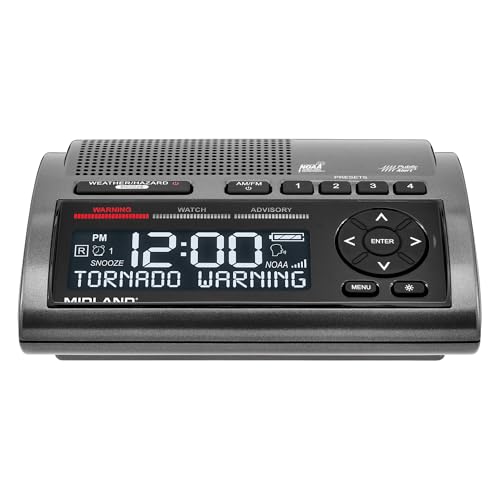
- NOAA scanning with S.A.M.E. county programming
- Up to 80 alerts and three notification modes
- AM/FM radio, clock, alarm, and USB output
Best For: Home-based severe-weather monitoring
Best Overall
Midland ER40 Emergency Crank Radio

- NOAA weather alerts with AM/FM reception
- 2,600 mAh battery plus crank and solar charging
- Portable design with built-in flashlight
Best For: Home emergency kits and weather-alert readiness
Rugged Crank Pick – Midland ER310 Emergency Radio
The Midland ER310 is a practical choice among emergency radios for weather monitoring, outdoor preparedness, and backup lighting. It supports AM/FM reception and NOAA weather scanning, while multiple power options help keep it useful when standard power is unavailable.
Best For: Emergency kits, camping, and users who want a radio with built-in safety tools.
Pros:
- Offers multiple power sources, including solar power and six included AA batteries.
- Includes a built-in flashlight, SOS emergency flashlight, and ultrasonic dog whistle.
- Supports AM/FM radio and NOAA weather scan with alerts.
Cons:
- Not water resistant.
- Its 9.61-inch length makes it less compact than some portable models.
With its combination of weather alerts, lighting, and emergency-focused features, the ER310 is a versatile preparedness radio. Its plastic enclosure and lack of water resistance make dry storage advisable.
Easy-Tune Home Radio – Veravoxes Portable NOAA Radio
This Veravoxes model is one of the more straightforward emergency radios for home use, especially for listeners who prefer analog controls. Its large tuning knob, AM/FM/NOAA reception, and AC-or-battery operation make it simple to use during outages or everyday listening.
Best For: Seniors, visually impaired users, and households wanting an easy-to-operate backup radio.
Pros:
- Large rotary tuning and volume controls are designed for simple operation.
- Receives AM, FM, and NOAA broadcasts with a telescopic antenna.
- Runs from AC power or four C batteries and includes an AUX input.
- Features a high-power speaker with adjustable bass control.
Cons:
- Uses four C batteries, which are larger than the batteries used by many compact radios.
- Mono audio output may not suit listeners seeking stereo sound.
The classic design favors accessibility over advanced emergency features. It is a sensible home radio for news and weather listening, though it lacks the solar and hand-crank charging found on more preparedness-oriented models.
High-Capacity Power Choice – 12000mAh Weather Radio
This high-capacity weather radio is built for extended emergency use, combining AM/FM/NOAA reception with several charging methods. Its 12000mAh lithium battery, large solar panel, hand crank, flashlight, and reading lamp make it a feature-rich option among emergency radios.
Best For: Extended blackouts, bug-out bags, camping, and off-grid preparedness.
Pros:
- Provides five-way power through solar, hand crank, USB-C input, the internal battery, or included AAA batteries.
- Large 12000mAh battery is designed to keep the radio and lights running during outages.
- Includes a focused flashlight, flip-up reading lamp, and SOS alarm.
- Receives NOAA, FM, and AM broadcasts and includes USB connectivity.
Cons:
- Requires a full charge before first use for optimal performance.
- Its many power and lighting features may be more than casual listeners need.
The combination of high battery capacity and multiple charging options gives this radio strong appeal for prolonged outages and outdoor use. Buyers should verify the battery level and charge it fully before relying on it in an emergency.
Localized Alert Specialist – Midland WR120B NOAA Alert Radio
The Midland WR120B focuses on targeted NOAA alerts rather than general portable listening. With S.A.M.E. programming, support for up to 25 counties, and alerts for more than 60 hazards, it is a strong choice for households that want localized emergency information.
Best For: Home preparedness and users who want county-specific weather and emergency alerts.
Pros:
- S.A.M.E. programming lets users target alerts for specific counties or partial counties.
- Can monitor up to 25 counties and identify alert severity with color-coded indicators.
- NOAA weather scan and alert override help surface impending dangers.
- Includes a backlit LCD, selectable alert tone, and trilingual display.
Cons:
- Its one-band FM tuner is focused on NOAA alerts rather than broad AM/FM listening.
- Designed primarily for corded home use, although it also requires six AAA batteries for backup.
For localized warning coverage, the WR120B is more specialized than general-purpose emergency radios. Its county programming and extensive alert settings are particularly useful for a fixed location, while the included battery backup helps maintain readiness during power interruptions.
Best Multi-Charging Pick – Yoidesu Solar Hand Crank Emergency Radio
For shoppers comparing emergency radios, the Yoidesu model offers flexible charging and core preparedness features in a compact package. Its solar panel, hand crank, and USB-C charging options help maintain power, while AM/FM/WB reception, an LED light, and an SOS alarm support everyday emergency readiness.
Best For: Campers, hikers, and households wanting a lightweight backup radio with several charging options.
Pros:
- Supports solar, hand-crank, and USB-C charging.
- Includes a 2,000mAh battery, battery indicator, and charging-status light.
- Receives AM, FM, and weather-band broadcasts.
- Combines an LED light with an SOS alarm and carrying strap.
Cons:
- The listed warranty is 90 days.
- Product details list a one-band radio designation despite the stated AM/FM/WB reception.
This is a practical portable option when charging flexibility and basic lighting matter most. The battery indicator is useful for monitoring remaining power during trips or outages.
Best Alert-Focused Pick – Midland WR400 Deluxe Emergency Radio
The Midland WR400 stands out among emergency radios for structured NOAA alert coverage rather than off-grid charging. It scans available weather channels, supports S.A.M.E. programming for up to 25 counties, and offers multiple warning formats, making it well suited to keeping households informed about severe weather and other emergencies.
Best For: Home users who prioritize detailed, customizable NOAA alerts and reliable battery backup.
Pros:
- Automatically scans 10 NOAA weather channels and locks onto the strongest signal.
- S.A.M.E. programming supports up to 25 counties and 80 emergency alerts.
- Offers an 85 dB siren, voice alerts, and visual LED notification.
- Includes AM/FM radio, clock, alarm, snooze function, and USB output.
Cons:
- Four AA backup batteries are required but not included.
- It is not water resistant.
- It relies on corded electricity or AA batteries rather than solar or hand-crank charging.
Choose this model if receiving targeted alerts is more important than portability or renewable charging. Its county programming and several notification modes make it particularly suitable for a home emergency station.
Best Simple Survival Pick – Portable Hand Crank Weather Radio
This compact option keeps emergency radios straightforward, combining hand-crank, solar, and USB charging with AM/FM/SW reception. Its hard plastic shell, flashlight, and SOS alarm provide practical support for blackouts, camping, hiking, and storm-preparedness kits without requiring complicated setup.
Best For: Buyers seeking a basic, easy-to-use radio for home backup and outdoor activities.
Pros:
- Supports hand-crank, solar, and USB charging.
- Provides AM/FM/SW reception, an LED flashlight, and an SOS alarm.
- Compact hard-plastic casing is designed to resist minor bumps.
- Simple controls allow direct tuning and light operation.
Cons:
- The brand is listed as Generic.
- Product details specify a nonstandard rechargeable battery rather than a common battery type.
- No battery capacity or water-resistance rating is provided in the supplied details.
This radio is a sensible value-oriented choice for basic preparedness. Its multiple charging methods and simple layout cover essential functions, though shoppers wanting advanced alert programming should consider a more feature-rich model.
Best Overall – Midland ER40 Emergency Crank Radio
The Midland ER40 is a compact choice for shoppers comparing emergency radios for weather updates, backup lighting, and off-grid charging. It combines NOAA weather alerts with AM/FM reception, a 2,600 mAh rechargeable battery, USB connectivity, solar power, and a hand-crank option.
Best For: Home emergency kits, weather-alert readiness, and users who want a rechargeable radio with multiple backup charging options.
Pros:
- Includes NOAA weather alerts and AM/FM radio reception.
- Offers hand-crank and solar charging alongside a 2,600 mAh rechargeable battery.
- Built-in flashlight and compact 14.08-ounce design improve portability.
Cons:
- The notes do not specify water resistance.
- Only FM reception is listed in the detailed radio-band specifications.
The ER40 is a well-rounded emergency radio for buyers who prioritize recognized-brand weather alerts, rechargeable power, and portability. Its versatile charging setup makes it practical when conventional power is unavailable.
Best Compact Option – Ywalxskk Wind-Up Weather Radio
This Ywalxskk model is one of the more compact emergency radios for a car kit, camping bag, or power-outage supplies. It supports AM, FM, and NOAA weather broadcasts, with hand-crank, solar, and Type-C charging plus a 3-LED torch and SOS alarm.
Best For: Buyers seeking a small, splash-resistant emergency radio with several charging methods and a basic warning light.
Pros:
- Supports AM, FM, and NOAA weather bands.
- Its 2,000 mAh battery can be charged by hand crank, solar panel, or Type-C cable.
- Includes a 3-LED torch, SOS alarm, and IPX3 splash resistance.
Cons:
- IPX3 protection covers light spray and splashes, not submersion.
- Solar charging is slow and depends on sunlight.
- The mono speaker is rated at 2W.
Choose this radio when compact storage and charging flexibility matter most. Its NOAA support and SOS features are useful additions, while the limited splash protection means it should not be treated as waterproof.
Best Power Bank Features – Jauarta NOAA Emergency Radio
The Jauarta NOAA emergency radio adds device charging to the core functions expected from emergency radios. Its 2,000 mAh power bank, hand crank, solar panel, and AAA battery support are paired with AM/FM/NOAA reception, a flashlight, a reading light, and a high-decibel SOS alarm.
Best For: Emergency kits that need a radio, lighting, alert signal, and backup power for a small phone or tablet.
Pros:
- Provides AM/FM and NOAA emergency weather broadcasts.
- Includes a 2,000 mAh power bank and three power-source options, including AAA batteries.
- Offers both a flashlight and 4-LED reading light, plus a loud SOS alarm.
Cons:
- The notes do not specify water resistance.
- Charging capacity is intended for emergency support rather than extended device use.
- The listed dimensions are unusually large, so buyers should verify sizing before storage.
This Jauarta radio is a strong fit when lighting and emergency charging are as important as broadcast access. Its multiple power options can help maintain essential functions during outages, though storage dimensions deserve a check.
How We Picked the Best Emergency Radios
We focused on practical emergency performance rather than feature counts alone. The selection includes models with NOAA weather access, AM/FM reception, multiple charging methods, battery backup, built-in lighting, and—in some cases—alert functionality or SOS features. We also considered portability, charging capacity, ease of operation, and whether each radio suits home preparedness, travel, camping, or vehicle storage.
A crank handle and solar panel can keep a radio usable during extended outages, while USB-C, AC, or replaceable-battery options offer faster and more predictable power when electricity is available. Because needs vary, the list includes both dedicated alert radios and multifunction survival radios.
Quick Comparison
| Best For | Look For | Why It Matters |
|---|---|---|
| Home weather alerts | NOAA alert monitoring and AC power | Can remain ready to receive warnings |
| Extended outages | Solar and hand-crank charging | Reduces dependence on disposable batteries |
| Camping or travel | Compact design and USB charging | Easier to carry and recharge |
| Emergency lighting | Flashlight, reading lamp, or SOS alarm | Adds useful backup functions |
| High power demands | Large battery capacity and power output | May support longer operation or device charging |
Key Buying Factors for Emergency Radios
NOAA Alerts and Reception
Choose a radio with NOAA weather access if receiving official forecasts and warnings is a priority. An alert-ready model is especially useful for home use because it may notify you while you are not actively listening. AM/FM support adds everyday news and entertainment reception.
Charging and Battery Options
Look for at least two power methods. Hand cranks provide dependable manual backup, solar panels help during prolonged outages, and USB-C or AC power makes routine charging easier. Check whether the listed battery capacity is intended only for the radio or can also charge a phone.
Lighting, Size, and Durability
A flashlight or reading lamp can be valuable during a blackout, but larger batteries and extra features often increase weight. For an emergency kit, prioritize controls you can operate quickly, a readable display, and construction suitable for storage in a garage, vehicle, or shelter.
Who Should Buy Which Emergency Radios?
For a Home Emergency Kit
Select a model with NOAA alert monitoring, dependable AC or battery operation, and an easy-to-read display. These features are more important than maximum portability when the radio will stay in one location.
For Camping, Hiking, or Travel
Choose a lightweight crank-and-solar radio with AM/FM, NOAA reception, a flashlight, and USB charging. A compact design is easier to pack, while multiple charging methods reduce reliance on outlets.
For Long Power Outages
Prioritize a larger rechargeable battery, solar and hand-crank charging, and a clear battery indicator. If phone charging matters, verify the output and capacity rather than assuming every emergency radio works as a full power bank.
For Simple Weather Monitoring
A dedicated NOAA weather alert radio may be the best fit. It can offer simpler controls and reliable standby monitoring without the extra bulk of survival-oriented features.