
When cell service disappears, the right emergency radio can deliver weather alerts, backup power, lighting, and a practical way to communicate. This roundup compares 10 options for remote camps, cabins, vehicles, and emergency kits.
The selection includes NOAA-capable radios, solar and hand-crank charging, large battery banks, and handheld two-way radios. Match the features to your terrain, licensing needs, and expected duration away from reliable power.
Best 10 Emergency Radios for Remote Areas Picks for 2026
Weather-Ready Backup

- NOAA weather scan and alerts
- Solar power plus six AA batteries
- Flashlight, whistle, and USB connectivity
Best For: Outdoor emergency kits needing weather alerts and backup lighting
Rugged Team Communication
Retevis RB48 FRS Walkie Talkies

- IP67 waterproof and dustproof design
- Two FRS radios with 22 channels
- Rechargeable batteries rated up to 20 hours
Best For: Groups needing durable short-range communication outdoors
High-Capacity Field Power
Roxicosly Emergency Weather Radio

- Advertised 12,000mAh built-in battery
- Solar, crank, USB-C, and AAA charging options
- NOAA bands, flashlight, lamp, and SOS alarm
Best For: Outdoor and blackout preparedness requiring power and lighting
Best All-Around Power Station

- 10,000mAh USB power bank
- Solar, crank, and USB-C charging
- NOAA alerts, SOS, and dual lights
Best For: Remote camping and emergency kits needing backup power
Best Survival Bundle
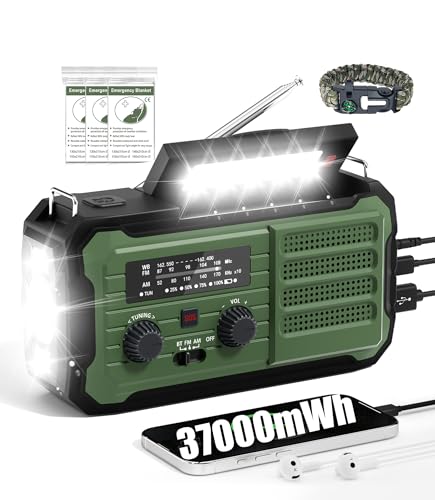
- 10,000mAh battery with three charging methods
- Automatic scanning across seven NOAA channels
- Includes thermal blanket and survival bracelet
Best For: Outdoor preparedness kits needing radio and basic survival extras
Best Off-Grid Power Backup
Solar and Hand-Crank Emergency Radio

- 12000mAh battery with solar and crank charging
- NOAA, FM, and AM reception
- Flashlight, reading lamp, and phone charging
Best For: Remote camping and blackout preparedness
Best Localized Weather Alerts

- S.A.M.E. county-specific alert programming
- 80+ alerts with three notification modes
- Plug-in or three-AA battery operation
Best For: Families and base camps needing targeted warnings
Weather-Ready Backup – Midland ER310 Emergency Radio
For anyone comparing emergency radios for remote areas, the Midland ER310 offers multiple ways to stay informed and powered when regular outlets are unavailable. It combines AM/FM reception, NOAA weather scan and alerts, a built-in flashlight, solar power, and a hand-crank-style emergency design.
Best For: Hikers, campers, and emergency kits that need weather alerts, basic radio reception, and backup lighting.
Pros:
- NOAA weather scan and alert capability helps provide severe-weather information.
- Multiple power sources, including solar power and six included AA batteries.
- Built-in SOS emergency flashlight and ultrasonic dog whistle add preparedness features.
- USB connectivity supports compatible smartphones and tablets.
Cons:
- Not water resistant, so it needs protection in wet conditions.
- AM/FM and two-band reception may be less versatile than radios with additional bands.
The ER310 is a straightforward preparedness radio with useful lighting and alert features. Its lack of water resistance is the main limitation for remote-area use, so pack it in a dry bag or other protective case.
Rugged Team Communication – Retevis RB48 FRS Walkie Talkies
For groups searching for emergency radios for remote areas, the Retevis RB48 focuses on reliable two-way communication in demanding conditions. This two-radio FRS set is IP67 waterproof and dustproof, tested to MIL-STD-810H, and includes rechargeable 2,000mAh batteries.
Best For: Hiking groups, work crews, and families who need durable short-range communication in wet, dusty, or rough environments.
Pros:
- IP67 waterproof and dustproof construction with claimed two-meter drop protection.
- FRS operation provides 22 license-free channels and weather-alert functionality.
- Rechargeable 2,000mAh batteries provide up to 20 hours of stated battery life.
- USB-C charging, a charging dock, dual PTT, and glove-friendly operation improve field usability.
Cons:
- This is a two-way radio set rather than a broadcast weather radio for receiving AM/FM news.
- Actual range can vary substantially with terrain, buildings, and obstructions.
- The supplied weight listing is relatively high for a compact walkie-talkie pair.
The RB48 is a strong choice when communication between people matters more than listening to general broadcasts. Its rugged, waterproof design and rechargeable setup make it particularly practical for teams working or traveling outdoors.
High-Capacity Field Power – Roxicosly Emergency Weather Radio
The Roxicosly CR1030 is a versatile option among emergency radios for remote areas, pairing AM/FM and NOAA reception with an advertised 12,000mAh battery. Its large solar panel, hand crank, USB-C input, flashlight, reading lamp, and phone-charging capability support extended off-grid use.
Best For: Campers, blackout kits, and remote travelers who prioritize backup power, lighting, and NOAA alerts in one device.
Pros:
- Multiple charging options include the built-in battery, USB-C, solar panel, hand crank, and AAA batteries.
- Advertised 12,000mAh battery can provide backup power for compatible devices.
- AM/FM and seven NOAA bands support general broadcasts and weather information.
- IPX6 waterproofing, a 5W flashlight, 12-LED reading lamp, and SOS alarm add field utility.
Cons:
- At 824 grams, it is heavier than a minimal emergency radio.
- Its many power and lighting features may be more than necessary for users seeking a simple radio.
- The supplied details do not specify a maximum radio reception range.
The CR1030 stands out as a power-and-lighting hub rather than just a radio. Its waterproof construction and broad charging choices make it well suited to extended outages and outdoor trips where phone power is important.
Programmable Ham Backup – Baofeng UV-5R Handheld Radio
The Baofeng UV-5R is a programmable VHF/UHF handheld for users considering emergency radios for remote areas and who understand two-way radio operation. It offers 128 channels, dual-band standby, selectable transmit power, an 1,800mAh battery, and PC or CHIRP programming support.
Best For: Experienced radio users, licensed operators, and outdoor groups needing a configurable VHF/UHF handheld with an emergency light.
Pros:
- Supports 128 channels across the listed 144-148MHz and 420-450MHz ranges.
- Dual-band display, dual standby, VOX, keypad lock, and selectable high/low power add flexibility.
- Includes an 1,800mAh lithium-ion battery, antenna, headset, belt clip, and desktop charger.
- PC and CHIRP programming support can simplify channel setup.
Cons:
- It is not water resistant according to the supplied details.
- Operation and programming are more complex than using a license-free consumer walkie-talkie.
- The stated maximum talking range is 5 kilometers, but terrain and conditions can reduce it.
The UV-5R offers considerable configuration for its size, but it is best treated as a specialized handheld rather than a simple emergency broadcast radio. Users should verify applicable radio rules and program appropriate channels before relying on it outdoors.
Best All-Around Power Station – FosPower D8 Emergency Radio
For emergency radios for remote areas, the FosPower D8 stands out as a versatile option when access to outlets is limited. It combines NOAA weather alerts, AM/FM reception, a 10,000mAh power bank, and three charging methods in a compact, water-resistant design.
Best For: Campers, travelers, and emergency kits that need weather updates, lighting, and USB device charging.
Pros:
- 10,000mAh power bank can recharge USB devices.
- Solar, hand-crank, and USB-C charging provide flexible power options.
- NOAA alerts, SOS siren, flashlight, and reading light support emergency readiness.
- Includes a headphone jack, compass-equipped holding strap, and limited lifetime warranty.
Cons:
- It is a radio and power bank rather than a two-way communication device.
- Solar and hand-crank charging require available light or manual effort.
The D8 is a strong general-purpose pick for remote trips because it covers information, illumination, signaling, and backup power in one unit.
Best Two-Way Communication – BAOFENG 5RM Ham Radio
Among emergency radios for remote areas, the BAOFENG 5RM is designed for communication rather than broadcast listening. Its 10W output, 999 channels, NOAA capability, and long-range positioning make it suitable for coordinating with compatible radios during outdoor activities.
Best For: Groups hiking, hunting, or camping together who need handheld two-way communication.
Pros:
- 10W high-power design is intended for long-range use.
- Offers 999 channels for flexible communication setup.
- Digital signal processing is designed to support clear, stable calls.
- High-definition display and user-friendly interface simplify operation.
Cons:
- Not water resistant, so it needs protection in wet conditions.
- It does not provide the flashlight, power-bank, or hand-crank functions found on emergency broadcast radios.
- Effective communication requires compatible radios and proper operating knowledge.
The 5RM is the more specialized choice here: select it when staying in contact with a group matters more than receiving alerts or generating emergency power.
Best Survival Bundle – 10,000mAh Hand-Crank Radio
This emergency radio for remote areas combines a 10,000mAh battery with hand-crank and solar charging, automatic NOAA weather scanning, and several signaling and lighting features. It also includes a thermal blanket and a multi-tool paracord bracelet for a broader preparedness kit.
Best For: Hikers, campers, and households wanting a radio bundled with basic shelter, signaling, and fire-starting accessories.
Pros:
- 10,000mAh battery and three charging methods support extended use.
- Automatically scans seven NOAA weather-band channels for alerts.
- Includes flashlight, headphone jack, USB port, and SOS siren with flashing light.
- Thermal blanket and 5-in-1 paracord bracelet add survival utility.
Cons:
- The supplied notes provide limited information about construction and water resistance.
- Extra survival accessories may be unnecessary for shoppers seeking only a radio.
- Solar and hand-crank charging are supplemental methods that require suitable conditions or effort.
This is a practical choice when you want more than weather information: the included blanket and paracord bracelet broaden its usefulness for basic outdoor contingencies.
Best Long-Range Two-Way Option – Baofeng AR-5RM 10W Handheld Radios
For remote areas where communication between people matters most, this two-pack of Baofeng AR-5RM handheld radios offers a practical option for emergency radios for remote areas. It includes up to 999 channels, NOAA weather reception, rechargeable batteries, and several charging accessories for camping, hiking, hunting, and other off-grid trips.
Best For: Groups that need handheld two-way communication during outdoor trips or emergencies.
Pros:
- Two-way radio pair with a listed maximum talking range of up to 5 miles.
- NOAA weather receiver, emergency alarm, flashlight, and battery-saver mode.
- USB-C, wall-base, and other USB charging options, with large rechargeable batteries included.
- Includes programming cable, speaker microphones, earpieces, antennas, belts, and hand straps.
Cons:
- Not water resistant, so it needs protection in wet conditions.
- Battery average life is listed at 6 hours.
- Advanced features may require programming and familiarity with ham radios.
This is the most communication-focused choice in the group. Its accessories and two-radio format are useful for coordinating across a campsite or trail, while the NOAA receiver adds weather awareness; however, its lack of water resistance is worth considering for exposed remote environments.
Best Off-Grid Power Backup – Solar and Hand-Crank Emergency Radio
This solar and hand-crank model is designed for situations where grid power and reliable phone charging may be unavailable. Among emergency radios for remote areas, it stands out with AM/FM/NOAA reception, a claimed 12000mAh battery, solar and crank charging, a phone-charging function, and integrated lights.
Best For: Campers, blackout kits, and remote-area users who want radio, lighting, and backup power in one device.
Pros:
- Supports NOAA, FM, and AM reception with a high-sensitivity signal chip and extended antenna.
- Offers solar charging, hand-crank charging, USB-C input, and optional AAA battery power.
- Includes a flashlight, reading lamp, SOS alarm, and emergency cellphone charger.
- Large listed 12000mAh lithium battery provides substantial backup capacity.
Cons:
- The radio should be fully charged before first use.
- Solar and hand-crank charging depend on available sunlight or physical effort.
- The supplied details do not specify water resistance.
This is a versatile preparedness device rather than a two-way communicator. Its combination of radio reception, lighting, and several power sources makes it useful when traveling beyond reliable infrastructure, especially when keeping a phone or small light operating is also important.
Best Localized Weather Alerts – DreamSky NOAA Emergency Radio
For households and fixed campsites that need targeted weather information, the DreamSky focuses on localized alerts rather than two-way communication. It is a useful candidate among emergency radios for remote areas, with S.A.M.E. programming, more than 80 listed alert events, FM radio, an LCD clock, and plug-in or battery operation.
Best For: Families and base camps that want county-specific weather alerts and a radio for everyday use.
Pros:
- S.A.M.E. technology and 23 customizable county codes help filter alerts for a selected area.
- Supports more than 80 emergency alert events with voice, tone, and display modes.
- Runs from household power or three AA alkaline batteries.
- Includes digital FM radio, alarm clock, snooze function, and adjustable backlight modes.
Cons:
- Three AA batteries are required but not included.
- It is designed primarily for receiving alerts, not handheld two-way communication.
- The supplied details do not identify solar charging, hand-crank charging, or water resistance.
This is the most suitable pick for a shelter, cabin, or home emergency station where localized warnings are the priority. Its everyday clock and FM functions make it easier to keep accessible, while dual power helps it remain useful during outages.
How We Picked These Emergency Radios for Remote Areas
We focused on features that matter when infrastructure is limited: NOAA weather reception, dependable backup charging, battery capacity, flashlight or SOS functions, portability, and communication range. The list includes both receive-only emergency radios and two-way handhelds because they solve different problems. Product specifications can vary by seller and revision, so verify included accessories, charging ports, battery ratings, and regional radio compatibility before buying.
For remote travel, redundancy is more valuable than a single headline feature. A radio with USB, solar, and hand-crank charging offers more recovery options than one that relies on a wall outlet. Likewise, a two-way radio is useful only when the people you need to reach have compatible radios and are within realistic range.
Quick Comparison
| Type | Best For | Features to Prioritize |
|---|---|---|
| NOAA emergency radio | Weather awareness and alerts | NOAA reception, alert mode, clear speaker, backup battery |
| Solar/crank power radio | Extended outages and remote camps | Battery capacity, solar panel, crank durability, USB output |
| FRS walkie-talkie | Simple group communication | Legal channel use, battery life, weather resistance, accessories |
| Ham handheld | Experienced operators and longer-range flexibility | Licensing, programming, antenna options, charging support |
Key Buying Factors for Emergency Radios for Remote Areas
Weather Alerts and Reception
Choose a model that receives NOAA weather broadcasts if you travel in areas covered by that service. Alert functionality is especially useful when you may not be monitoring the radio continuously. AM/FM reception can add value for local news, but it should not replace checking coverage in your destination.
Charging and Battery Capacity
Compare watt-hours or milliamp-hours carefully, since advertised capacity does not equal usable output. Solar charging is a slow maintenance option, while hand cranks are best for short emergency top-ups. USB input and output make a radio more useful with phones, headlamps, and other small devices.
Communication Range and Legality
“Long range” depends heavily on terrain, obstructions, antenna position, and local regulations. FRS radios are generally simpler for casual group use. Ham radios can provide more capabilities but typically require an amateur radio license to transmit. Learn the rules before operating a programmable handheld.
Durability and Usability
Look for readable controls, a strong speaker, a visible battery indicator, a useful flashlight, and a housing suited to your environment. Pack radios in a waterproof bag unless they have a verified weather-resistance rating. Test charging, alert reception, and battery life before departure.
Who Should Buy Which Emergency Radios for Remote Areas?
Choose a compact NOAA radio with battery backup if your main goal is receiving alerts at home, in a cabin, or at a campsite. Pick a solar-and-crank model with a larger battery if you need power recovery and device charging during multi-day outages. Select FRS walkie-talkies for straightforward communication among family or hiking partners. Choose a Baofeng or other ham handheld only if you understand programming, accessories, and licensing requirements; its flexibility is most valuable to prepared, experienced users.