
The best emergency radios for families do more than play weather updates. They can provide critical alerts, recharge phones, illuminate a room, and help family members communicate when power or cellular service is unavailable.
Our roundup covers multifunction emergency radios, solar and hand-crank models, and two-way radios for households that need local communication during storms, outages, evacuations, or outdoor emergencies.
Best 10 Emergency Radios for Families Picks for 2026
Best All-Around Weather Radio

- NOAA weather scan and alerts
- Solar power plus six included AA batteries
- Flashlight and ultrasonic dog whistle
Best For: Families building a versatile emergency kit
Best Family Communication Set
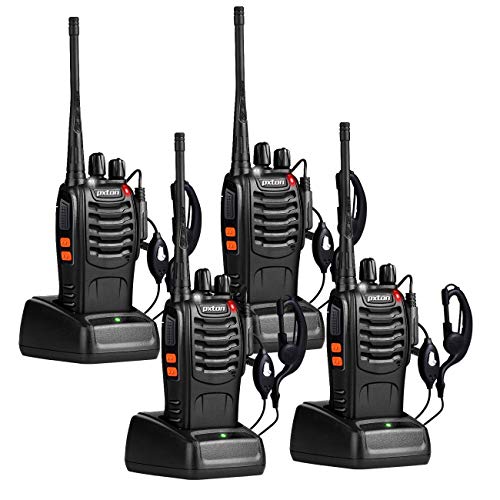
- Four rechargeable two-way radios
- 16 channels and 165 privacy codes
- Water-resistant with built-in flashlights
Best For: Families coordinating across a home, campsite, or property
Best Power-Bank Emergency Radio

- AM/FM/weather-band and NOAA access
- 2000 mAh power bank for small devices
- Solar, hand-crank, USB-C, and AAA power
Best For: Families preparing for outages and severe weather
Best Long-Range Two-Way Radios

- 50 channels and 142 privacy codes
- NOAA alerts and JIS4 water resistance
- Rechargeable packs plus AA battery option
Best For: Families needing robust outdoor communication
Best All-Around Backup

- Real 12000mAh battery for device charging
- Large solar panel and efficient hand crank
- NOAA alerts, dual lights, and IPX6 protection
Best For: Family emergency kits, blackouts, storms, and outdoor use
Best for Family Communication

- Two-pack with 22 FRS channels
- VOX hands-free operation and privacy codes
- Backlit display, flashlight, and IP65 rating
Best For: Family outings, camping, hiking, cruises, and short-range coordination
Best Survival Bundle
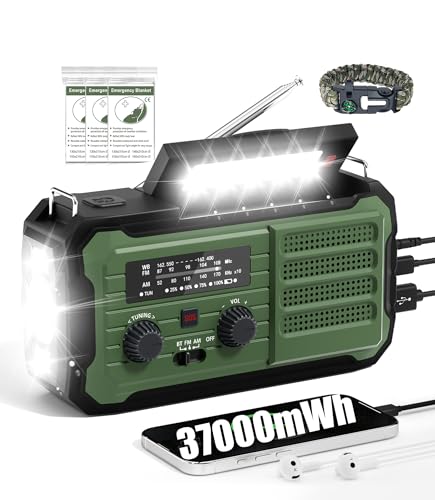
- 37000mWh battery with solar and crank charging
- Automatic scanning across seven NOAA channels
- Includes thermal blanket and survival paracord bracelet
Best For: Family preparedness kits, storms, outages, hiking, and camping
Best All-Around Pick
Philips TAR3500 Multi-Powered Emergency Radio

- Four charging options for flexible backup power
- 5200 mAh battery doubles as a phone power bank
- SOS siren, lights, and IP55 water resistance
Best For: Families building a versatile home or camping emergency kit
Longest-Lasting Power
Solar Hand-Crank Emergency Radio with 12000mAh Battery

- AM/FM/NOAA reception for weather and emergency updates
- Stated 12000 mAh battery supports longer backup use
- Includes large solar panel, hand crank, flashlight, and lamp
Best For: Families preparing for storms and extended power outages
Best All-Around Weather Radio – Midland ER310
For families comparing emergency radios for families, the Midland ER310 is a practical weather-alert option with multiple ways to stay powered. It combines AM/FM reception, NOAA weather scan and alerts, an LED flashlight, and an ultrasonic dog whistle in a compact 16-ounce design.
Best For: Families wanting a versatile weather radio for emergency kits, outages, and outdoor preparedness.
Pros:
- Multiple power sources, including solar power and six included AA batteries.
- NOAA weather scan and alerts help monitor changing conditions.
- Built-in flashlight and ultrasonic dog whistle add useful emergency functions.
Cons:
- Not water resistant.
- Supports AM/FM rather than the broader AM/FM/weather-band format listed for some competing models.
The ER310 is a well-rounded choice when weather information and basic emergency signaling matter most. Its lack of water resistance makes protective storage advisable for wet conditions.
Best Family Communication Set – pxton PX-888S Walkie Talkies
Unlike a broadcast-focused emergency radio, this four-pack gives families a way to communicate when phones are inconvenient or unavailable. The pxton set offers 16 channels, 165 privacy codes, rechargeable batteries, earpieces, charging stations, and built-in flashlights.
Best For: Families who need multiple handheld radios for outings, property use, or coordinating during an emergency.
Pros:
- Four radios include rechargeable 1500 mAh batteries, chargers, earpieces, and belt clips.
- Offers 16 channels, 165 privacy codes, VOX, scanning, and low-battery alerts.
- Water-resistant, compact, and equipped with night flashlights.
Cons:
- Listed maximum talking range is up to two miles, with actual range affected by obstructions.
- Provides UHF two-way communication rather than AM/FM or NOAA broadcast reception.
This set is most useful as a family communication tool, not as a standalone source of weather broadcasts. Its four-radio configuration makes it convenient when several people need to stay in contact.
Best Power-Bank Emergency Radio – FosPower A1
The FosPower A1 is a strong pick for families seeking emergency radios for families with device-charging capability. It receives AM, FM, and weather-band broadcasts while offering solar, hand-crank, USB-C, and AAA battery power, plus a 2000 mAh power bank.
Best For: Families wanting weather information, lighting, and backup power for a phone or small tablet.
Pros:
- AM/FM/weather-band reception with NOAA emergency broadcast access.
- 7400 mWh power bank can provide emergency power to a small tablet or phone.
- Includes a 1W flashlight, four-LED reading light, SOS alarm, solar panel, and hand crank.
Cons:
- AAA batteries are required separately from the rechargeable power-bank system.
- The power bank is intended for small devices and should not be treated as a full-size battery pack.
With weather-band reception, lighting, and several charging options, the A1 covers many common outage needs in one portable unit. Its limited lifetime warranty is an added benefit for preparedness gear.
Best Long-Range Two-Way Radios – Midland GXT1000VP4
For families who prioritize communication across campgrounds, outdoor areas, or larger properties, the Midland GXT1000VP4 offers two-way coverage with 50 channels and 142 privacy codes. It also includes NOAA weather alerts, rechargeable packs, headsets, and dual-power support with AA batteries.
Best For: Families and groups needing feature-rich radios for outdoor trips, work areas, and severe-weather preparedness.
Pros:
- Two radios include rechargeable battery packs, a desktop charger, headsets, and adapters.
- 50 channels and 142 privacy codes support flexible group communication.
- NOAA weather alerts, SOS siren, VOX hands-free operation, and JIS4 water resistance.
Cons:
- Battery life is listed at about 10 hours, so spare AA batteries are useful for extended use.
- The advertised 36-mile range depends heavily on terrain and obstructions.
This pair is more communication-focused than a conventional emergency broadcast radio, but NOAA alerts add useful severe-weather awareness. Dual-power operation and included accessories make it adaptable for family outings and preparedness kits.
Best All-Around Backup – 12000mAh Solar Weather Radio
For families comparing emergency radios for families, this rugged model combines NOAA alerts, multiple charging options, phone charging, and dedicated lighting in one unit. Its large solar panel and stated 12000mAh battery make it especially practical for blackouts and storm preparation.
Best For: Family emergency kits, hurricane-season readiness, blackouts, and outdoor use.
Pros:
- Real 12000mAh battery can charge phones and power lights.
- Large monocrystalline solar panel and efficient hand crank provide backup charging.
- Includes NOAA alerts, a 5W adjustable flashlight, and a 12-LED reading lamp.
- IPX6 waterproof construction, SOS alarm, and five charging methods add versatility.
Cons:
- At 824 g, it is less lightweight than a basic emergency radio.
- Requires three AAA batteries if using the AAA power option.
This is a strong household choice when reliable backup power and lighting matter as much as weather updates. It is bulkier than minimalist models, but its battery capacity and feature set suit family preparedness well.
Best for Family Communication – MOICO Two-Way Radios
Families looking beyond broadcast updates may prefer these two-way radios for staying in contact around campgrounds, neighborhoods, or crowded outings. The two-pack offers 22 FRS channels, hands-free VOX operation, and a compact design with practical lighting.
Best For: Family outings, camping, hiking, cruises, and short-range coordination.
Pros:
- Two radios support one-to-one or one-to-more communication.
- 22 channels and 99 privacy-code sets provide many communication combinations.
- VOX offers hands-free use with three sensitivity levels.
- Backlit LCD, LED flashlight, belt clips, and IP65 water resistance support outdoor use.
Cons:
- Four AAA batteries are required and are not included.
- Actual range varies with buildings, vehicles, weather, and other obstructions.
- These radios communicate locally rather than receiving NOAA weather broadcasts.
These are a useful companion to emergency radios for families when the priority is keeping family members connected during activities or local disruptions. Their stated maximum range should be treated as environment-dependent, especially in built-up areas.
Best Survival Bundle – 37000mWh Emergency Radio Kit
This emergency radio stands out among emergency radios for families by pairing weather information and backup charging with additional survival gear. Its 37000mWh battery, automatic NOAA scanning, thermal blanket, and paracord bracelet create a broader preparedness package for home or outdoor emergencies.
Best For: Families wanting a radio-centered survival kit for storms, outages, hiking, and camping.
Pros:
- 37000mWh rechargeable battery supports extended backup power.
- Hand crank and solar charging provide options when grid power is unavailable.
- Automatic scanning across seven NOAA weather channels helps surface alerts.
- Includes a flashlight, headphone jack, USB port, SOS alarm, thermal blanket, and paracord bracelet.
Cons:
- The supplied details do not specify water-resistance or overall dimensions.
- Its extra survival accessories may be unnecessary for shoppers seeking only a radio.
This option makes sense for buyers who want more than weather alerts and a phone charger. The added blanket and bracelet broaden its emergency usefulness, though a simpler radio may be easier to pack if those accessories are not needed.
Best All-Around Pick – Philips TAR3500 Multi-Powered Emergency Radio
Philips TAR3500 Multi‑Powered Emergency Radio with AM/FM, SOS Siren & Power Bank
Check Price On AmazonFor families comparing emergency radios for families, the Philips TAR3500 is a well-rounded option for outages, travel, and emergency kits. It combines AM/FM reception with four charging methods, a phone-charging power bank, and useful lighting in a rugged IP55-rated design.
Best For: Families wanting one versatile radio for home power outages, camping, and emergency preparedness.
Pros:
- Supports USB-C, solar, hand-crank, and four AAA-battery power.
- 5200 mAh rechargeable battery provides up to 60 hours of radio playtime and can charge compatible devices.
- One-button SOS activates a siren, flashing light, and ultrasonic whistle.
- IP55 water-resistant housing includes a torch, reading light, and carry strap.
Cons:
- Provides AM/FM reception rather than NOAA weather-band reception.
- Its 0.95 kg weight may be more than some compact kits require.
The TAR3500 is a practical family emergency-radio choice when charging flexibility, lighting, and phone backup matter as much as basic broadcasts. Its AM/FM tuning and rugged construction make it especially useful for general preparedness and outdoor use.
Longest-Lasting Power – Solar Hand-Crank Emergency Radio with 12000mAh Battery
This solar hand-crank model stands out among emergency radios for families with its stated 12,000 mAh battery, AM/FM/NOAA reception, and multiple charging options. Its large solar panel, flashlight, reading lamp, and easy-grip controls are suited to extended outages and off-grid use.
Best For: Households prioritizing battery capacity, NOAA weather reception, and bright utility lighting.
Pros:
- Supports AM, FM, and NOAA weather-band reception.
- Offers solar, hand-crank, USB-C, battery, and rechargeable-battery power options.
- Includes a stated 12,000 mAh lithium battery and emergency cellphone charging.
- Focused flashlight and soft reading lamp each offer two brightness levels.
Cons:
- The manufacturer recommends fully charging the radio before first use.
- Its larger battery-focused design may be less convenient for minimalist carry kits.
With NOAA reception and a high-capacity battery, this radio is a strong fit for families preparing for storms or multi-day blackouts. The hand crank and solar panel add useful backup options, while the lighting makes it more functional around the home after dark.
Best Simple Pick – Baofeng AR-5RM Rechargeable Two-Way Radio Pair
Families seeking emergency radios for families that also support direct communication may prefer this two-pack of Baofeng AR-5RM handheld radios. These rechargeable VHF/UHF units include NOAA weather reception, speaker microphones, programming accessories, and up to 999 storage channels.
Best For: Families who need two-way communication during outdoor activities, emergencies, or situations where cell service may be unavailable.
Pros:
- Two radios allow family members to communicate directly.
- Receives NOAA weather broadcasts and supports a broad listed frequency range.
- Includes 2500 mAh rechargeable batteries, USB-C charging, base chargers, and a programming cable.
- Package includes speaker microphones, earpieces, belt accessories, and hand straps.
Cons:
- Programming and advanced amateur-radio functions may require more setup than a broadcast-only radio.
- Not water resistant.
- Listed battery average life is six hours.
This Baofeng set is better understood as a communication-focused emergency tool than a conventional news radio. It is useful for keeping two people connected, but families should be comfortable with radio setup and applicable operating requirements before relying on its advanced transmitting features.
How We Picked the Best Emergency Radios for Families
We focused on features that matter when normal infrastructure is unreliable: NOAA weather access, multiple charging methods, battery capacity, dependable controls, built-in lighting, phone charging, and useful communication range. We also included two-way radios because some families need to stay in contact around a property, at a shelter, or during an evacuation.
Because listed specifications can vary by model or seller, confirm the radio’s current manual, included accessories, charging ports, and regional compatibility before buying. Advertised range for walkie-talkies is typically measured in open conditions and may be much shorter indoors or around buildings.
Quick Comparison
| Type | Best For | Features to Prioritize |
|---|---|---|
| Emergency weather radio | Alerts and outage preparedness | NOAA reception, siren, flashlight, hand crank, solar charging |
| High-capacity emergency radio | Extended outages | Large battery, USB power bank, multiple charging options |
| FRS or GMRS walkie-talkies | Family communication nearby | Channel access, battery life, weather channels, headsets |
| Amateur handheld radio | Advanced users | Licensing requirements, programming, antenna performance |
Key Buying Factors for Emergency Radios for Families
Alert Reception and Controls
Choose a model that receives the AM/FM bands and NOAA weather broadcasts if those alerts are relevant to your area. Large buttons, readable displays, and simple tuning are valuable when the room is dark or users are stressed. An SOS siren can help attract attention, but it should be easy to disable to avoid accidental activation.
Power and Charging Flexibility
Hand cranks and solar panels are useful backups, but they are not always fast ways to recharge a large battery. Look for a combination of USB charging, replaceable or rechargeable batteries, solar input, and a crank. A power bank output is helpful for a phone, but it may drain the radio quickly, so keep a separate power bank when possible.
Lighting, Durability, and Portability
A flashlight or reading lamp adds practical value during outages. Consider water resistance, grip, weight, carrying handles, and whether the radio fits in an emergency kit. Test the light and charging functions periodically rather than storing the device untouched for years.
Two-Way Radio Range and Licensing
FRS radios are generally the simplest choice for family use. GMRS equipment can offer more capability but may require an FCC license in the United States. Amateur radios such as upgraded handheld models require appropriate licensing and setup; they are better for trained users than for casual emergency communication.
Who Should Buy Which Emergency Radios for Families?
Choose a compact crank-and-solar weather radio if your priority is receiving alerts, powering a light, and keeping one dependable device in a home emergency kit. Select a high-capacity model if your household expects lengthy outages or wants phone-charging capability.
Buy a two-way radio set if family members may separate during storms, camping trips, evacuations, or property emergencies. Models with headsets are useful when hands-free communication or quieter operation matters. Advanced radio users may prefer an amateur handheld, but beginners should prioritize simple FRS or GMRS equipment and learn the applicable rules before an emergency.
Whichever option you choose, store it with charging cables, spare batteries where supported, written instructions, and a testing schedule. The most useful emergency radio is one every family member can operate before a crisis begins.