
Digital rain gauges make it easier to track precipitation without manually reading a collection tube after every storm. The best models combine a self-emptying outdoor sensor with an indoor display for current rainfall, totals, temperature, and alerts.
Our 2026 roundup compares 10 digital rain gauges for homeowners, gardeners, weather watchers, and anyone who wants more convenient rainfall data at home.
Best 10 Digital Rain Gauges Picks for 2026
Best for Rain Alerts
AcuRite 00899 Wireless Rain Gauge

- Programmable rain-rate and flood-watch alerts
- Self-emptying collector needs little maintenance
- Wireless indoor display includes date and time
Best For: Homeowners and gardeners wanting simple rainfall alerts
Best for Rainfall History
ECOWITT WH5370BH Rain Gauge Kit

- Tracks rainfall across multiple time periods
- Stores extensive historical rainfall records
- Includes mounting hardware and bird spikes
Best For: Detailed precipitation tracking without internet upload
Best Compact Option
AcuRite 02446M Wireless Rain Gauge

- Compact vertical indoor display
- Self-emptying collector reduces maintenance
- Tracks daily through yearly rainfall totals
Best For: Casual backyard monitoring and gardening
Best Weather Station Bundle
Wireless Digital Rain Gauge Weather Station

- Combines rainfall with broad weather data
- Large 7.5-inch adjustable color display
- Includes atomic clock and three-channel support
Best For: Homes wanting a multifunction weather station
Best Overall
AcuRite Self-Emptying Wireless Rain Gauge
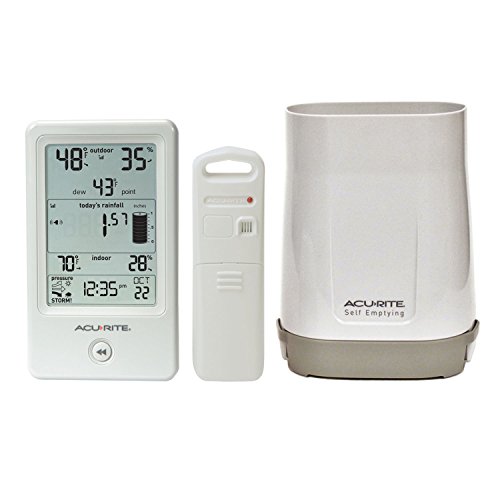
- Tracks rainfall across day, week, month, and year periods
- Adds storm alerts plus indoor and outdoor weather readings
- Wireless ranges reach up to 100 feet for rain and 330 feet for temperature/humidity
Best For: Homeowners wanting detailed rainfall history and broader weather monitoring
Best Display Features
Wireless Rain Gauge with Backlit Console

- Shows eight rainfall measurement periods plus historical data
- Self-emptying sensor provides wireless indoor readings
- 15-second blue backlight and built-in clock, calendar, and alarms
Best For: Users who want flexible rainfall views and extra console functions
Best Records
Wireless Rain Gauge with 9-Day History

- Stores nine days of rainfall data with inch/mm selection
- Measures precipitation at 0.1 mm/0.01 inch resolution
- Provides wireless transmission up to 300 feet/100 meters
Best For: Garden, farm, and yard monitoring over a larger wireless distance
Best All-Around Monitoring

- Eight rainfall measurement periods with historical display
- Self-emptying sensor for low-maintenance use
- Temperature, alarms, clock, calendar, and backlight included
Best For: Households wanting detailed rain history and extra weather-station functions
Best for Maintenance-Free Setup
High-Precision Wireless Rain Gauge

- Automatic connection after batteries are installed
- Self-emptying collector reduces upkeep
- Rainfall alerts and eight measurement periods
Best For: Users wanting simple setup and automated precipitation tracking
Best for Detailed Rainfall Trends

- Visual graph plus eight rainfall accumulation periods
- Wireless, self-emptying outdoor collector
- Temperature readings, rain alarms, and clock functions
Best For: Buyers who want visual precipitation history and remote monitoring
Best for Rain Alerts – AcuRite 00899 Wireless Rain Gauge
The AcuRite 00899 is a practical choice among digital rain gauges for homeowners who want rainfall totals, history, and alerts on an indoor LCD console. Its self-emptying outdoor collector sends readings wirelessly every 60 seconds and requires little maintenance.
Best For: Homeowners and gardeners who want straightforward rainfall monitoring with customizable alerts.
Pros:
- Programmable alerts for rain rate or flood-watch conditions.
- Self-emptying collector simplifies outdoor maintenance.
- Displays rainfall data along with the current date and time.
- Wireless readings update the indoor console every 60 seconds.
Cons:
- Its lower temperature rating is 32°F, limiting cold-weather use.
- The rectangular horizontal console requires indoor display space.
This is a focused rain gauge rather than a full weather station. Choose it if alerts and easy-to-read rainfall information matter more than extra weather measurements.
Best for Rainfall History – ECOWITT WH5370BH Rain Gauge Kit
The ECOWITT WH5370BH stands out among digital rain gauges for detailed rainfall tracking. Its raised collector is designed to collect more rain, while the indoor console records multiple time periods and provides extensive historical data without uploading information to the internet.
Best For: Weather watchers who want detailed rainfall records, graphs, and flexible installation.
Pros:
- Displays rain rate, event totals, and 1-hour, 24-hour, daily, weekly, monthly, and yearly records.
- Stores 24 months of rain history and up to 730 days of rainfall records.
- Raised funnel design is intended to improve rainfall data collection.
- Includes mounting options and bird spikes to discourage nesting.
Cons:
- Does not upload rainfall data to the internet.
- Its extensive display and history features may be more than casual users need.
With its strong record-keeping and installation flexibility, this kit is a better fit for users who study precipitation trends than for shoppers seeking only a basic daily total.
Best Compact Option – AcuRite 02446M Wireless Rain Gauge
The AcuRite 02446M is one of the more compact digital rain gauges for backyard monitoring. It pairs a self-emptying collector with an indoor vertical LCD display, rainfall history, and an audible alert when a chosen rainfall total is reached.
Best For: Gardeners and casual weather watchers who want a compact, low-maintenance rainfall monitor.
Pros:
- Self-emptying collector avoids daily emptying.
- Shows today’s, yesterday’s, weekly, monthly, and yearly rainfall totals.
- Customizable audible alert signals when a set total is reached.
- Compact vertical display is suited to smaller indoor spaces.
Cons:
- It is focused on rainfall rather than broader weather-station data.
- The notes do not specify a transmission interval for wireless readings.
This model keeps the essential rainfall features easy to access without adding unrelated weather measurements. It is a sensible pick when simple history, alerts, and a small footprint are the priorities.
Best Weather Station Bundle – Wireless Digital Rain Gauge Weather Station
This wireless digital rain gauge is part of a broader home weather station with a colorful 7.5-inch LCD screen. Along with rainfall, it reports indoor and outdoor temperature, humidity, air pressure, forecasts, moon phase, alerts, and clock information.
Best For: Households that want rainfall monitoring combined with a full indoor-outdoor weather display.
Pros:
- Combines a self-emptying rain gauge with temperature, humidity, pressure, and forecast data.
- Large 7.5-inch color screen offers adjustable backlight brightness.
- Includes WWVB atomic clock synchronization and automatic daylight-saving adjustment.
- Supports three remote channels for multiple locations, with one sensor included.
Cons:
- Only one remote sensor is included despite the three-channel capability.
- The corded electric console may be less convenient where an outlet is unavailable.
- Its many functions may be unnecessary if rainfall is the only measurement you need.
This is the most versatile option in the group, but it is also the least focused. Select it when a large, multifunction display is more valuable than a dedicated rain-only instrument.
Best Overall – AcuRite Self-Emptying Wireless Rain Gauge
For dependable backyard monitoring, this digital rain gauge combines a self-emptying collector with wireless indoor readings. It tracks rainfall across multiple time periods and adds temperature, humidity, and storm-alert features for a more complete home weather setup.
Best For: Home gardeners and homeowners who want detailed rainfall history plus indoor weather monitoring.
Pros:
- Tracks rainfall for the current day, previous day, week, month, year, and previous year.
- Wireless transmission reaches up to 100 feet for rainfall data and up to 330 feet for outdoor temperature and humidity readings.
- Includes oncoming-storm alerts, a programmable rain alarm, and high/low temperature and humidity records.
- Self-emptying collector and monochrome LCD display simplify routine use.
Cons:
- Requires three AAA batteries.
- Uses a monochrome display rather than a color screen.
This is the strongest all-around choice when you want more than a basic rainfall total. Its broad historical tracking and configurable alerts make it particularly useful for sprinkler decisions and storm awareness.
Best Display Features – Wireless Rain Gauge with Backlit Console
This digital rain gauge is designed for easy at-a-glance monitoring from indoors. Its console shows several rainfall intervals, historical data, and a graphical representation, while the brief blue backlight helps with nighttime checks.
Best For: Users who prioritize flexible rainfall views and a console with extra household functions.
Pros:
- Displays current, one-hour, 24-hour, daily, seven-day, monthly, yearly, and total rainfall measurements.
- Self-emptying wireless sensor automatically sends rainfall and temperature data to the indoor console.
- Includes programmable rain alarms for watering or potential flood conditions.
- Offers blue backlighting for 15 seconds, plus clock, calendar, dual alarms, and snooze.
Cons:
- The backlight stays on for only 15 seconds.
- The supplied notes do not specify a wireless transmission range.
Choose this model if you want the most varied rainfall summaries and a multifunction console. The historical and graphical views are useful for spotting watering trends without going outside.
Best Records – Wireless Rain Gauge with 9-Day History
For gardeners and property owners who want recent rainfall history, this digital rain gauge records nine days of data and supports selectable measurement units. Its self-emptying tipping-bucket sensor sends readings to an indoor display from as far as 300 feet away.
Best For: Garden, farm, and yard monitoring where recent rainfall records and long wireless range matter.
Pros:
- Stores a nine-day rainfall record and switches between millimeters and inches.
- Provides 0.1 mm/0.01 inch rainfall resolution.
- Offers a 300-foot/100-meter wireless transmission range for remote monitoring.
- Includes self-emptying operation, temperature readings, clock, calendar, and programmable rain alarms.
Cons:
- The supplied notes do not mention humidity readings.
- Its listed display dimensions are relatively compact, which may limit at-a-glance readability for some users.
This model stands out for its combination of fine rainfall resolution, nine-day records, and extended transmission range. It is a practical fit when you need to monitor a garden or larger property from inside the home.
Best All-Around Monitoring – Wireless Digital Rain Gauge
This wireless digital rain gauge is a versatile choice for homeowners who want rainfall totals, temperature readings, and useful alerts in one indoor display. It tracks precipitation across eight time periods, from current rainfall through yearly and total accumulation.
Best For: Gardeners and households seeking detailed rainfall history plus indoor convenience features.
Pros:
- Measures rainfall now, hourly, daily, weekly, monthly, yearly, and total accumulation.
- Self-emptying outdoor sensor supports low-maintenance operation.
- Includes programmable rain alarms, indoor and outdoor temperature readings, and a cylindrical rainfall graph.
- Blue 15-second backlight, dual alarm clock, calendar, and WWVB radio-controlled time add everyday utility.
Cons:
- The display requires pressing the light button for nighttime illumination.
- Its broad set of clock and weather-station features may be more than needed for simple rainfall measurement.
With detailed accumulation views and a self-emptying sensor, this model is a practical digital rain gauge for monitoring watering needs and keeping an eye on potentially heavy precipitation.
Best for Maintenance-Free Setup – High-Precision Wireless Rain Gauge
This digital rain gauge is designed for straightforward setup: install batteries in the outdoor sensor and indoor host, and the system automatically connects to begin recording rainfall and temperature data. Its indoor console provides multiple precipitation views and a rainfall graph.
Best For: Users who prioritize automatic operation, precipitation alerts, and an easy-to-read indoor console.
Pros:
- Self-emptying design helps provide maintenance-free rainfall monitoring.
- Displays current, hourly, daily, weekly, monthly, yearly, and total rainfall.
- Programmable rain alarms can help monitor heavy precipitation and possible flooding conditions.
- Also shows indoor and outdoor temperatures and includes a 15-second blue backlight.
Cons:
- Requires batteries in both the outdoor sensor and indoor host.
- The numerous measurements and added clock features may feel excessive for buyers wanting a basic rain collector.
This is a strong option among digital rain gauges for buyers who want automated data collection, broad rainfall history, and alerts without manually emptying the outdoor collector.
Best for Detailed Rainfall Trends – Remote Digital Rain Gauge
This remote digital rain gauge combines a wireless outdoor collector with an indoor console that shows eight rainfall measurements and a cylindrical rainfall graph. It is suited to buyers who want to compare recent precipitation with longer-term totals while also checking temperature indoors.
Best For: Gardeners and weather-conscious households that want visual rainfall trends and programmable alerts.
Pros:
- Records rainfall for the current period, hour, 24 hours, day, week, month, year, and total accumulation.
- Self-emptying outdoor sensor automatically measures rainfall after connection with the indoor host.
- Provides indoor and outdoor temperature readings, programmable rain alarms, and a graphical display.
- Includes WWVB radio-controlled time, dual alarms with snooze, calendar, and blue nighttime backlight.
Cons:
- The backlight remains on for only 15 seconds after pressing the light button.
- Its weather-station and clock functions may be unnecessary if rainfall measurement is the only goal.
For shoppers comparing digital rain gauges, this model stands out for its visual trend information and wide range of accumulation periods, while retaining the convenience of wireless, self-emptying operation.
How We Picked the Best Digital Rain Gauges
We focused on the features that matter most in everyday use: measurement convenience, sensor design, display readability, wireless range, rainfall-history options, alerts, temperature monitoring, and resistance to outdoor conditions. Self-emptying collectors received particular attention because they reduce maintenance and make the readings easier to trust after heavy rain.
We also considered the differences between established weather-instrument brands and more affordable generic-style units. A lower-cost gauge can be suitable for basic garden monitoring, while a more advanced system may be worthwhile if you want longer-term records, storm notifications, or a clearer indoor console.
Quick Comparison
| Best For | Look For |
|---|---|
| Basic rainfall tracking | Clear display and simple wireless setup |
| Storm monitoring | Rain alerts, high-precipitation warnings, and history |
| Garden and lawn care | Accurate totals, temperature readings, and easy placement |
| Cold climates | Freeze-resistant construction and reliable outdoor sensing |
| Detailed weather observation | Longer rainfall history, stronger range, and a feature-rich console |
Key Buying Factors for Digital Rain Gauges
Collector and Measurement Design
A self-emptying tipping-bucket collector is generally more convenient than a manual cylinder because it resets automatically and can continue recording during extended rain. Check the stated measurement resolution and accuracy, especially if you use readings for irrigation decisions.
Display, History, and Alerts
An indoor console should show current rainfall clearly from across the room. Rainfall history is useful for comparing storms and weekly totals, while alerts can notify you when precipitation reaches a selected threshold. Some products also display indoor and outdoor temperature, date, and time.
Wireless Range and Installation
Confirm that the sensor can reach your preferred indoor location after passing through walls and other obstructions. Install the outdoor collector on a stable, level surface away from roof runoff, trees, fences, and sprinkler spray. Proper placement often matters as much as the hardware.
Weather Resistance and Maintenance
Look for outdoor components designed to handle sun, rain, and seasonal temperature changes. Even self-emptying gauges need occasional cleaning to remove leaves, insects, and debris. A bird-spike accessory can help protect some collectors from obstruction.
Who Should Buy Which Digital Rain Gauges?
Choose a straightforward wireless model if you mainly want rainfall totals and an indoor readout. Gardeners should prioritize accurate cumulative measurements and temperature information to guide watering. Buyers who track severe weather should choose a model with rainfall history and storm alerts.
If you live in a cold or exposed climate, prioritize freeze-resistant construction, dependable wireless communication, and a collector that is easy to access for seasonal cleaning. For more serious weather tracking, a feature-rich system with a larger console, stronger range, and detailed history is the better long-term investment.