
The best digital oscilloscopes make it easier to visualize voltage changes, troubleshoot circuits, and verify designs with confidence. This roundup covers 10 options ranging from compact, multifunction instruments to higher-bandwidth bench scopes.
Use the comparison and buying guide below to match bandwidth, channels, sampling performance, resolution, and extra measurement tools to the work you actually do.
Best 10 Digital Oscilloscopes Picks for 2026
Versatile Four-Channel Pick
- Four analog channels
- I2C, SPI, UART/RS232, CAN, and LIN decoding
- Optional MSO and USB AWG expansion
Best For: Embedded development and serial-bus troubleshooting
Budget Lab Option

- 150 MHz bandwidth rating
- Two channels with arbitrary waveform output
- 14 trigger modes and serial decoding
Best For: Education, hobbyist labs, and general commissioning
High-Resolution MSO Choice

- 12-bit resolution with four 100 MHz channels
- 2 GSa/s sampling and 50 Mpts memory
- Optional 16-channel logic analysis
Best For: Detailed analog work and expandable mixed-signal testing
Feature-Rich Portable Pick

- Four channels with 12-bit resolution
- Fast waveform capture and search tools
- Serial decode, FFT, LAN, USB, and HDMI
Best For: Embedded debugging, teaching labs, and connected bench work
Best Portable Touchscreen
FNIRSI 1013D Plus 100MHz Oscilloscope

- 7-inch touchscreen with gesture and cursor measurements
- 1 GSa/s sampling and 100 MHz × 2 bandwidth
- Battery-powered design with waveform and screenshot storage
Best For: Portable electronics testing and touchscreen operation
Best Bus-Analysis Option
Siglent SDS1202X-E 200MHz Oscilloscope
- 200 MHz bandwidth with up to 1 GSa/s sampling
- 14 Mpts maximum record length
- Serial decode for I2C, SPI, UART, CAN, and LIN
Best For: Embedded-systems and serial-bus troubleshooting
Best 3-in-1 Value
FNIRSI 2C53T 50MHz Oscilloscope

- Combines oscilloscope, multimeter, and DDS signal generator
- 250 MSa/s sampling with automatic measurements
- Compact 400-gram design with 3,000 mAh battery
Best For: Repair work, education, and space-saving test setups
Best Deep-Memory Bench Scope

- 200 MHz bandwidth with 1 GSa/s sampling
- Up to 24 Mpts memory and 30,000 wfms/s capture
- RS232/UART, I2C, and SPI decode support
Best For: Bench electronics, embedded troubleshooting, and long captures
Best Portable All-in-One

- 350 MHz bandwidth with 1 GSa/s sampling
- Oscilloscope, spectrum, FRA, and DDS functions
- 8,000 mAh battery and USB-C charging
Best For: Field testing, EMI analysis, Bode plots, and signal generation
Best Value Bench Scope

- 100 MHz bandwidth with 1 GSa/s sampling
- 24 Mpts memory and 30,000 wfms/s capture rate
- Serial-bus decode plus USB and LAN connectivity
Best For: Education, hobby electronics, and general bench debugging
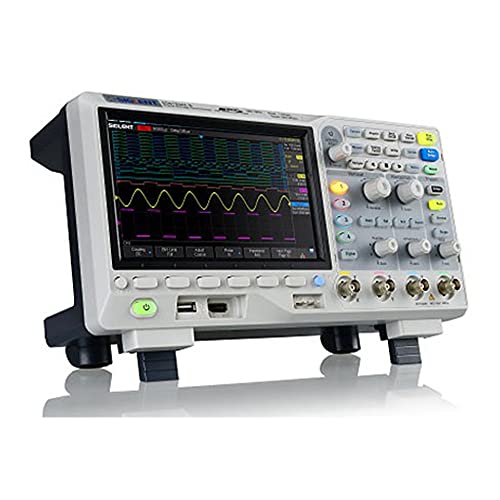
Versatile Four-Channel Pick – Siglent SDS1104X-E
Siglent Technologies SDS1104X-E 100Mhz Digital Oscilloscope 4 Channels Standard Decoder, Grey
Check Price On AmazonThe Siglent SDS1104X-E is a practical choice among digital oscilloscopes when four analog channels and protocol decoding are priorities. It includes four passive probes and supports I2C, SPI, UART/RS232, CAN, and LIN decoding, with optional expansion for mixed-signal work.
Best For: Embedded development, serial-bus troubleshooting, and users who need four-channel measurement capacity.
Pros:
- Four analog channels for comparing multiple signals.
- Supports I2C, SPI, UART/RS232, CAN, and LIN decoding.
- Includes four passive probes, a USB cable, quick-start materials, and a calibration certificate.
Cons:
- Digital channels and the USB AWG module are optional rather than included.
- At 6.6 pounds, it is less portable than lighter bench instruments.
Choose this model if broad channel coverage and built-in serial decoding matter more than a compact footprint. Its optional MSO and AWG upgrades also leave room for a more advanced setup later.
Budget Lab Option – Hantek DSO2D15
The Hantek DSO2D15 is a cost-conscious option for buyers comparing digital oscilloscopes for general lab and commissioning work. It combines a 150 MHz bandwidth rating with two channels, arbitrary waveform output, multiple trigger modes, and serial protocol trigger and decode support.
Best For: Students, hobbyists, and technicians seeking a versatile economy oscilloscope for general commissioning and troubleshooting.
Pros:
- 150 MHz bandwidth rating provides useful headroom for many lab tasks.
- Supports arbitrary waveform output.
- Offers 14 trigger modes and five serial protocol trigger/decode options.
- Suitable for communication, embedded systems, computer, research, and education applications.
Cons:
- Only two channels are provided.
- The supplied notes do not specify included probes or accessories.
This Hantek makes the most sense when keeping cost under control is important but waveform generation and protocol features are still desirable. Its two-channel layout may be limiting for more complex multi-signal measurements.
High-Resolution MSO Choice – Siglent SDS814X HD
The Siglent SDS814X HD stands out among digital oscilloscopes for its 12-bit resolution, four 100 MHz analog channels, and mixed-signal capability. Its 2 GSa/s sampling rate, 50 Mpts memory depth, and seven-inch touch screen are suited to detailed waveform inspection and multi-signal analysis.
Best For: Engineers who need high vertical resolution, deep memory, and room to add logic-channel analysis.
Pros:
- 12-bit analog/digital conversion supports fine vertical detail.
- Four analog channels, 2 GSa/s sampling, and 50 Mpts memory depth.
- Waveform capture reaches up to 80,000 wfms/s in normal mode and 500,000 wfms/s in sequence mode.
- Supports up to 16 digital channels with the separately sold option and logic probe.
Cons:
- Digital-channel functionality requires the optional SDS800XHD-16LA and SLA1016 logic probe.
- At 8.4 pounds, it is relatively heavy for a portable setup.
This is a strong fit when waveform detail and capture performance take priority. Confirm the cost and availability of the optional logic accessories if mixed-signal measurements are central to your work.
Feature-Rich Portable Pick – RIGOL DHO804
The RIGOL DHO804 is a feature-rich choice among digital oscilloscopes, combining four channels, 12-bit resolution, a 70 MHz bandwidth, and a 7-inch touch screen. Its measurement toolkit includes FFT, automatic measurements, serial decode, waveform search, and connectivity for lab documentation and remote control.
Best For: Embedded bring-up, power troubleshooting, protocol validation, teaching labs, and users who value search and connectivity features.
Pros:
- Four analog channels with 12-bit vertical resolution and up to 25 Mpts memory depth.
- UltraAcquire reaches up to 1,000,000 wfms/s, with waveform search and navigation.
- Includes FFT, filters, 41 automatic measurements, and peak detection for glitches down to 1.6 ns.
- Supports CAN, RS232/UART, I2C, SPI, and 4-bit parallel decode, plus LAN, USB, and HDMI connectivity.
Cons:
- Its 70 MHz bandwidth is lower than some alternatives in this roundup.
- At 1.25 GSa/s, its sampling rate is below the 2 GSa/s specification of the Siglent SDS814X HD.
The DHO804 is compelling for everyday bench work where usability, analysis tools, and connectivity are as important as basic bandwidth. It is especially attractive for quickly locating intermittent events and documenting results.
Best Portable Touchscreen – FNIRSI 1013D Plus 100MHz Oscilloscope
For buyers comparing digital oscilloscopes, the FNIRSI 1013D Plus stands out as a portable two-channel option with a large touchscreen, 1 GSa/s sampling rate, and 100 MHz × 2 bandwidth. Its battery-powered design and waveform storage make it practical for bench work, field troubleshooting, and signal analysis on the go.
Best For: Portable electronics testing, waveform comparison, and users who prefer touchscreen controls.
Pros:
- 7-inch, 800 × 480 touchscreen with gesture and cursor measurements.
- 1 GSa/s sampling rate, 100 MHz × 2 bandwidth, and complete trigger modes.
- Built-in 6,000 mAh battery, high-voltage protection, and storage for screenshots and waveform data.
- Includes Lissajous display and FFT viewing for additional signal analysis.
Cons:
- Continuous use is listed at about four hours per charge.
- At 2.31 pounds, it is portable but less compact than smaller handheld instruments.
The 1013D Plus is a well-rounded choice when display size, touch operation, and portability matter. Its FFT and Lissajous tools add useful analysis capability, while the internal storage helps document measurements.
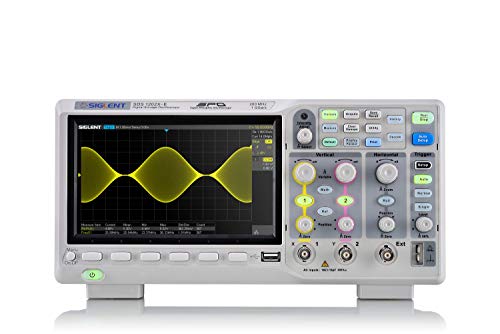
Best Bus-Analysis Option – Siglent SDS1202X-E 200MHz Oscilloscope
The Siglent SDS1202X-E is a strong contender among digital oscilloscopes for users who need higher bandwidth and protocol-focused features. It combines 200 MHz bandwidth with 1 GSa/s real-time sampling, a deep 14 Mpts record length, and serial bus triggering and decoding.
Best For: Engineers and technicians working with embedded systems and serial communication buses.
Pros:
- 200 MHz bandwidth supports higher-frequency signal work than the other listed models.
- Up to 1 GSa/s real-time sampling rate.
- Record length extends to 14 Mpts for capturing longer events.
- Standard serial bus triggering and decode support I2C, SPI, UART, RS232, CAN, and LIN.
Cons:
- It has two channels, which may be limiting for applications requiring more simultaneous inputs.
- Its listed 5.5-pound weight is less suited to portable use.
Choose the SDS1202X-E when bandwidth, long record length, and serial-bus tools are more important than handheld portability. Its protocol support makes it especially useful for embedded electronics debugging.
Best 3-in-1 Value – FNIRSI 2C53T 50MHz Oscilloscope
For shoppers seeking versatile digital oscilloscopes, the FNIRSI 2C53T combines a two-channel oscilloscope, multimeter, and DDS signal generator in one handheld instrument. It offers 50 MHz bandwidth, 250 MSa/s sampling, automatic measurements, and a compact design suited to repair work, classrooms, and general electronics testing.
Best For: Hobbyists, students, and professionals who want oscilloscope, multimeter, and signal-generator functions in one device.
Pros:
- Three-in-one design includes a 50 MHz oscilloscope, 4.5-digit multimeter, and signal generator.
- Multimeter measures AC/DC voltage, AC/DC current, resistance, capacitance, and continuity.
- Signal generator supports 13 waveforms with output up to 50 kHz and 1 Hz steps.
- Handheld 400-gram design includes a 3,000 mAh battery and Type-C charging.
Cons:
- Its 250 MSa/s sampling rate and 1 Kpts record depth are more modest than the larger bench-style models.
- The 2.8-inch display is considerably smaller than the 7-inch screen on the FNIRSI 1013D Plus.
The 2C53T is compelling when minimizing equipment count matters. It trades display size and oscilloscope depth for a lightweight package that adds everyday multimeter and waveform-generation capabilities.
Best Deep-Memory Bench Scope – RIGOL DS1202Z-E 200MHz
The RIGOL DS1202Z-E is a practical choice among digital oscilloscopes for bench work that benefits from 200 MHz bandwidth, deep memory, and serial-bus troubleshooting. Its 1 GSa/s sampling, fast waveform capture, and large display support detailed analysis of power, embedded, and general electronics signals.
Best For: Students, hobbyists, and bench users working on embedded systems, power electronics, and longer waveform captures.
Pros:
- 200 MHz bandwidth, two analog channels, and up to 1 GSa/s real-time sampling.
- Up to 24 Mpts standard memory and 30,000 wfms/s capture rate help expose intermittent events.
- Supports RS232/UART, I2C, and SPI triggering and decoding, with USB and LAN connectivity.
Cons:
- Its desktop design is less convenient for field use than a handheld scope.
- The listed measurement functions and interfaces may be more than needed for basic waveform checks.
Choose this model when capture depth, waveform history, and embedded-bus features matter more than portability. The 7-inch intensity-graded display and recording/playback functions add useful visibility during troubleshooting.
Best Portable All-in-One – FNIRSI DPOS350P 350MHz
The FNIRSI DPOS350P combines an oscilloscope, spectrum analyzer, frequency response analyzer, and DDS signal generator in a rechargeable handheld format. For buyers comparing digital oscilloscopes for lab and field work, its 350 MHz bandwidth, touchscreen, and broad analysis features make it unusually versatile.
Best For: Portable troubleshooting, EMI checks, Bode plots, loop-stability testing, and signal-generation tasks.
Pros:
- 350 MHz bandwidth, 1 GSa/s sampling, two channels, and 50,000 wfms/s refresh.
- Built-in FFT spectrum analysis, frequency response analysis, and waterfall views support deeper signal investigation.
- DDS generator offers 14 standard waveforms, 1 Hz resolution, and support for custom clipping waveforms.
Cons:
- Its 47 Kpts memory depth is substantially less than the deep-memory RIGOL models in this roundup.
- The feature-rich design may be excessive for users who only need basic voltage and timing measurements.
- Battery operation requires USB-C charging and depends on the included lithium-polymer battery.
This is the strongest fit when portability and multiple test functions are priorities. Its 8,000 mAh battery, 7-inch touchscreen, waveform storage, and signal-generation tools help consolidate several instruments into one unit.
Best Value Bench Scope – RIGOL DS1102Z-E 100MHz
The RIGOL DS1102Z-E delivers the same practical bench-oriented feature set as its higher-bandwidth sibling while using a 100 MHz input bandwidth. It is a sensible digital oscilloscope option for education, hobby projects, embedded bring-up, and everyday electronics debugging.
Best For: General-purpose bench measurements, students, hobbyists, and embedded work where 100 MHz bandwidth is sufficient.
Pros:
- Two analog channels, external trigger input, and up to 1 GSa/s real-time sampling.
- Up to 24 Mpts memory and 30,000 wfms/s capture rate support detailed event review.
- Includes serial-bus triggering and decoding for RS232/UART, I2C, and SPI, plus USB and LAN interfaces.
Cons:
- Its 100 MHz bandwidth is lower than the DS1202Z-E and FNIRSI DPOS350P.
- The desktop form factor is not designed primarily for portable field testing.
- It may be more capable than necessary for simple, occasional measurements.
For a fixed workstation, this model offers a balanced mix of capture depth, display quality, connectivity, and decoding features. Consider it when your signals fit within 100 MHz and you want a full-featured scope without stepping up to the 200 MHz version.
How We Picked These Digital Oscilloscopes
We selected models across several common use cases, including electronics education, repair benches, embedded development, laboratory work, and portable testing. The lineup balances core specifications such as bandwidth, channel count, sampling rate, memory, and vertical resolution with practical features including touchscreens, mixed-signal capability, waveform generation, multimeter functions, and protocol decoding.
Specifications should be treated as starting points rather than the entire buying decision. Probe quality, software usability, display controls, warranty support, and the instrument’s input limitations can matter just as much during real troubleshooting.
Quick Comparison
| Priority | What to look for | Best fit |
|---|---|---|
| General bench work | Four channels, around 100 MHz bandwidth, and useful decoding tools | Mixed-signal and development projects |
| Higher-frequency signals | 200 MHz or more, with a high sample rate and suitable probes | Fast digital and analog circuits |
| Signal detail | 12-bit vertical resolution and a clear display | Low-level or precision measurements |
| Portability | Compact design, touchscreen, or integrated battery-friendly features | Field service and classroom use |
| All-in-one value | Built-in multimeter, signal generator, or other test functions | Space-conscious hobby and repair benches |
Key Buying Factors for Digital Oscilloscopes
Bandwidth and Sample Rate
Bandwidth determines the highest signal frequency the scope can display accurately, while sample rate affects how well it captures fast changes. As a practical rule, choose bandwidth comfortably above the fastest signal of interest and check that the sample rate remains high when using multiple channels.
Channels and Resolution
Two channels are sufficient for many waveform comparisons, but four channels are more useful for power systems, motor control, buses, and mixed-signal debugging. Higher vertical resolution can reveal smaller voltage differences, although noise, probe quality, and front-end performance also influence usable detail.
Triggering, Memory, and Decoding
A stable trigger is essential for finding intermittent faults. Look for edge, pulse-width, runt, and other advanced trigger modes when troubleshooting complex signals. Deeper memory helps capture longer events, while serial-bus decoding can save time when working with common digital protocols.
Connectivity and Included Tools
Consider USB or network connectivity if you need screenshots, data transfer, remote control, or automated testing. Integrated waveform generators and multimeters add convenience, but verify their specifications before treating them as replacements for dedicated equipment.
Who Should Buy Which Digital Oscilloscopes?
Choose a four-channel model if you routinely compare several signals or work on embedded, power, or mixed-signal systems. A 12-bit model is attractive for users who prioritize waveform detail and measurement precision. Two-channel, 200 MHz instruments suit faster circuits when channel count is less important.
For students, hobbyists, and mobile technicians, a compact touchscreen or multifunction scope can provide strong versatility without requiring several separate instruments. If your work involves demanding high-frequency measurements, prioritize bandwidth, sample rate, probe performance, and manufacturer support over extra features or a low purchase price.