
Choosing the right scope can make troubleshooting faster, clearer, and far less frustrating. For repair work, the best options balance bandwidth, sampling speed, display quality, and probe support.
Below, we focus on practical picks for electronics technicians, hobbyists, and field repair use, with a mix of bench and handheld tools that fit different workflows and budgets.
Best 10 Digital Oscilloscopes for Electronics Repair Picks for 2026
Bench-Ready Deep-Memory Scope

- 200 MHz, 2-channel bench oscilloscope
- 24 Mpts memory and 1 GSa/s sampling
- UART, I2C, and SPI serial decode
Best For: Bench repair, embedded debugging, and education labs
Portable Touchscreen Repair Scope

- 2-channel handheld scope with 100 MHz bandwidth
- 1 GSa/s sampling and 7" touchscreen
- Built-in protection and 4-hour battery life
Best For: Field troubleshooting and portable repair work
Classic Budget Bench Scope

- 100 MHz, 2-channel bench oscilloscope
- 32 automatic measurements plus FFT
- USB storage and remote control support
Best For: Hobbyists and repair users wanting a budget bench scope
All-in-One Handheld Repair Tool

- Oscilloscope, multimeter, and signal generator in one
- 2-channel scope with 10 MHz bandwidth
- Portable battery-powered design with protection
Best For: Technicians and hobbyists who want a compact all-in-one tool
Portable 4-in-1 Analyzer
FNIRSI DPOS350P 350MHz 4-in-1 Tablet Oscilloscope

- 350 MHz 2-channel handheld oscilloscope with 1 GSa/s sampling
- Includes FFT spectrum analysis, FRA, and DDS signal generation
- 7-inch touchscreen, 8000 mAh battery, and waveform storage
Best For: Technicians who want advanced portable testing with analysis and generator tools
Scope-Meter Combo
HANMATEK HO52 50MHz Handheld Scope + Multimeter
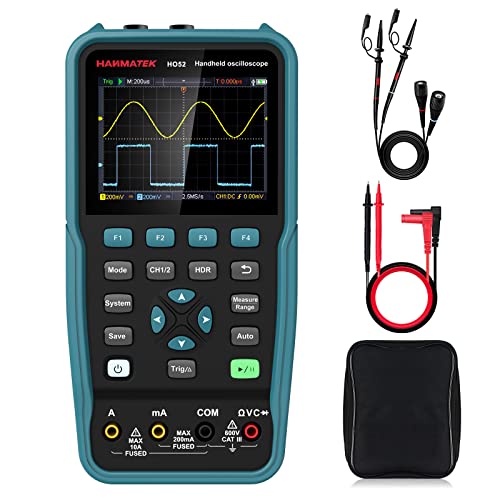
- 50 MHz 2-channel handheld oscilloscope with 250 MSa/s sampling
- 4 1/2-digit multimeter mode for voltage, current, resistance, and more
- USB-C charging plus waveform and screenshot saving
Best For: Portable repair work that needs both oscilloscope and multimeter functions
Portable Scope-Meter-Generator
OWON HDS272S 70MHz Handheld Scope-Meter-Generator

- 70 MHz handheld oscilloscope with 125 MSa/s sampling
- 20,000-count multimeter plus continuity, capacitance, and diode tests
- Built-in waveform generator and about 6 hours of battery life
Best For: Portable diagnostics that benefit from scope, meter, and generator functions
Portable 3-in-1 Basic Repair Tool

- Single-channel scope plus true RMS multimeter and signal generator
- 12MHz bandwidth and 50MS/s sampling for basic repair work
- Rechargeable 1500mAh battery with Type-C charging
Best For: Students, hobbyists, and technicians needing a compact all-in-one tester
Feature-Rich Dual-Mode Upgrade
FNIRSI 2C53T Upgraded Handheld Oscilloscope

- 2-channel 50MHz scope with 250MS/s sampling and waveform storage
- 19999-count multimeter plus DDS generator with 13 waveforms
- Adds math, cursor, persistence, and XY mode features
Best For: Users wanting dual-channel analysis and more advanced handheld features
Higher-Speed Portable Repair Pro
Dual Channel Handheld Oscilloscope

- 70MHz dual-channel scope with 200MS/s sampling
- Stores 1000 meter readings and 200 waveform records
- Replaceable 18650 battery with Type-C fast charging
Best For: Technicians who need faster capture and onboard data storage
Bench-Ready Deep-Memory Scope – RIGOL DS1202Z-E
For digital oscilloscopes for electronics repair, the RIGOL DS1202Z-E is built for longer captures, clearer glitch hunting, and solid serial-bus troubleshooting. Its 200 MHz bandwidth, 2 channels, 1 GSa/s sample rate, and 24 Mpts memory give you enough room to inspect fast edges while still seeing the larger event context.
Best For: Bench repair work, embedded debugging, and education labs that need deep memory and protocol decode.
Pros:
- 30,000 wfms/s capture rate helps expose intermittent glitches.
- 24 Mpts deep memory supports longer captures at higher sample rates.
- Serial decode for RS232/UART, I2C, and SPI aids embedded troubleshooting.
- 7″ intensity-graded display gives a digital-phosphor style view of noise and jitter.
Cons:
- It is a corded bench scope, not a handheld portable unit.
- Only 2 channels, so it is less flexible than multi-channel options.
Overall, this is a strong choice when repair jobs depend on long captures, better visibility of rare events, and straightforward serial analysis. The LAN, USB, and USB host connectivity also make it easier to fit into a documentation or remote-control workflow.
Portable Touchscreen Repair Scope – FNIRSI 1013D Plus
If you want digital oscilloscopes for electronics repair in a grab-and-go format, the FNIRSI 1013D Plus leans heavily into portability. It offers 2 channels, 100 MHz bandwidth, 1 GSa/s sampling, and a 7″ touch display, making it practical for quick signal checks where carrying a full bench unit is inconvenient.
Best For: Field troubleshooting and lightweight repair work that benefits from a portable touchscreen scope.
Pros:
- Portable tablet-style design with a 7″ touchscreen.
- 1 GSa/s sampling and 100 MHz bandwidth cover many common repair tasks.
- Built-in high-voltage protection module tolerates continuous voltage up to 400 V.
- 6000 mAh battery supports about 4 hours of use.
Cons:
- Storage and waveform management are more limited than a full bench scope.
- Only 2 channels, so complex multi-signal troubleshooting is constrained.
As a portable repair tool, this model emphasizes convenience, touch control, and battery-powered flexibility. It is a good fit when you need a compact scope for periodic or aperiodic signals and do not want to be tied to the bench.
Classic Budget Bench Scope – Hantek DSO5102P
Hantek DSO5102P Digital Storage Oscilloscope USB 100MHz 1GSa/s 40K,2 Channel,2CH
Check Price On AmazonThe Hantek DSO5102P is a straightforward bench option for digital oscilloscopes for electronics repair, with 100 MHz bandwidth, 2 channels, and 1 GSa/s sampling. Its 7-inch color TFT display and USB storage/PC connectivity make it practical for everyday fault-finding, waveform review, and basic documentation.
Best For: Hobbyists, home users, and repair work that needs an affordable bench scope with solid basic features.
Pros:
- 100 MHz bandwidth and 1 GSa/s sampling suit common repair measurements.
- 32 automatic measurement functions and FFT help speed up analysis.
- USB storage and remote control add convenient workflow options.
- 7″ 800 x 480 color display is large enough for clear waveform viewing.
Cons:
- It is a desktop unit, so it is less convenient than a handheld scope.
- Feature set is more basic than newer deep-memory or protocol-focused models.
This is a practical pick when you want a dependable bench oscilloscope without overcomplicating the buying decision. It covers repair, DIY, and education use cases well, especially when easy measurements and USB workflow matter.
All-in-One Handheld Repair Tool – FNIRSI 2C23T
For digital oscilloscopes for electronics repair when you want more than one tool in your hand, the FNIRSI 2C23T combines a 2-channel oscilloscope, multimeter, and DDS signal generator. With 10 MHz bandwidth, 50 MSa/s sampling, 32 kb record depth, and a built-in protection module, it is aimed at quick checks, basic signal generation, and portable troubleshooting.
Best For: Technicians, students, and hobbyists who want an oscilloscope, multimeter, and signal generator in one compact device.
Pros:
- Three functions in one: oscilloscope, 10,000-count multimeter, and signal generator.
- Supports 2-channel measurement with automatic measurement and waveform storage.
- Built-in high-voltage protection and rechargeable battery improve portability.
- Generator output reaches up to 2 MHz with multiple waveform types.
Cons:
- 10 MHz bandwidth is lower than bench scopes meant for faster signals.
- 2.8″ display is smaller than full-size oscilloscope screens.
This model makes sense when space, portability, and tool consolidation matter more than raw scope performance. It is especially useful for fast bench checks and educational work where an integrated meter and signal source are handy.
Portable 4-in-1 Analyzer – FNIRSI DPOS350P 350MHz 4-in-1 Tablet Oscilloscope
If you want one of the more feature-packed digital oscilloscopes for electronics repair, the FNIRSI DPOS350P stands out as a portable 4-in-1 tool built for deeper troubleshooting. Its 350 MHz bandwidth, 1 GSa/s sampling, digital phosphor display, and spectrum/FRA/generator functions make it useful when you need more than a basic waveform view.
Best For: Field and bench repair work that benefits from high bandwidth, spectrum analysis, and built-in signal generation.
Pros:
- 350 MHz bandwidth with 2-channel operation and 1 GSa/s sampling.
- Digital phosphor screen with 50,000 wfms/s refresh, FFT spectrum view, and 3D waterfall analysis.
- Built-in frequency response analyzer and DDS signal generator for gain/phase checks and test signals.
- Portable design with 7-inch touchscreen, 8000 mAh battery, USB-C charging, and waveform storage.
Cons:
- Larger and heavier than simpler handheld scopes.
- Feature set may be more than needed for basic repair tasks.
For technicians who want a handheld scope that can also handle spectrum checks, Bode-style testing, and signal generation, this model offers an unusually broad toolkit. It is best suited to users who will actually use the extra measurement modes rather than only the standard scope function.
Scope-Meter Combo – HANMATEK HO52 50MHz Handheld Scope + Multimeter
The HANMATEK HO52 is a practical choice among digital oscilloscopes for electronics repair when you want scope and multimeter functions in one compact unit. With 50 MHz bandwidth, 2 channels, 250 MSa/s sampling, and a built-in meter mode, it fits routine troubleshooting, classroom use, and on-the-go diagnostics.
Best For: Everyday repair work where a handheld oscilloscope and multimeter combo is more useful than a larger bench setup.
Pros:
- 2-channel oscilloscope with up to 50 MHz bandwidth and 250 MSa/s sampling.
- Includes 4 1/2-digit multimeter functions such as voltage, current, resistance, capacitance, diode, and continuity tests.
- USB-C power and data support, including power bank use and waveform/image transfer to a computer.
- Built-in storage for settings, reference waveforms, screenshots, and CSV waveform files.
Cons:
- 3.5-inch screen is smaller than larger handheld models.
- 8k-dot record length is modest compared with deeper-storage scopes.
This is a sensible repair-tool pick if you value portability and a true all-in-one meter-plus-scope layout. It covers the core measurements most electronics repair jobs call for without adding the size and complexity of a more advanced analyzer.
Portable Scope-Meter-Generator – OWON HDS272S 70MHz Handheld Scope-Meter-Generator
The OWON HDS272S is a strong middle-ground option in digital oscilloscopes for electronics repair, combining a 70 MHz handheld scope with a 20,000-count multimeter and built-in waveform generator. Its compact size, color LCD, and battery-powered design make it useful when you need a capable all-in-one tool that still travels easily.
Best For: Repair techs who want a portable oscilloscope with multimeter and generator features in one device.
Pros:
- 70 MHz handheld oscilloscope with 1-channel operation and 125 MSa/s sampling.
- 20,000-count digital multimeter for AC/DC voltage and current, resistance, diode, capacitance, and continuity tests.
- Built-in waveform generator with 14-bit vertical resolution, 50Ω output impedance, and 8K waveform length.
- Low power consumption and about 6 hours of battery life after charging.
Cons:
- Single-channel scope limits simultaneous signal comparison.
- Generator output range is modest compared with more specialized benchtop gear.
For users who want a compact repair instrument with more capability than a basic handheld meter-scope, the HDS272S is well balanced. It is especially appealing if you will use the waveform generator along with the scope and multimeter during routine diagnostics.
Portable 3-in-1 Basic Repair Tool – 3-in-1 Handheld Oscilloscope
If you want digital oscilloscopes for electronics repair in a compact all-in-one format, this handheld model covers the essentials without adding clutter. It combines a single-channel oscilloscope, true RMS multimeter, and signal generator, making it handy for quick checks on audio circuits, microcontroller signals, sensor outputs, and power supplies.
Best For: Students, hobbyists, and field techs who need a portable basic-repair tool with multimeter and signal generation built in.
Pros:
- 3-in-1 design combines oscilloscope, true RMS multimeter, and signal generator.
- 12MHz bandwidth and 50MS/s sampling suit mid-to-low frequency troubleshooting.
- Measures voltage, current, resistance, capacitance, frequency, diode, and continuity.
- Rechargeable 1500mAh battery and Type-C charging support cordless use.
Cons:
- Single-channel design is less flexible than dual-channel models.
- 12MHz bandwidth is better for basic repair than higher-speed work.
- 2.4-inch display is compact rather than expansive.
This is a practical pick if your repair work centers on everyday electronics and you value portability over advanced scope features. It offers a straightforward balance of measurement tools for quick diagnostics in the workshop or on the go.
Feature-Rich Dual-Mode Upgrade – FNIRSI 2C53T Upgraded Handheld Oscilloscope
For buyers comparing digital oscilloscopes for electronics repair, this upgraded handheld model brings more bench-style capability into a portable format. It offers a 2-channel oscilloscope with 50MHz bandwidth, a 19999-count multimeter, and a DDS generator, making it a strong fit for more detailed troubleshooting and waveform comparison.
Best For: Repair users, students, and hobbyists who want dual-channel scope features with extra measurement and analysis tools.
Pros:
- 2-channel oscilloscope with 50MHz bandwidth and 250MS/s sampling.
- 19999-count multimeter covers voltage, current, resistance, capacitance, and continuity.
- Added math, cursor measurement, persistence, and XY mode support analysis.
- Signal generator outputs 13 waveforms with up to 50kHz frequency.
Cons:
- 1Kpts record depth is more limited than larger bench scopes.
- 2.8-inch LCD is smaller than a desktop instrument display.
- Best suited to general repair and learning rather than high-end lab use.
This is the most feature-packed option in the group for users who want a clearer step up from a basic handheld meter-scope combo. Its dual-channel setup and analysis functions make it especially useful when you need to compare signals during troubleshooting.
Higher-Speed Portable Repair Pro – Dual Channel Handheld Oscilloscope
If your electronics repair work needs a faster handheld option, this dual-channel model is built around higher bandwidth and stronger data handling. It combines a 70MHz oscilloscope, 200MSa/s sampling, a 20000-count true RMS multimeter, and a signal generator, so it can cover more demanding troubleshooting and documentation tasks.
Best For: Repair technicians and advanced hobbyists who want faster dual-channel capture plus onboard data storage.
Pros:
- 70MHz dual-channel bandwidth with 200MS/s sampling for more demanding capture.
- Stores up to 1000 multimeter readings and 200 waveform records.
- True RMS multimeter covers common electrical tests and 20000-count reading precision.
- Type-C fast charging, replaceable 18650 battery, and adjustable sleep settings support field use.
Cons:
- Feature set may be more than casual users need for simple repairs.
- Portable display is smaller than a benchtop oscilloscope screen.
- Battery runtime is listed at about 4 hours, so longer sessions may need charging.
This model stands out when you want better speed, dual-channel flexibility, and the ability to save test results for later comparison. It is a strong fit for on-site diagnostics where portability and traceability both matter.
How We Picked the Best Digital Oscilloscopes for Electronics Repair
We evaluated Digital Oscilloscopes for Electronics Repair based on the specs that matter most in real troubleshooting: bandwidth, sampling rate, memory depth, channel count, waveform update speed, display usability, and the usefulness of built-in tools like multimeter and signal generator functions. We also considered whether a model is better suited to bench work, portable field diagnostics, or a hybrid workflow.
Quick Comparison
For most repair benches, a traditional two-channel oscilloscope with solid bandwidth and memory is the most versatile choice. Portable handheld models are better when you need one tool for service calls, automotive work, or cramped benches. If you frequently test audio, control boards, switching supplies, or general embedded electronics, midrange bandwidth and a readable display usually matter more than extreme headline numbers.
Key Buying Factors for Digital Oscilloscopes for Electronics Repair
Bandwidth and Sampling Rate
Bandwidth determines how accurately the scope can show fast signal edges and higher-frequency content. A 50 MHz to 100 MHz scope covers many repair tasks, while 200 MHz or higher gives more headroom for mixed-signal, power, and faster digital circuits. Sampling rate should be high enough to support that bandwidth with margin, especially for capturing transients and intermittent faults.
Memory Depth and Waveform Update Speed
Deeper memory helps preserve detail when you zoom in on captured events. Faster waveform update rates improve your chances of catching glitches, dropouts, and noise bursts that may not appear on slower instruments.
Channels and Form Factor
Two channels are the practical minimum for comparing inputs, clocks, and control lines. Bench scopes usually offer a larger screen and better ergonomics, while handheld units trade some comfort for portability and convenience in tight spaces.
Built-In Tools
Many modern scopes add multimeter, signal generator, FFT, or frequency response features. These extras can save time during repair, but they should not replace core oscilloscope performance. Choose them as useful additions, not the main reason to buy.
Who Should Buy Which Digital Oscilloscopes for Electronics Repair?
If you want a primary bench scope for routine board-level troubleshooting, prioritize a two-channel model with stronger bandwidth, deeper memory, and a clear display. If you need portable diagnostics for field service or mixed work, a handheld 3-in-1 or 4-in-1 unit can be the smarter fit. Beginners and general hobbyists can often save money with a lower-bandwidth model, while advanced users should lean toward higher bandwidth and faster capture performance for more demanding repair jobs.
In short, the best choice depends on where you work, what signals you test, and how often you need portability versus bench convenience.