
The best digital anemometers make it easier to measure wind speed and airflow accurately without relying on guesswork. This roundup compares handheld meters ranging from straightforward pocket testers to Bluetooth-connected tools and heat-stress monitors.
Whether you work in HVAC, fly drones, sail, shoot outdoors, or simply need dependable wind readings, the right meter depends on more than its maximum speed rating. Display quality, airflow functions, temperature sensing, portability, and app support can all affect which model is the better fit.
Best 10 Digital Anemometers Picks for 2026
Best All-Around Value
BTMETER BT-100 Handheld Anemometer

- Five wind-speed units plus temperature and wind chill
- ±2% stated wind-speed accuracy
- Tripod mount, case, strap, and batteries included
Best For: General HVAC and outdoor wind measurements
Best for App Logging
BTMETER BT-100APP Bluetooth Anemometer

- Bluetooth pairing with iOS and Android devices
- Data logging with Excel and TXT export
- Includes hold, MAX/MIN/AVG, and power-saving controls
Best For: Documented HVAC and field measurements
Best Large-Display Pick
TopTes TS-301 Digital Anemometer
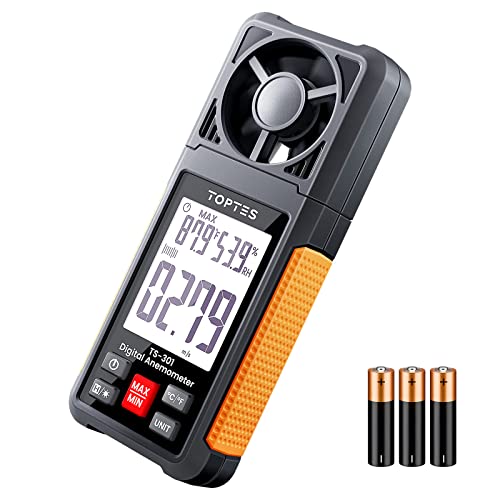
- 2.26-inch backlit LCD for easy reading
- Six wind-speed units plus temperature and humidity
- Three-year warranty and pouch included
Best For: Outdoor activities and quick airflow checks
Best Professional HVAC Tool
testo 405i Bluetooth HVAC Anemometer

- 15-inch telescopic shaft for in-duct airflow checks
- Bluetooth app provides tables, graphs, and reports
- Measures air velocity, temperature, and volume flow
Best For: Professional HVAC inspections and servicing
Versatile Everyday Pick
Mcbazel 3-in-1 Handheld Digital Anemometer

- Measures wind speed, temperature, and Beaufort level
- Offers five wind-speed units and a backlit display
- Includes MAX/MIN/AVG, hold, and auto-off functions
Best For: Portable HVAC, sailing, fishing, and general wind checks
Professional HVAC Choice
Kethvoz KE-846A CFM Airflow Meter

- Measures speed, temperature, and CFM/CMM airflow volume
- Uses a split sensor extendable up to 2 meters
- Stores 600 measurement groups with multiple averaging modes
Best For: HVAC diagnostics, duct balancing, and airflow troubleshooting
Heat-Stress Monitoring Pick
BTMETER BT-881W WBGT Anemometer

- Combines wind speed, temperature, humidity, and WBGT readings
- Provides indoor and outdoor heat-stress modes with alarms
- Includes multiple units, data hold, MAX/MIN, and backlight
Best For: Worksite heat-stress checks, outdoor activities, and HVAC monitoring
Versatile Field Pick
Soonkoda 3-in-1 Handheld Anemometer

- Measures speed, temperature, and wind level
- 0.06–30.0 m/s range with five speed units
- Dual-line display with hold and backlight
Best For: HVAC checks, outdoor activities, and general wind monitoring
Screen-and-Humidity Pick

- Large backlit screen for outdoor readability
- Displays CFM/CMM plus six wind-speed units
- Measures temperature and relative humidity
Best For: HVAC airflow checks and broader environmental monitoring
Professional Outdoor Pick
HoldPeak 866B Digital Anemometer

- 0.67–67.1 mph range with ±2% stated accuracy
- Measures wind speed, wind chill, temperature, and CFM
- Tripod mount, strap, pouch, and one-year warranty
Best For: Outdoor activities and HVAC duct airflow checks
Best All-Around Value – BTMETER BT-100 Handheld Anemometer
The BTMETER BT-100 is a practical choice for shoppers comparing digital anemometers for HVAC checks, outdoor activities, and airflow measurements. It measures wind speed in five units, includes wind temperature and wind chill readings, and has a backlit display for low-light use.
Best For: Home HVAC checks, outdoor hobbies, drone flying, shooting, and general-purpose wind measurements.
Pros:
- Measures wind speeds from 0.67 to 67.1 mph with stated ±2% reading accuracy.
- Includes wind temperature, wind chill, multiple speed units, and a backlit LCD.
- Tripod mount, carry case, neck strap, and included AAA batteries improve portability.
Cons:
- Does not include Bluetooth app connectivity or data logging.
- Temperature range is limited to -10°C to 60°C.
Choose the BT-100 if you want a compact digital anemometer with useful readings and accessories without adding app-based features.
Best for App Logging – BTMETER BT-100APP Bluetooth Anemometer
The BTMETER BT-100APP stands out among digital anemometers for users who want to record and review measurements on a phone or tablet. Bluetooth connectivity supports app pairing, data logging, and export, while the meter also provides wind speed, temperature, wind chill, and maximum/minimum/average readings.
Best For: HVAC airflow documentation, weather observations, sailing, shooting, and users who need saved measurement data.
Pros:
- Connects to iPhone, iPad, Android phones, and tablets through Bluetooth.
- Logs data and supports Excel or TXT export through the app.
- Offers data hold, MAX/MIN/AVG readings, adjustable power-off settings, and five speed units.
Cons:
- Its stated wind-speed accuracy is ±5%, less precise than the BT-100 model listed here.
- Temperature measurement is limited to -10°C to 45°C.
If measurement records matter as much as live readings, the BT-100APP is the more capable digital anemometer in this lineup.
Best Large-Display Pick – TopTes TS-301 Digital Anemometer
The TopTes TS-301 is one of the easier digital anemometers to read at a glance, thanks to its 2.26-inch backlit LCD. It measures wind velocity in six units and adds humidity and temperature readings for outdoor activities and basic indoor airflow checks.
Best For: Sailing, windsurfing, drone and RC flying, golf, shooting, HVAC vents, and users who prefer a large display.
Pros:
- Large 2.26-inch backlit screen is designed for easy reading.
- Provides six wind-speed units plus temperature and relative humidity.
- Lightweight pocket design includes a pouch, three AAA batteries, and a three-year warranty.
Cons:
- Temperature and humidity sensors may need at least 30 minutes to adjust to a new environment.
- Automatically shuts down after 10 minutes of inactivity.
The TS-301 makes sense for buyers who prioritize display visibility and added humidity information over Bluetooth logging.
Best Professional HVAC Tool – testo 405i Bluetooth HVAC Anemometer
The testo 405i is a professional-leaning option among digital anemometers, built for HVAC inspections and in-duct airflow work. Its hot-wire sensor measures air velocity and temperature, while the hinged telescopic shaft extends up to 15 inches for reaching ducts and confined vents.
Best For: HVAC technicians, air-conditioning servicing, in-duct measurements, and professional reporting.
Pros:
- 15-inch telescopic shaft helps reach tight ducts, vents, and other difficult areas.
- Bluetooth connects the meter to smartphones or tablets for remote readings.
- Smart Probe App presents data in tables and graphs and supports storage and custom reports.
Cons:
- Designed primarily for HVAC and professional use rather than casual outdoor activities.
- Requires a compatible smartphone or tablet to use its Bluetooth app features.
- Its listed response time is five seconds.
For ductwork access and documented HVAC service, the testo 405i offers a more specialized design than basic handheld digital anemometers.
Versatile Everyday Pick – Mcbazel 3-in-1 Handheld Digital Anemometer
If you want straightforward digital anemometers for general wind checks, the Mcbazel 3-in-1 combines wind speed, temperature, and Beaufort-scale readings in a compact handheld design. Its backlit, double-line display and multiple measurement units make it convenient for indoor or outdoor use.
Best For: HVAC checks, sailing, fishing, and portable everyday wind measurements.
Pros:
- Measures wind speed, wind temperature, and Beaufort wind level together.
- Supports m/s, km/h, knots, ft/s, and mph.
- Includes MAX/MIN/AVG, data hold, backlight, and auto power-off features.
Cons:
- AAA batteries are required but not included.
- It does not provide CFM air-volume measurements or data logging.
Choose this model when portability and simple multi-reading functionality matter more than advanced HVAC airflow analysis. The 100 g body and low-battery indicator also make it practical to keep in a tool bag.
Professional HVAC Choice – Kethvoz KE-846A CFM Airflow Meter
For technicians who need more than basic digital anemometers, the Kethvoz KE-846A adds CFM/CMM airflow calculations, temperature readings, data storage, and a split sensor. Its extended probe can help reach overhead vents and other difficult measurement points.
Best For: HVAC installation, duct testing, air-vent balancing, dryer vents, and dust-collection systems.
Pros:
- Measures wind speeds from 0.3 to 45 m/s and calculates air volume up to 999,900 CFM.
- Split sensor extends up to 2 m for overhead or hard-to-reach airflow checks.
- Stores up to 600 groups of measurements and supports MAX, MIN, average, and 2/3 maximum modes.
Cons:
- At 0.9 kg, it is substantially heavier than compact handheld models.
- Its professional airflow features may be unnecessary for casual wind readings.
This is the strongest fit for users who regularly work with duct dimensions and airflow volume rather than simply checking outdoor wind speed. The included case and lifetime technical support add practicality for field work.
Heat-Stress Monitoring Pick – BTMETER BT-881W WBGT Anemometer
The BTMETER BT-881W is one of the more specialized digital anemometers in this roundup, pairing wind-speed measurement with humidity, temperature, black-globe temperature, and WBGT heat-stress monitoring. It is designed for users who need environmental context, not just airflow readings.
Best For: Heat-stress assessment in work areas, outdoor activities, HVAC checks, and environments affected by radiant heat.
Pros:
- Measures wind speed up to 30 m/s along with temperature and relative humidity.
- Supports indoor and outdoor WBGT modes with configurable heat-stress alarms.
- Offers five air-velocity units, data hold, backlit LCD, MAX/MIN readings, and auto power-off.
Cons:
- Its heat-stress features add complexity for buyers who only need wind speed.
- It requires a 9V battery.
- Temperature accuracy varies by reading, with the supplied specifications listing different accuracy figures.
Select this model when humidity and radiant-heat conditions are important to the measurement. For basic wind testing, a simpler anemometer may be easier to use, but the WBGT functions make this a more capable environmental monitor.
Versatile Field Pick – Soonkoda 3-in-1 Handheld Anemometer
For shoppers comparing digital anemometers, the Soonkoda stands out as a straightforward three-function meter for checking wind speed, wind temperature, and wind level. Its dual-line display shows speed and temperature together, while multiple unit options make readings easier to use across HVAC, outdoor, and industrial tasks.
Best For: HVAC checks, outdoor activities, and general wind monitoring.
Pros:
- Measures wind speed, wind temperature, and Beaufort wind level.
- Supports readings from 0.06 to 30.0 m/s and five wind-speed units.
- Includes max, minimum, average, data hold, backlight, and low-battery functions.
- Displays wind speed and temperature simultaneously on a liquid-crystal screen.
Cons:
- Its wind-speed range tops out at 30.0 m/s.
- The supplied notes do not mention included batteries or a carrying case.
This is a practical choice if you want core measurements without adding unnecessary complexity. The Beaufort scale and broad application range are especially useful for quick field readings.
Screen-and-Humidity Pick – H10 Digital Anemometer
If easy viewing and broader environmental data matter, this digital anemometer pairs a large backlit screen with wind velocity, CFM/CMM airflow, temperature, and humidity readings. It is designed for quick use outdoors and includes a pouch and batteries to help you get started.
Best For: HVAC airflow checks and outdoor users who want temperature and humidity readings.
Pros:
- Large backlit LCD screen is designed for easier outdoor reading.
- Displays wind velocity in six units and airflow in CFM or CMM without manual calculation.
- Measures temperature from 0°C to 45°C and relative humidity from 0.0% to 99.9% RH.
- Includes three AAA batteries, a user manual, and a carry pouch.
Cons:
- The stated wind-velocity range varies by unit, with the top listed range reaching 30 m/s.
- Automatic shutdown is set after 10 minutes of inactivity, according to the supplied notes.
This model makes sense for buyers who want more than wind speed alone. Its large screen, direct airflow display, and added humidity measurement give it a useful edge for HVAC and general environmental checks.
Professional Outdoor Pick – HoldPeak 866B Digital Anemometer
The HoldPeak 866B is one of the more feature-focused digital anemometers in this group, combining wind-speed, wind-temperature, wind-chill, and CFM-oriented functions. Its 0.67–67.1 mph range, tripod mount, hand strap, and protective pouch suit repeated field use and HVAC measurements.
Best For: Outdoor enthusiasts, drone and sailing use, and HVAC duct airflow checks.
Pros:
- Measures wind speed across a stated range of 0.67–67.1 mph with ±2% of readings accuracy.
- Provides wind speed, wind chill, temperature, and CFM-related airflow measurements.
- Offers max, minimum, and average readings, unit switching, backlight, and battery display.
- Includes a tripod hole, hand strap, waterproof carrying pouch, batteries, and screwdriver.
Cons:
- CFM requires calculating airflow from wind speed and duct cross-sectional area.
- Its feature set may be more than needed for simple wind-speed checks.
Choose the 866B when mounting flexibility and a wider stated wind-speed range are priorities. The included protective accessories and one-year warranty also support its role as a durable, field-oriented meter.
How We Picked These Digital Anemometers
We focused on the features that matter during real measurements: wind-speed range, airflow and CFM capabilities, temperature or humidity readings, display readability, portability, response controls, and stated measurement accuracy. We also considered each meter’s intended use, from basic outdoor checks to HVAC diagnostics and heat-stress monitoring.
The selection includes both simple handheld instruments and more specialized options, such as Bluetooth models, telescoping-probe meters, and WBGT tools. Because specifications and included accessories can vary by seller, confirm the current package contents and measurement units before ordering.
Quick Comparison
| Best For | Look For | Useful Features |
|---|---|---|
| HVAC airflow checks | CFM, air-volume modes, temperature | Large display, hold function, duct access |
| Outdoor wind readings | Wide wind-speed range and durable housing | Backlight, maximum reading, compact size |
| Remote logging | Bluetooth or app compatibility | Data recording, charts, shareable results |
| Heat-stress assessment | WBGT and environmental sensors | Wet-bulb, ambient-temperature, and humidity data |
Key Buying Factors for Digital Anemometers
Measurement Type and Accuracy
Decide whether you need wind speed only or calculated airflow volume such as CFM. For HVAC work, CFM and temperature readings can be more valuable than a basic speed measurement. Accuracy matters most when balancing systems or comparing readings, so check the manufacturer’s stated tolerance and operating conditions.
Display and Controls
A backlit, easy-to-read screen is useful in mechanical rooms, attics, and outdoor settings. Look for minimum, maximum, average, and data-hold functions when readings fluctuate. Selectable units are helpful if you work with both metric and imperial specifications.
Probe Design and Connectivity
A telescoping probe can reach vents and ducts more easily than a fixed sensor. Bluetooth connectivity is worthwhile when you need to record readings, monitor a location from a short distance, or create job documentation. For occasional checks, a simpler meter may be faster and less complicated.
Environmental Measurements
Temperature and humidity sensors expand a meter’s usefulness for comfort checks and troubleshooting. If you need workplace heat assessment, choose a dedicated WBGT-capable instrument rather than assuming a standard anemometer provides the same information.
Who Should Buy Which Digital Anemometers?
- HVAC technicians: Choose a model with CFM, temperature, and a probe or airflow hood-compatible design.
- Homeowners and DIY users: A compact handheld meter with a clear backlit display and basic airflow modes should cover most ventilation checks.
- Drone pilots, sailors, and outdoor athletes: Prioritize portability, quick response, wind-speed range, and readable outdoor controls.
- Professionals who document results: A Bluetooth model with app-based logging can reduce manual transcription.
- Safety and facility teams: Select a WBGT meter when heat-stress monitoring is part of the job.
Before buying, compare the sensor range with the environments you measure most often, verify whether batteries and calibration information are included, and choose the simplest feature set that supports your work.