
The best compound microscopes make it easier to examine cells, tissues, microorganisms, and prepared slides with useful clarity and control. This roundup compares 10 models across student, home-learning, and laboratory-oriented use cases.
We considered magnification, optics, focusing systems, mechanical stages, illumination, included accessories, and overall practicality so you can choose a microscope that matches your experience level and budget.
Best 10 Compound Microscopes Picks for 2026
Research-Ready Choice
Swift SW380T Trinocular Microscope

- 40X–2500X across six magnification levels
- Trinocular head supports cameras and shared viewing
- Precise coarse and fine focusing controls
Best For: Advanced students, clinicians, and microscopy hobbyists
Reliable Student Starter
AmScope M150C Cordless Compound Microscope

- Five settings from 40X to 1000X
- All-metal frame with optical glass lenses
- LED illumination works with AC or AA batteries
Best For: Students, homeschoolers, and beginner users
Versatile Learning Lab
JECONE Binocular Microscope with Accessories

- 40X–2500X magnification with binocular viewing
- Dual LEDs handle opaque and translucent specimens
- Includes slides, coverslips, toolkit, and phone holder
Best For: Home schooling, school labs, and varied specimen viewing
Beginner-Friendly Flexibility
TOMLOV CM101 Compound Microscope

- Coarse and fine focus simplify specimen viewing
- Dual LEDs support slides and surface objects
- Includes slides, coverslips, and six filter positions
Best For: Beginners, students, and homeschool STEM projects
Best Overall Compound Microscope
OMAX 40X-2000X Binocular Microscope
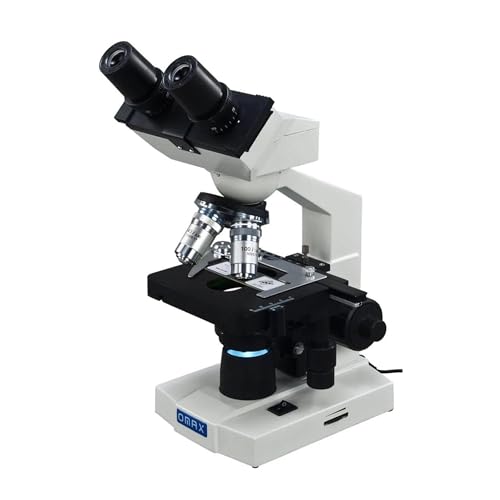
- Binocular head with adjustable diopters
- Mechanical stage and coaxial focusing
- Includes slides, coverslips, and cleaning paper
Best For: Home labs, advanced students, and serious hobbyists
Best Student Compound Microscope
PalliPartners 100X-2000X Microscope Kit

- Includes 28 prepared and blank slides
- Top and bottom adjustable LED illumination
- Phone adapter and Bluetooth camera shutter included
Best For: Student science projects and beginner home learning
Best Trinocular Compound Microscope
Woehrsh 40X-5000X Lab Microscope

- Trinocular design with HD USB camera support
- Stated magnification up to 5000X
- Dual mechanical stage and extensive lab kit
Best For: Adult learners, teaching labs, and electronic imaging
Best Value Student Pick
BEBANG 100X-2000X Compound Microscope
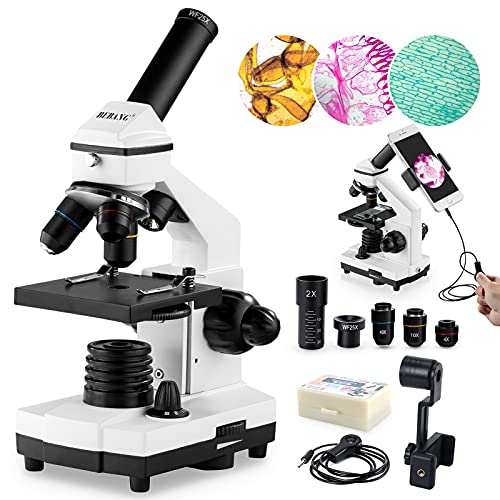
- Six listed settings from 100X to 2000X
- Coarse and fine focus controls
- Includes slides, phone adapter, and bag
Best For: Students, beginners, and home biology instruction
Comfort-Oriented Upgrade
Herwicm Binocular Compound Microscope

- Binocular ultra-wide-angle viewing
- Dual LED illumination
- Mechanical stage and coaxial focus
Best For: Extended observation sessions requiring comfort and stage control
Most Complete Kids Kit
PALOBIL 100X-2000X Compound Microscope

- Six listed settings from 100X to 2000X
- Prepared slides and beginner tools included
- Incident and transmitted LED lighting
Best For: Kids, homeschool activities, and introductory biology projects
Research-Ready Choice – Swift SW380T Trinocular Microscope
For users who need advanced compound microscopes for detailed specimen work, the Swift SW380T combines broad magnification, precise focusing, and a camera-compatible trinocular head. Its achromatic objectives and rotatable Siedentopf head make it practical for shared viewing in educational, clinical, and hobbyist settings.
Best For: Clinicians, university and high-school science students, and hobbyists who want camera-ready viewing and up to 2500X magnification.
Pros:
- Offers six magnification levels from 40X to 2500X.
- Trinocular head supports microscope cameras and an additional eyepiece.
- Rotatable Siedentopf head and 30-degree viewing angle support shared, comfortable use.
- Coarse and extremely fine focusing controls help refine specimen detail.
Cons:
- Camera and additional eyepiece attachments are not included.
- Uses AC power rather than battery operation.
- Its research-oriented feature set may be more than beginners need.
The SW380T is the strongest fit here for users planning to document or livestream observations. Choose it when precise control and expandability matter more than a simple starter setup.
Reliable Student Starter – AmScope M150C Cordless Compound Microscope
The AmScope M150C is a straightforward option for home-school and classroom science. This compound microscope uses all-optical glass elements, a sturdy metal frame, and LED illumination, while its outlet adapter and battery support make it convenient to use in different locations.
Best For: Elementary through high-school students, homeschool science, and beginners who want dependable 40X–1000X viewing.
Pros:
- Provides five magnification settings from 40X to 1000X.
- All-metal construction offers a sturdy platform.
- LED lighting can run from an outlet or three AA batteries.
- Widefield optical glass and a disc diaphragm support basic slide observation.
Cons:
- Monocular viewing is less suitable for users seeking binocular comfort.
- Maximum magnification is lower than the other listed models.
- Designed for basic learning rather than camera-based documentation.
With its uncomplicated controls and cordless lighting option, the M150C is a sensible entry point into compound microscopy. It is particularly appealing when portability and classroom-friendly operation are priorities.
Versatile Learning Lab – JECONE Binocular Microscope with Accessories
This JECONE model adds useful flexibility to compound microscopes intended for school labs and home learning. It combines binocular viewing, mechanical-stage positioning, dual illumination, color filters, and included slides and a phone holder for a more complete hands-on setup.
Best For: Families, students, and educators who need a versatile microscope for transparent slides, opaque objects, and phone-assisted observation.
Pros:
- Six magnification levels cover 40X through 2500X.
- Upper and lower LEDs support opaque and translucent specimens.
- Five-color filter wheel can improve contrast without relying on staining.
- Includes slides, coverslips, a toolkit, and phone holder.
Cons:
- USB-powered operation may require access to a suitable power source.
- The included phone holder may not fit every phone setup equally well.
- Its broad feature set may require more initial setup than a basic monocular model.
The JECONE is a strong all-around educational package for buyers who want more than prepared-slide viewing. Its dual lighting and filter wheel make it especially adaptable for varied specimens and classroom demonstrations.
Beginner-Friendly Flexibility – TOMLOV CM101 Compound Microscope
The TOMLOV CM101 is designed to make compound microscopy approachable for students, beginners, and adult hobbyists. Its coaxial coarse-and-fine focus, dual LEDs, achromatic objectives, filter positions, and included slides provide a practical starting point for exploring prepared and everyday specimens.
Best For: Beginners, homeschool STEM projects, and students who want simple controls plus flexible lighting and filter options.
Pros:
- Coaxial coarse and fine focus helps users locate and refine specimens.
- Dual LED lighting supports prepared slides and surface details.
- Three achromatic objectives pair with 10X and 25X eyepieces.
- Includes prepared slides, blank slides, coverslips, and a 6-position filter disc.
Cons:
- Monocular viewing may be less comfortable for extended shared use.
- Its listed maximum magnification is 2000X, below some competing options.
- The one-year manufacturer warranty is shorter than the five-year warranty listed for the AmScope.
The CM101 emphasizes ease of use and experimentation rather than advanced imaging. It is a good match for newcomers who want a guided, ready-to-use kit with more specimen flexibility than a basic slide-only microscope.
Best Overall Compound Microscope – OMAX 40X-2000X Binocular Microscope
For buyers seeking versatile compound microscopes with a sturdy, lab-oriented design, the OMAX M82ES-SC100-LP100 combines binocular viewing, mechanical stage controls, and broad magnification options. Its achromatic objectives, adjustable LED illumination, and included slide supplies make it suitable for detailed specimen work.
Best For: Home laboratories, advanced students, hobbyists, and users who want a durable binocular microscope with extensive accessories.
Pros:
- Offers magnification settings from 40X through 2000X with 4X, 10X, 40X, and 100X objectives.
- Includes a 360-degree swiveling binocular head with adjustable interpupillary distance and diopters.
- Features a double-layer X-Y mechanical stage, coaxial coarse and fine focus, and adjustable LED lighting.
- Includes 100 blank slides, 100 coverslips, and 50 sheets of lens-cleaning paper.
Cons:
- The 100X objective requires immersion oil for its stated oil-immersion configuration.
- Its corded power setup and approximately 9.6-pound weight make it less portable than compact models.
With a solid metal frame, protective stage lock, and five-year manufacturer warranty, this OMAX is a strong choice for buyers prioritizing mechanical control and long-term use over portability.
Best Student Compound Microscope – PalliPartners 100X-2000X Microscope Kit
The PalliPartners is one of the more approachable compound microscopes for students and families because it combines high-power optics with a ready-to-use slide kit. Its upper and lower LED illumination also gives beginners flexibility when viewing translucent specimens and some opaque objects.
Best For: Middle-school and high-school STEM activities, homeschooling, classroom demonstrations, and beginner adult users.
Pros:
- Provides stated magnification from 100X to 2000X using 4X, 10X, and 40X objectives, a WF25X eyepiece, and a 2X lens.
- Includes 10 prepared slides, 18 blank slides, a phone adapter, Bluetooth camera shutter, and power adapter.
- Dual top-and-bottom LED illumination supports varied specimen types.
- Coaxial coarse and fine focus controls help users make precise adjustments.
Cons:
- The housing uses PC and PE materials rather than the full metal construction found on more laboratory-oriented models.
- Its stated 30-degree viewing angle may provide less ergonomic viewing than a 45-degree head.
- Adult supervision is recommended for younger users.
This kit emphasizes accessibility and experimentation: the included specimens and smartphone accessories reduce setup friction, while its dual illumination broadens what beginners can examine.
Best Trinocular Compound Microscope – Woehrsh 40X-5000X Lab Microscope
For users who want compound microscopes with very high stated magnification and imaging flexibility, this Woehrsh trinocular model adds an electronic eyepiece and HD USB camera support to its optical viewing system. Its dual mechanical stage and achromatic infinity optical design suit more demanding educational and laboratory-style observation.
Best For: Adult users, school labs, biological testing, teaching, and applications that benefit from electronic image viewing or documentation.
Pros:
- Offers stated magnification from 40X to 5000X with WF10X and WF25X eyepieces and additional 2X lenses.
- Trinocular configuration and HD USB camera support enable electronic viewing and documentation.
- Includes a dual mechanical stage, LED lighting, coaxial coarse and fine focus, and a 306-degree swivel head.
- Comes with slides, coverslips, specimens, tools, phone holder, Petri dishes, and protective packaging.
Cons:
- The extensive accessories and trinocular design may be more equipment than casual users need.
- Its corded, metal construction is better suited to a fixed workstation than portable use.
- The supplied notes do not specify the camera’s resolution or software compatibility.
This model stands out for connectivity and expansion potential. Buyers should confirm their preferred computer setup and camera workflow, but the combination of trinocular viewing, mechanical controls, and a broad accessory pack is compelling for serious users.
Best Value Student Pick – BEBANG 100X-2000X Compound Microscope
This BEBANG compound microscope is a practical option for students, beginners, and home biology instruction. It combines six listed magnification settings with coarse and fine focus controls, dual LED illumination, and a useful starter accessory bundle.
Best For: Students, beginners, and families wanting a metal-framed microscope kit for school or home education.
Pros:
- Offers six listed magnification settings from 100X to 2000X using the WF25X eyepiece, optional 2X lens, and 4X/10X/40X objectives.
- Coarse and fine focusing knobs support more precise image adjustment.
- Includes a phone adapter, carrying bag, operating accessories, and a 15-piece slide set.
- Top and bottom LED illumination supports brightfield observation of different specimens.
Cons:
- The monocular design provides one viewing path rather than binocular viewing.
- Battery operation is listed, but the notes do not specify whether batteries are included.
With its straightforward controls and included slides, this is one of the more approachable compound microscopes for getting started with basic biological observation without assembling a separate accessory kit.
Comfort-Oriented Upgrade – Herwicm Binocular Compound Microscope
The Herwicm compound microscope stands out for its binocular, ultra-wide-angle viewing setup and dual LED lighting. Its two-layer mechanical stage, coaxial focusing controls, and listed 4X, 10X, and 40X objectives make it a more feature-focused choice for extended observation.
Best For: Users who prefer binocular viewing, a mechanical stage, and adjustable illumination for longer biology sessions.
Pros:
- Binocular ultra-wide-angle eyepieces are designed for a larger field of view and more comfortable viewing.
- Dual top and bottom LED lighting supports observation with adjustable fill light.
- Coaxial coarse and fine focusing knobs allow quicker and more controlled focusing.
- Large stage with a spiral moving scale provides more controlled specimen positioning.
Cons:
- The supplied details contain an inconsistent magnification description, listing 40X-2500X in the title but a maximum magnification of 40X in the specifications.
- It is corded electric, so it is less portable than battery-powered alternatives.
- The notes do not provide a specific accessory list for the kit.
This model is most compelling when viewing comfort and stage control matter more than portability. Verify the actual magnification range before purchase because the supplied listing information is inconsistent.
Most Complete Kids Kit – PALOBIL 100X-2000X Compound Microscope
The PALOBIL compound microscope is built around guided exploration, with six listed magnification settings, dual illumination, and prepared slides included. Its metal frame, phone adapter, and beginner experiment accessories make it suitable for homeschool activities, demonstrations, and introductory biology work.
Best For: Kids, homeschool families, and beginners who want prepared specimens and a broad starter kit.
Pros:
- Provides six listed magnification settings from 100X to 2000X with the WF25X eyepiece, 2X lens, and 4X/10X/40X objectives.
- Adjustable top incident and bottom transmitted LED lighting accommodates opaque and translucent specimens.
- Includes prepared slides, blank slides, droppers, tweezers, a phone adapter, and other beginner accessories.
- Metal construction and shockproof, drop-resistant packaging support storage and transport.
Cons:
- Three AA batteries are required and are not included, although an AC adapter is included.
- The extensive feature and accessory set may be more than a casual observer needs.
- At 1.65 kg, it is heavier than the listed BEBANG model.
For families choosing among compound microscopes, the PALOBIL is appealing because it pairs adjustable specimen lighting with ready-to-use slides and experiment tools, reducing the preparation needed for a first project.
How We Picked These Compound Microscopes
We selected models representing the main buying categories: beginner microscopes for children and families, dependable student instruments, and more advanced binocular or trinocular systems for laboratory-style work. Our comparison focuses on specifications that affect real use rather than maximum magnification alone.
Important considerations included optical construction, objective and eyepiece combinations, coarse and fine focusing, stage movement, illumination, viewing comfort, camera connectivity, and the accessories needed to begin observing specimens. Models with mechanical stages and fine focus generally offer better control than basic instruments with simple clip-style stages.
Quick Comparison
| Best For | Features to Prioritize | Recommended Type |
|---|---|---|
| Children and first-time users | Simple controls, included slides, sturdy construction | Basic monocular or binocular model |
| School and home biology | Mechanical stage, fine focus, multiple objectives | Binocular student microscope |
| Frequent specimen work | Quality optics, bright LED, comfortable head | Binocular laboratory-style model |
| Teaching or digital documentation | Trinocular head, USB camera compatibility | Trinocular microscope |
Key Buying Factors for Compound Microscopes
Magnification and Optical Quality
Compound Microscopes commonly combine 4X, 10X, 40X, and 100X objectives with 10X or 25X eyepieces. Higher stated magnification is not automatically better; useful detail depends on numerical aperture, lens quality, alignment, lighting, and specimen preparation. For most students, a clear 40X to 400X range is more useful than an exaggerated maximum.
Focusing and Stage Control
Coarse focus quickly brings a specimen into view, while fine focus sharpens details at higher powers. A two-layer mechanical stage lets you move the slide precisely in both directions and is especially valuable for biology lessons, repeated observations, and larger specimens.
Lighting and Condenser Features
LED illumination is efficient, cool-running, and generally practical for home and classroom use. Dual lighting can help with transparent prepared slides and thicker or opaque specimens. A condenser and iris diaphragm provide additional control over contrast and brightness.
Viewing Head and Camera Support
Monocular models are often compact and affordable. Binocular heads are more comfortable during longer sessions, while trinocular designs add a dedicated camera port for image capture or group instruction. Confirm whether a camera is included and whether its software and connection type fit your computer.
Who Should Buy Which Compound Microscopes?
Choose a basic kids’ or beginner kit if affordability, included slides, and straightforward operation matter most. These models suit occasional discovery and early science activities.
For middle-school, high-school, and home-school biology, a binocular microscope with a mechanical stage, fine focus, and several useful objective powers is the better long-term choice. It provides more control without requiring professional-level setup.
Choose a laboratory-style binocular model if you expect frequent use, need improved ergonomics, or want more consistent viewing. A trinocular microscope is the strongest fit for educators, hobbyists documenting specimens, and users who need live camera output or saved images.
Before ordering, verify the included objectives, eyepieces, power requirements, camera accessories, warranty, and available replacement parts. Those details often matter more over time than the headline magnification number.