
Finding a capable microscope on a limited budget is easier when you focus on usable optics and controls rather than impressive magnification claims. The best compound microscopes under $200 can support classroom assignments, prepared slides, basic specimen work, and home science projects.
This roundup compares 10 student- and beginner-friendly models, including monocular, binocular, and trinocular designs. Use the guide below to match each microscope’s focusing system, mechanical stage, illumination, accessories, and viewing comfort to your needs.
Best 10 Compound Microscopes Under 200 Picks for 2026
Best Beginner-Friendly Pick
TOMLOV CM101 Compound Microscope

- Coaxial coarse and fine focus
- Dual LED lighting for varied specimens
- Includes prepared and blank slides
Best For: Students, beginners, and adult hobbyists
Best Binocular Value

- Binocular 360-degree rotating head
- Mechanical stage for controlled movement
- Dual adjustable LED illumination
Best For: Home-schooling and school-lab users
Best Complete STEM Kit
PalliPartners Compound Microscope

- Includes 28 prepared and blank slides
- Dual top and bottom LED lighting
- Phone adapter and Bluetooth remote included
Best For: Homeschool science and supervised student use
Best Mechanical-Stage Option
Herwicm RM Binocular Microscope

- Binocular wide-angle eyepieces
- Two-layer mechanical stage
- Dual LED and coaxial focusing
Best For: Students and hobbyists wanting controlled stage movement
Best Budget Starter
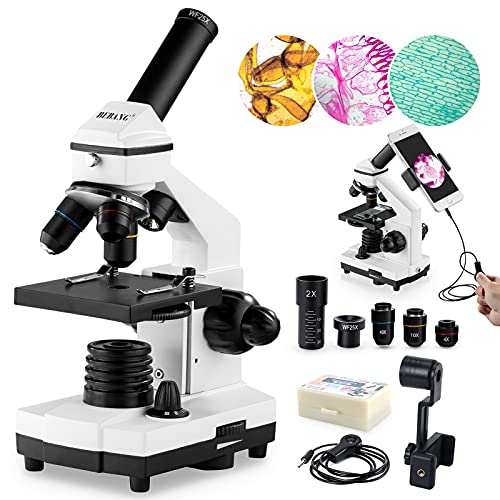
- Six listed settings from 100X to 2000X
- Coarse and fine focus with metal frame
- Phone adapter, slides, bag, and accessories included
Best For: Students, beginners, and home biology learning
Best Lab-Style Upgrade
VEVOR Trinocular Compound Microscope

- 12 listed magnification options up to 5000X
- Trinocular head with computer interface
- Mechanical stage and broad accessory set
Best For: Advanced students and lab-style computer-connected viewing
Best Family Learning Kit
PALOBIL 2000X Compound Microscope

- Six listed settings from 100X to 2000X
- Top and bottom adjustable LED illumination
- Prepared slides and beginner tools included
Best For: Homeschooling, families, and introductory biology demonstrations
Best Complete Kit
PalliPartners Binocular Compound Microscope

- 100X–2000X stated magnification range
- 28 slides plus collecting and dissecting tools
- Dual LED lighting with phone accessories
Best For: Students, homeschoolers, and families wanting a ready-to-use science kit
Best Flexible Setup
Woehrsh Dual-Eyepiece Compound Microscope
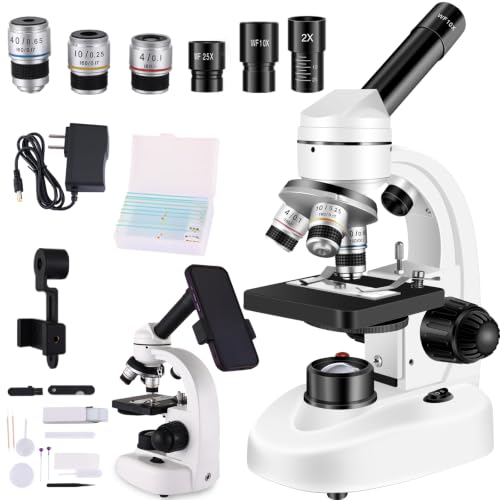
- WF10X and WF25X eyepieces
- Top and bottom LED illumination
- Swivel head and complete starter accessories
Best For: Beginners and students needing adjustable viewing and lighting
Best Compact Metal Build
HUTACT 40X–2000X Compound Microscope

- Aluminum-alloy body for a lightweight build
- Achromatic glass optics with LED illumination
- Prepared slides and storage bag included
Best For: Beginners wanting a portable microscope for basic science exploration
Best Beginner-Friendly Pick – TOMLOV CM101 Compound Microscope
If you are comparing compound microscopes under 200 for classroom work, homeschool projects, or casual specimen viewing, the TOMLOV CM101 offers a straightforward setup with coarse and fine focus controls. Its 4X, 10X, and 40X achromatic objectives, dual LED lighting, and included prepared and blank slides make it versatile for getting started.
Best For: Students, beginners, and adult hobbyists who want flexible lighting and an easy-to-use monocular design.
Pros:
- Coaxial coarse and fine focus controls help locate specimens and sharpen details.
- Top and bottom LED illumination supports both opaque and transparent specimens.
- Includes five prepared slides, five blank slides, coverslips, and two eyepieces.
- Six-position color filter disc can adjust brightness, contrast, and illumination color.
Cons:
- Monocular viewing may be less comfortable for extended shared observation than a binocular model.
- The supplied specifications list a maximum magnification of 2000X, but the practical usefulness of the highest setting depends on specimen preparation and focusing.
The CM101 is a practical option when ease of use and included accessories matter more than advanced laboratory features. Its dual illumination also gives it broader specimen flexibility than a basic transmitted-light student microscope.
Best Binocular Value – JECONE 40X-2500X Microscope
Among compound microscopes under 200, this JECONE model stands out for its binocular head, mechanical stage, and broad listed magnification range. It combines 4X, 10X, and 100X objectives with WF10X and WF25X eyepieces, while dual LED lighting helps accommodate both translucent and opaque samples.
Best For: Home-schooling, school labs, and users who prefer binocular viewing with a more substantial stage setup.
Pros:
- Binocular, 45-degree inclined, and 360-degree rotating head supports comfortable viewing and sharing.
- Mechanical stage provides controlled specimen positioning.
- Dual LED illumination includes adjustable light intensity.
- Includes slides, coverslips, a toolkit, manual, and phone holder.
Cons:
- At 2.27 kg, it is heavier than some compact beginner microscopes.
- The included 100X objective may require more careful focusing and specimen preparation.
This is a strong fit for buyers who value binocular ergonomics and stage control in an educational microscope. Its phone holder and included accessories further support classroom demonstrations and home observation.
Best Complete STEM Kit – PalliPartners Compound Microscope
For shoppers seeking compound microscopes under 200 that are ready for immediate educational use, the PalliPartners model includes a substantial slide and photography accessory set. Its 4X, 10X, and 40X objectives, WF25X eyepiece, dual LED lighting, and coaxial focus controls cover common student and hobbyist applications.
Best For: Children and teens using a microscope with adult supervision, homeschool science, and entry-level biology activities.
Pros:
- Includes 10 prepared slides and 18 blank slides for guided and DIY experiments.
- Top and bottom LED lighting supports opaque and translucent specimens.
- Phone adapter and Bluetooth remote support basic specimen photography.
- SGS safety certification is listed for non-toxic materials and electrical safety.
Cons:
- The listed power details are inconsistent, identifying both a power adapter and battery-powered operation.
- It uses a single WF25X eyepiece rather than a binocular viewing system.
The PalliPartners package is appealing when accessories and educational readiness are priorities. It offers a broad starter experience without requiring separate purchases for slides, phone mounting, or a remote shutter.
Best Mechanical-Stage Option – Herwicm RM Binocular Microscope
This Herwicm RM is worth considering among compound microscopes under 200 if you want binocular viewing, dual LED illumination, and a two-layer mechanical stage. Its 4X, 10X, and 40X objectives are paired with wide-angle eyepieces and coaxial coarse and fine focus controls for routine educational observation.
Best For: Students, adult beginners, and hobbyists who want binocular comfort and controlled stage movement.
Pros:
- Ultra-wide-angle binocular eyepieces are designed for a larger viewing field.
- Top and bottom LED lights accommodate different specimen types.
- Coaxial coarse and fine focus controls support faster locating and precise adjustment.
- Mechanical stage includes a spiral moving scale for specimen positioning.
Cons:
- The supplied details list a maximum magnification of 40X, which conflicts with the stated 40X-2500X range; verify the listing before purchase.
- The notes do not specify the included slide or accessory set in detail.
This model has the feature mix of a more structured student microscope, particularly for buyers who prefer binocular viewing and a mechanical stage. Because the magnification specifications conflict, confirming the seller’s current product details is especially important.
Best Budget Starter – 2000X Compound Microscope Kit
For shoppers comparing compound microscopes under 200, this BEBANG model is a practical starter kit for home learning, school projects, and basic biological observation. It combines six listed magnification settings with coarse and fine focus controls, dual LED illumination, and useful phone and slide accessories.
Best For: Students, beginners, families, and hobbyists who want a complete microscope kit for introductory biology work.
Pros:
- Offers six listed magnification settings from 100X to 2000X using the eyepiece, optional 2X lens, and 4X, 10X, and 40X objectives.
- Metal frame and separate coarse and fine focus knobs support more controlled focusing.
- Top-and-bottom LED illumination and a 0.65 NA condenser help provide evenly lit observations.
- Includes a phone adapter, carrying bag, 15-piece slide set, and additional operating accessories.
Cons:
- The monocular design provides single-eye viewing rather than binocular or trinocular observation.
- The listed 2000X maximum may be more useful for occasional high-magnification viewing than routine work.
- At 2.4 pounds, it is portable, but the compact size may offer less bench stability than heavier lab models.
Overall, the BEBANG is a well-equipped entry-level option when accessories and portability matter. Its focusing controls and dual illumination make it more versatile than a very basic educational microscope, while its monocular format keeps the setup straightforward.
Best Lab-Style Upgrade – VEVOR Trinocular Compound Microscope
Among compound microscopes under 200, the VEVOR stands out for shoppers prioritizing a more laboratory-oriented setup. It provides a trinocular head, dual-layer mechanical stage, coarse and fine focusing, adjustable LED lighting, and an external screen interface for computer connection.
Best For: Advanced students, teaching labs, and users who need mechanical-stage handling and computer-connected viewing.
Pros:
- Lists 12 magnification options with a maximum of 5000X.
- Trinocular design and external screen interface support shared or computer-connected observation.
- Dual-layer stage helps secure specimens, while coarse and fine controls support precise focusing.
- Includes cover slides, glass slides, test tubes, culture dishes, a phone holder, and 100 cover glasses.
Cons:
- Electronic eyepieces and connecting cables are not included.
- At 7.2 pounds, it is substantially less portable than the smaller educational models in this roundup.
- The corded-electric design is less flexible for locations without a convenient power connection.
The VEVOR is the most feature-focused choice here for users who want a heavier, lab-style instrument rather than a simple starter microscope. Confirm the required electronic accessories before buying if computer-based imaging is central to your workflow.
Best Family Learning Kit – PALOBIL 2000X Compound Microscope
This PALOBIL model is a strong family-learning pick among compound microscopes under 200, pairing a metal frame with six listed magnification settings and a broad beginner accessory kit. Its dual LED system can illuminate both translucent specimens and opaque objects, making it useful for varied demonstrations.
Best For: Homeschooling, children learning with adult supervision, beginners, and introductory biology demonstrations.
Pros:
- Provides six listed settings from 100X through 2000X with a WF25X eyepiece, optional 2X lens, and three objectives.
- Adjustable top incident and bottom transmitted LED lighting accommodates opaque and translucent specimens.
- Metal construction and focusing controls are designed for a sturdy setup and quicker image finding.
- Includes a phone adapter, prepared slides, blank slides, droppers, tweezers, and other beginner supplies.
Cons:
- Three AA batteries are required but are not included; an AC adapter is included.
- The monocular viewing format may be less comfortable for extended sessions than a binocular model.
- The product description uses broad age and application ranges, so advanced laboratory users may want more specialized features.
PALOBIL makes a sensible choice for hands-on learning because the lighting modes and included specimens support varied experiments right away. Its battery option also adds flexibility, though buyers should plan to supply the batteries separately.
Best Complete Kit – PalliPartners Binocular Compound Microscope
For shoppers comparing compound microscopes under 200, the PalliPartners model stands out as a complete binocular learning kit. It combines 100X–2000X stated magnification, dual LED illumination, and supplies for prepared and self-made specimens, making it ready for hands-on exploration.
Best For: Students, homeschoolers, families, and adults who want a broad biology starter setup with phone-recording accessories.
Pros:
- Includes 4X, 10X, and 40X objectives, a WF25X eyepiece, and a 2X Barlow lens.
- Comes with 10 prepared slides, 18 blank slides, collection supplies, and dissecting tools.
- Top and bottom LED lighting supports translucent specimens and opaque objects.
- Binocular viewing, coaxial coarse/fine focus, phone adapter, and Bluetooth shutter add versatility.
Cons:
- The enclosure is plastic, which may feel less substantial than an all-metal microscope.
- The 2000X maximum depends on the included Barlow lens and eyepiece combination.
This is the most supplies-rich option of the three. Its dual illumination and accessories make it especially practical for ongoing home or classroom projects, while the SGS safety certification is a useful detail for supervised younger users.
Best Flexible Setup – Woehrsh Dual-Eyepiece Compound Microscope
Among compound microscopes under 200, this Woehrsh microscope offers flexible viewing and power options for students and beginners. Its WF10X and WF25X eyepieces provide several stated magnification settings, while dual lighting and a six-hole diaphragm help accommodate different specimens.
Best For: Children, adult beginners, and home-school users who value adjustable illumination, a rotating head, and a supplied lab package.
Pros:
- Includes 4X, 10X, and 40X objectives with WF10X and WF25X eyepieces.
- Top and bottom LED lights support opaque and translucent objects.
- Features a 360-degree swivel head, coaxial coarse/fine focusing, and adjustable brightness.
- Package includes prepared sections, slides, coverslips, lab tools, a phone holder, and a protective bag.
Cons:
- The listing states a 2500X maximum, but the supplied objective and eyepiece combinations should be checked before purchase.
- Its 110-volt electric specification may be less convenient for users needing international compatibility.
The Woehrsh is a strong choice when convenience features matter as much as magnification. Its rotating head, dual power claim, and included protective bag make it adaptable for home learning, though buyers should clarify the power arrangement and magnification labeling.
Best Compact Metal Build – HUTACT 40X–2000X Compound Microscope
For buyers seeking compound microscopes under 200 with a straightforward educational setup, the HUTACT offers achromatic glass optics, LED lighting, and a lightweight aluminum-alloy body. It includes a small prepared slide set and storage bag, so beginners can start exploring without assembling a separate kit.
Best For: Kids, adults, students, and beginners who prioritize a compact metal-made microscope for basic science exploration.
Pros:
- Uses H10X and H25X eyepieces with 4X, 10X, and 40X objectives.
- Offers stated magnification combinations from 40X to 1000X, reaching 2000X with the 2X lens.
- Aluminum-alloy construction and achromatic glass lenses are designed for stability and clear, bright images.
- Includes a five-piece prepared slide set, storage bag, LED light, and user manual.
Cons:
- The included slide set is smaller than the kits supplied with the other two models.
- The notes do not mention dual illumination, so it may be less suited to opaque-object viewing.
The HUTACT keeps the package focused and portable. Its metal construction and achromatic optics are appealing for beginners who want a stable educational microscope, but users seeking extensive specimens or dual-light capability may prefer one of the more accessory-heavy alternatives.
How We Picked the Best Compound Microscopes Under 200
We selected models based on the features that matter most in practical student and home-lab use: objective and eyepiece combinations, focusing controls, stage design, illumination, viewing format, included accessories, and intended user age. We also considered whether a microscope appears suited to prepared slides, basic biology observation, classroom demonstrations, or more frequent hobby use.
Advertised magnification is only one part of the evaluation. A 2,000x or 2,500x rating does not guarantee useful detail if the optics, lighting, or specimen preparation cannot support it. Models with mechanical stages, fine focus, dual LED lighting, or binocular viewing may be more convenient even when their headline magnification is lower.
Quick Comparison
| Feature | What to look for | Why it matters |
|---|---|---|
| Viewing format | Monocular, binocular, or trinocular | Binocular designs improve comfort; trinocular models can support camera use. |
| Stage | Two-layer mechanical stage | Makes it easier to position slides precisely. |
| Focus | Coarse and fine adjustment | Fine focus helps sharpen details at higher powers. |
| Lighting | Adjustable LED illumination | Provides consistent, controllable lighting for transparent specimens. |
| Accessories | Slides, phone holder, or specimen tools | Lets beginners start observing with fewer extra purchases. |
Key Buying Factors for Compound Microscopes Under 200
Optics and Usable Magnification
Check the objective powers and eyepieces rather than relying on the maximum number in the listing. Common combinations such as 4x, 10x, and 40x objectives with a 10x eyepiece cover many school applications. A 25x eyepiece can increase magnification, but it may narrow the field of view and make focusing more demanding.
Stage and Focusing Controls
A mechanical stage is one of the most useful upgrades for beginners because its knobs move the slide smoothly in two directions. Coarse focus locates the image, while fine focus brings small details into sharper view. These controls are especially valuable at 400x and above.
Lighting and Viewing Comfort
LED illumination is generally practical for home and classroom use because it is bright, cool, and economical. A binocular head may reduce eye strain during longer sessions, while a monocular model can be simpler and less expensive. If imaging is important, consider a trinocular model or a microscope with a phone adapter, but verify camera compatibility.
Included Kit and Construction
Prepared slides, blank slides, covers, and basic tools can add real value for a first-time buyer. Also check the microscope’s footprint, carrying handle, power requirements, warranty, and availability of replacement accessories.
Who Should Buy Which Compound Microscopes Under 200?
- For younger beginners: Choose a straightforward kit with prepared slides, a stable base, and simple controls.
- For students: Prioritize coarse and fine focus, a mechanical stage, adjustable LED lighting, and standard objective powers.
- For home-schooling families: A bundled slide set and phone holder can make lessons easier to demonstrate and document.
- For adults and frequent users: Binocular viewing, smoother stage movement, and stronger ergonomics are worth considering.
- For camera-based projects: Look at trinocular designs or models that clearly support an adapter, while confirming that the required camera hardware is included.
Before buying, compare the complete package rather than the magnification claim alone. The best choice is the model whose controls, optics, accessories, and viewing format fit the way you plan to use it.