
The best chemistry sets turn abstract science concepts into hands-on discoveries, giving children a structured way to explore reactions, mixtures, acids, bases, and more.
We compared 10 popular kits across experiment variety, age range, equipment, instructions, and educational value to help you choose a set that fits your child’s experience and interests.
Best 10 Chemistry Sets Picks for 2026
Best All-Around Chemistry Set
National Geographic Amazing Chemistry Set

- 100+ experiment ideas with 15 supplied projects
- Includes beakers, test tubes, and pipettes
- Ages 8+ with crystal and color-change activities
Best For: Children wanting a broad, hands-on introduction to chemistry
Best Lab-Station Design

- 57-piece chemistry setup with a dedicated station
- Includes experiment cards and a full-color manual
- Non-hazardous chemicals; recommended for ages 6+
Best For: Younger children who enjoy organized lab-style play
Best Three-in-One Science Kit
National Geographic Mega Science Lab
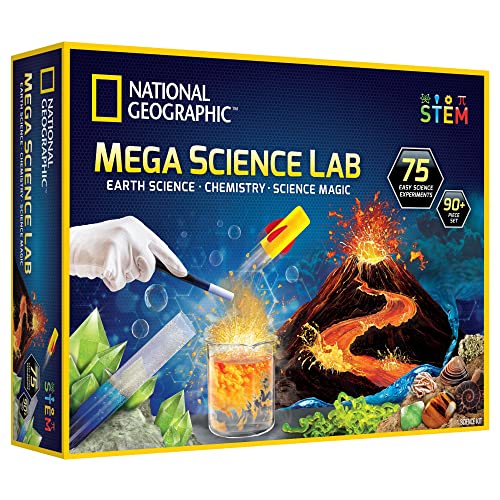
- Combines chemistry, Earth science, and science magic
- Includes 45 experiments plus 30 bonus activities
- Adds rocks, minerals, crystals, and a fossil
Best For: Children who want chemistry alongside other science topics
Best Advanced Chemistry Set

- Includes 333 experiments across 27 chapters
- Covers inorganic, organic, and electrochemistry
- Comes with lab equipment, chemicals, and a 192-page manual
Best For: Students 12+ pursuing serious, supervised chemistry study
Best Starter Chemistry Set

- 50 hands-on experiments
- 20+ child-safe lab tools
- Illustrated instructions for ages 4+
Best For: Young beginners and early STEM learning
Best Advanced Beginner Chemistry Set

- 125 experiments in 10 chapters
- Real lab equipment and 7 chemicals
- 80-page illustrated manual
Best For: Learners ages 10+ with adult supervision
Best Chemistry Set for Big Reactions

- 45 hands-on experiments
- Includes volcano, geyser, and rocket activities
- Illustrated STEM instructions
Best For: Ages 8–12 who enjoy visual science projects
Intermediate Lab Pick

- 250 experiments with a 128-page full-color manual
- Includes an alcohol burner and real lab equipment
- Designed for ages 11+ with adult supervision
Best For: Aspiring young chemists and high school chemistry preparation
Broad STEM Activity Pick
Doctor Jupiter Ultimate Science Kit

- 135+ guided experiments for ages 8 and up
- Includes 90+ bonus household-item activities
- Illustrated instructions and leak-proof ingredient bottles
Best For: Younger children and parent-child science activities
Introductory Chemistry Pick

- 28 guided experiments for a focused introduction
- Covers acids, bases, gases, and invisible ink
- Includes basic lab equipment and a 48-page guide
Best For: Beginning chemistry learners ages 10 to 15
Best All-Around Chemistry Set – National Geographic Amazing Chemistry Set
For families seeking approachable chemistry sets, the National Geographic Amazing Chemistry Set combines 15 experiments with a bonus guide featuring 85 additional activities using common household items. Kids can explore color-changing solutions, crystal growing, glowing test tubes, bouncy balls, and other hands-on reactions with included lab-style tools.
Best For: Children ages 8 and up who want a broad introduction to hands-on chemistry and STEM activities.
Pros:
- Offers more than 100 total experiment ideas.
- Includes materials for 15 experiments plus test tubes, beakers, and pipettes.
- Covers engaging activities such as crystal growing and color-changing reactions.
- Bonus experiments use common household items.
Cons:
- Only 15 experiments include the supplied materials; the additional 85 require household items.
- Recommended for ages 8 and up, so it may not suit younger children.
This is a versatile pick for a first chemistry set, especially when variety and repeat play matter. Its mix of included activities and household-material experiments gives children room to continue exploring after the initial projects.
Best Lab-Station Design – Ooze Labs Chemistry Station
The Ooze Labs Chemistry Station stands out among chemistry sets with a large, colorful workstation that keeps equipment and experiment cards organized. It includes 57 pieces for activities such as glowing slime, fizzing reactions, oozing bubbles, and chromatography, along with non-hazardous chemicals and a full-color manual.
Best For: Children ages 6 and up who benefit from an organized, role-play-friendly lab setup.
Pros:
- Includes a functional chemistry station with 57 pieces.
- Provides beakers, test tubes, flasks, pipettes, and other lab equipment.
- Experiment cards clip onto the station for convenient reference.
- Uses non-hazardous chemicals and does not contain borax.
Cons:
- The experiment range is smaller than that of the more advanced 333-experiment kit in this roundup.
- The plastic station is a larger setup to store than a basic chemistry kit.
Choose this set if presentation and easy access to materials are priorities. The dedicated station makes experiments feel more like laboratory work, while the included cards and manual help keep activities moving.
Best Three-in-One Science Kit – National Geographic Mega Science Lab
Among chemistry sets, the National Geographic Mega Science Lab is a flexible choice for children who want more than chemistry alone. It combines chemistry, Earth science, and science magic, with 45 supplied experiments and a bonus guide containing 30 additional activities using common household items.
Best For: Kids ages 8 and up whose interests span chemistry, geology, and entertaining science demonstrations.
Pros:
- Combines three areas of science in one kit.
- Includes chemistry activities involving bubbling reactions, gooey worms, gas-powered rockets, and crystal fireworks.
- Adds Earth science specimens, including rocks, minerals, crystals, and a fossil.
- Bonus guide provides 30 more household-item experiments.
Cons:
- Chemistry is only one part of the overall kit, so it is less specialized than a dedicated chemistry set.
- The 30 bonus experiments require common household items.
This kit makes sense for families looking for variety rather than a focused chemistry curriculum. Its broad subject coverage can help children discover which area of science interests them most.
Best Advanced Chemistry Set – Thames & Kosmos CHEM C3000
The Thames & Kosmos CHEM C3000 is the most advanced option here for students seeking substantial chemistry sets rather than simple demonstration toys. Designed for ages 12 and up with adult supervision, it includes 333 experiments across inorganic, organic, and electrochemistry, plus real lab equipment, chemicals, and a 192-page manual.
Best For: Aspiring chemists, homeschoolers, and students ages 12 and up preparing for more advanced chemistry.
Pros:
- Offers more than 333 experiments organized into 27 chapters.
- Covers inorganic chemistry, organic chemistry, and electrochemistry.
- Includes extensive equipment such as glass test tubes, beakers, an Erlenmeyer flask, an alcohol burner, and safety goggles.
- The 192-page manual explains topics including chemical equations, acids and bases, redox reactions, electrolysis, and organic chemistry.
Cons:
- Adult supervision is required throughout.
- Some experiments require common household additions.
- Its advanced content and 12+ recommendation may overwhelm beginners.
This is the strongest choice for depth and authentic laboratory practice, but it demands more supervision and commitment than beginner chemistry sets. The extensive manual and equipment make it better suited to serious learners than casual play.
Best Starter Chemistry Set – Junior Chemistry Set
For younger children exploring chemistry sets for the first time, the National Geographic Junior Chemistry Set offers 50 hands-on activities using the included tools and familiar household ingredients such as baking soda and vinegar. Its illustrated directions keep the experience approachable for early learners.
Best For: Children ages 4 and up who need an introductory, activity-focused STEM kit.
Pros:
- Includes 50 interactive chemistry experiments.
- Provides more than 20 child-safe lab tools, including test tubes and goggles.
- Illustrated, step-by-step instructions support independent participation.
Cons:
- Many activities rely on common household items in addition to the kit.
- Its early-learning focus may be too basic for older children seeking formal laboratory work.
This is a practical pick for introducing young children to scientific observation and simple reactions. It emphasizes accessibility and guided play rather than advanced chemistry techniques.
Best Advanced Beginner Chemistry Set – Chem C1000
Among chemistry sets for older children, the Thames & Kosmos Chem C1000 stands out as a more structured introduction to laboratory technique. It combines 125 experiments, real lab equipment, seven chemicals, and an 80-page full-color manual for learners ready to move beyond simple kitchen activities.
Best For: Students ages 10 and up, homeschool families, and aspiring young scientists with adult supervision.
Pros:
- Offers 125 experiments organized across 10 themed chapters.
- Includes professional-quality equipment such as glass test tubes, graduated beakers, pipettes, and safety goggles.
- Covers varied topics including chromatography, electrochemistry, crystals, indicators, and electrolysis.
- Provides safety rules, hazard labeling, first-aid guidance, and waste-disposal instructions.
Cons:
- Adult supervision is required.
- The included chemicals and laboratory procedures make it less suitable for younger children.
- Some activities require a 9-volt battery and household materials.
Choose this set when depth and authentic lab practice matter more than quick, low-preparation activities. Its extensive manual and equipment make it the strongest option here for a more formal chemistry-learning experience.
Best Chemistry Set for Big Reactions – Stunning Chemistry Set
For families comparing chemistry sets for children ages 8 and up, the National Geographic Stunning Chemistry Set focuses on lively demonstrations and recognizable STEM projects. The 45 experiments include volcanoes, geysers, rockets, and other fizzy or bubbly reactions, with illustrated instructions explaining the underlying chemistry.
Best For: Children ages 8–12 who enjoy visual experiments and energetic science activities.
Pros:
- Includes 45 hands-on experiments.
- Features engaging volcano, geyser, and rocket activities.
- Illustrated directions explain each step and provide insight into chemical reactions.
- Introduces the scientific process and basic chemistry-safety fundamentals.
Cons:
- The activities emphasize demonstrations and reactions rather than advanced laboratory technique.
- Some experiments may require additional materials beyond the kit.
This set is a good middle ground between an early-learning kit and a formal chemistry laboratory. It should appeal most to children motivated by visible results and project-style experimentation.
Intermediate Lab Pick – Thames & Kosmos Chem C2000
For older learners who want chemistry sets with genuine laboratory equipment and a substantial experiment library, the Thames & Kosmos Chem C2000 is a serious step beyond beginner kits. It includes 250 experiments, an alcohol burner, and a 128-page manual covering topics from acids and bases to chromatography and electrochemistry.
Best For: Aspiring young chemists ages 11 and up, homeschoolers, and students preparing for high school chemistry with adult supervision.
Pros:
- Includes 250 real chemistry experiments across 18 themed chapters.
- Offers professional-style components, including glassware, safety goggles, tubing, and electrolysis equipment.
- The alcohol burner enables heat-based experiments such as combustion, evaporation, and crystallization.
- Provides detailed safety, first-aid, labeling, and waste-disposal guidance.
Cons:
- Its intermediate level and alcohol burner require careful adult supervision.
- The broad experiment range may be more than younger or casual learners need.
The Chem C2000 stands out when depth, authentic equipment, and a logical progression matter more than a quick activity set. It is a strong choice for families seeking a long-term chemistry learning tool.
Broad STEM Activity Pick – Doctor Jupiter Ultimate Science Kit
Families comparing chemistry sets for younger children may prefer the Doctor Jupiter Ultimate Science Kit, which combines chemical reactions with colorful, hands-on science activities. It offers more than 135 guided experiments, plus bonus activities using common household items, with separate leak-proof bottles intended to help reduce mess.
Best For: Children ages 8 and up who enjoy varied STEM activities and parents looking for an easy-to-follow kit to use together.
Pros:
- Includes more than 135 experiments, ranging from color changes and glowing water to underwater volcanoes.
- Step-by-step instructions and illustrations make activities approachable for children and parents.
- Includes 90-plus bonus experiments that use everyday household items.
- Separate leak-proof bottles help keep the included chemical materials organized.
Cons:
- It is a broad science activity kit rather than a focused, advanced chemistry curriculum.
- Some activities depend on household items in addition to the included components.
This kit is a practical choice when variety and accessible family activities are the priority. Its wide experiment mix makes it more suitable for exploration than for building a structured laboratory foundation.
Introductory Chemistry Pick – Thames & Kosmos Chem C500
The Thames & Kosmos Chem C500 is a compact starting point for families seeking chemistry sets with a focused introduction to core reactions. Its 28 guided experiments explore acids and bases, fizzy reactions, invisible ink, and interactions among solids, liquids, and gases.
Best For: Beginning chemistry learners ages 10 to 15 who want classic experiments with clear explanations and basic lab components.
Pros:
- Introduces chemistry through 28 guided classic experiments.
- Includes beakers, test tubes, chemicals, stoppers, and pipettes.
- The 48-page full-color guide explains both procedures and the science behind the results.
- Compact dimensions make it easier to store than larger laboratory-style sets.
Cons:
- With 28 experiments, it offers less activity depth than larger chemistry kits.
- The introductory scope may feel limited for experienced young chemists.
Choose the Chem C500 when you want a manageable first tour of chemistry rather than an extensive course. It provides a focused set of classic reactions and enough explanation to connect each activity with its underlying concepts.
How We Picked the Best Chemistry Sets
We evaluated these Chemistry Sets based on the quality and variety of experiments, clarity of the lab manual, included equipment, recommended age, and how well each kit supports independent learning. We also considered whether a set is best suited to a first introduction, repeated experimentation, or more advanced study.
Experiment counts can be useful, but they do not tell the whole story. A kit with fewer, better-explained activities may be more valuable than one with hundreds of repetitive demonstrations. We also looked for sets that provide meaningful hands-on work rather than relying mainly on observation or simple assembly.
Quick Comparison
- Best for younger beginners: National Geographic Junior Chemistry Set and National Geographic Chemistry Set with 45 Experiments.
- Best for broad exploration: National Geographic Amazing Chemistry Set and Mega Science Lab.
- Best for a dedicated chemistry experience: Ooze Labs Chemistry Station and Thames & Kosmos Chem C500.
- Best for progressive learning: Thames & Kosmos Chem C1000, Chem C2000, and Chem C3000.
- Best for general STEM variety: Doctor Jupiter Ultimate Science Experiments Kit.
Key Buying Factors for Chemistry Sets
Age and Experience Level
Choose a kit that matches both the child’s age and reading ability. Junior and introductory sets generally use shorter activities and simpler explanations, while intermediate and advanced kits may require careful measuring, patience, and adult guidance.
Experiment Quality and Variety
Look for a balance of demonstrations and repeatable experiments. A strong set should introduce several concepts, such as chemical reactions, pH, crystallization, density, and separation, without overwhelming the learner.
Equipment and Materials
Real lab-style tools can make experiments more engaging, but check what is included and what must be supplied at home. Also confirm whether consumable ingredients need to be replenished after the first use.
Instructions and Supervision
A detailed, illustrated manual is especially important for younger scientists. Review safety guidance before buying, and plan to supervise activities involving powders, liquids, heat, glass, or anything that should not be handled without an adult.
Who Should Buy Which Chemistry Sets?
For a child trying chemistry for the first time, choose a beginner kit with clear instructions and a manageable number of activities. A broader National Geographic set may suit families who want chemistry alongside general science demonstrations.
For children who already enjoy experiments, Ooze Labs or the Chem C500 can provide a more focused lab experience. The Chem C1000 is a sensible next step for beginners who want more depth, while the Chem C2000 and Chem C3000 are better for older, highly motivated learners seeking more equipment and challenging experiments.
If the goal is variety across multiple STEM subjects rather than chemistry alone, Doctor Jupiter’s kit may be the more flexible choice. Whichever set you select, prioritize clear safety instructions, an appropriate difficulty level, and enough space and time to complete experiments carefully.