
Finding the best camera slider for heavy cinema cameras means balancing payload support, smooth movement, setup time, and portability. A slider that works well with a lightweight DSLR may struggle once you add a cinema body, lens, matte box, monitor, and follow-focus accessories.
This roundup compares 10 motorized and manual sliders by rail length, construction, control options, and suitability for demanding video work. Use the guide below to narrow the list based on your rig and shooting style.
Best 10 Camera Slider for Heavy Cinema Cameras Picks for 2026
Best Long-Travel Motorized Option
NEEWER ER1 47.2-Inch Motorized Slider

- 11-lb horizontal load rating
- App-controlled video and time-lapse modes
- 47.2-inch carbon-fiber rail
Best For: Longer shots with heavier horizontal rigs
Best Lightweight Manual Pick
Zecti 24-Inch Carbon Fiber Slider

- Portable 1.4-lb construction
- 4.4-lb maximum recommended load
- Adjustable legs and multiple mounting threads
Best For: Traveling with small cameras and light rigs
Best Mid-Length Motorized Value

- 11-lb horizontal load rating
- App-controlled motorized movement
- Includes a 4400mAh NP-F750 battery
Best For: Compact motorized setups with heavier horizontal cameras
Best Aluminum Motorized Alternative

- 2.5-kg maximum recommended load
- Time-lapse and automatic round-trip modes
- Supports vertical, horizontal, and 45-degree shooting
Best For: Lighter cinema, DSLR, and interview setups
Compact App-Controlled Dolly

- 6.6-pound maximum load
- Quiet motors below 30 dB
- App control with included NP-F750 battery
Best For: Compact DSLR and mirrorless camera movements
Long-Travel Professional Rail
GVM 48-Inch Motorized Camera Slider
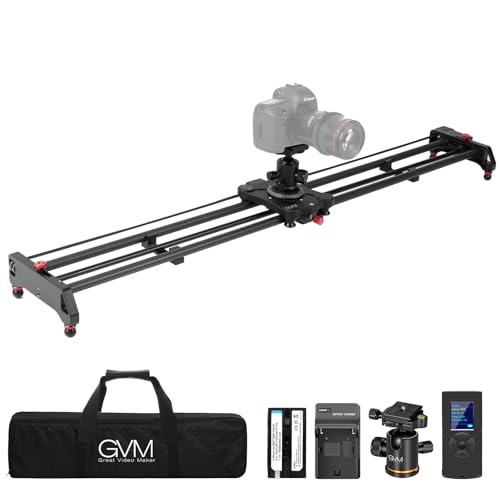
- 48-inch carbon-fiber travel
- 120-degree panoramic shooting mode
- Remote-programmable motion and time-lapse
Best For: Studio and location productions requiring extended programmed movement
Portable Wireless Carbon-Fiber Rail

- Six programmable shooting modes
- Bluetooth app control
- Carbon-fiber rail with adjustable legs and carry bag
Best For: Portable multi-angle video and time-lapse setups
Best All-Around Control
GVM 48-Inch Motorized Carbon Fiber Slider

- 20-pound stated maximum load recommendation
- App control and six shooting modes
- Adjustable legs with multiple mounting threads
Best For: Heavier camera setups needing long travel and flexible control
Best Compact Option
NEEWER ER1-80 31.5-Inch Motorized Slider

- 11-pound horizontal load capacity
- Silent motor with app and manual control
- Includes 4400mAh NP-F750 battery
Best For: Portable productions using smaller heavy-camera packages
Best Long-Travel Value
NEEWER ER1 47.2-Inch Motorized Slider

- 47.2-inch motorized travel
- 11-pound horizontal load rating
- Silent motor with app-controlled shooting modes
Best For: Long camera moves with moderate-weight cinema rigs
Best Long-Travel Motorized Option – NEEWER ER1 47.2-Inch Motorized Slider
If you need a camera slider for heavy cinema cameras and want extended travel, the NEEWER ER1 provides a 47.2-inch carbon-fiber rail with motorized movement. Its stated 11-pound horizontal capacity can suit heavier camera setups, though tilting reduces the limit to 5.5 pounds.
Best For: Longer tracking shots, time-lapse work, and heavier horizontal camera rigs.
Pros:
- Supports up to 11 pounds horizontally.
- App control, optional 2.4G remote support, video, manual, and time-lapse modes.
- Includes a 4400mAh NP-F750 battery and offers 1/4-inch and 3/8-inch mounting threads.
Cons:
- Charger is not included.
- Tilting capacity drops to 5.5 pounds.
- Minor shake may occur during macro photography.
This is the strongest fit in the group when both travel length and horizontal payload matter. Plan for a separate charger and verify the full rig weight before using the 45-degree tilt mode.
Best Lightweight Manual Pick – Zecti 24-Inch Carbon Fiber Slider
The Zecti is a compact manual option for buyers who prioritize portability over motorized control. For a camera slider for heavy cinema cameras, its 4.4-pound maximum recommendation makes it better suited to small cameras and lightweight builds than genuinely heavy cinema rigs.
Best For: Travel photography, compact cameras, smartphones, and lightweight video setups.
Pros:
- Lightweight 1.4-pound design with a carrying bag.
- Adjustable legs, non-slip feet, and a bubble level support setup on varied surfaces.
- Multiple 1/4-inch and 3/8-inch mounting holes enable horizontal, vertical, diagonal, and sideways use.
Cons:
- Maximum recommended load is 4.4 pounds.
- Product notes indicate movement may be noisy or uneven if screws are overtightened.
- Manual operation lacks automated motion and time-lapse control.
Choose this slider for a portable, budget-conscious manual setup rather than a heavy cinema package. Check the adjustment screws carefully to help maintain smoother movement.
Best Mid-Length Motorized Value – NEEWER ER1 31.5-Inch Slider
The 31.5-inch NEEWER ER1 balances manageable size with motorized control. As a camera slider for heavy cinema cameras, it offers the same stated 11-pound horizontal capacity as the longer ER1, while its shorter rail may be easier to transport and position in smaller shooting spaces.
Best For: Product videos, interviews, time-lapse scenes, and heavier horizontal rigs where a shorter rail is preferable.
Pros:
- Rated for up to 11 pounds horizontally and 5.5 pounds at a 45-degree tilt.
- App control, manual, video, and time-lapse shooting modes.
- Silent stepper motor, carbon-fiber construction, and included 4400mAh NP-F750 battery.
Cons:
- Charger is not included.
- 2.4G remote control is not included.
- Minor shake may occur during macro photography.
This is a practical middle ground for filmmakers who want automated movement without the footprint of a 47.2-inch rail. Keep heavy rigs horizontal unless their weight is comfortably within the lower tilt rating.
Best Aluminum Motorized Alternative – GVM 27-Inch Motorized Slider
The GVM 27-inch motorized slider combines aluminum-alloy construction with time-lapse, video, and automatic round-trip modes. For a camera slider for heavy cinema cameras, its 2.5-kilogram maximum recommendation is more limited than the NEEWER ER1 models, so it is better for lighter cinema or DSLR configurations.
Best For: Interviews, repeatable round-trip shots, and lighter DSLR or video-camera packages.
Pros:
- Supports horizontal, vertical, and 45-degree shooting.
- Offers time-lapse, video, and automatic round-trip modes.
- Multiple 1/4-inch and 3/8-inch mounting holes, adjustable feet, and a bubble level aid setup flexibility.
Cons:
- Maximum recommended load is 2.5 kilograms.
- At 2.36 kilograms, the slider itself is relatively heavy to transport.
- Its stated compatibility is aimed at DSLR cameras, video cameras, cellphones, and similar equipment rather than the heaviest cinema rigs.
The GVM is appealing when automated repeatable movement and multi-angle use are more important than maximum payload. Confirm your complete camera, lens, and accessory weight before selecting it for cinema work.
Compact App-Controlled Dolly – NEEWER DL400 Motorized Slider
For creators seeking a camera slider for heavy cinema cameras, the NEEWER DL400 is better suited to compact DSLR and mirrorless setups within its 6.6-pound load limit. Its quiet dual motors, app control, and included battery make it practical for mobile video and time-lapse work.
Best For: Compact Canon, Sony, Nikon, or Fujifilm camera setups needing quiet, wireless motion control.
Pros:
- Supports loads up to 6.6 pounds.
- Quiet dual-motor operation below 30 dB.
- App control, five speeds, and an included NP-F750 battery with up to five hours of runtime.
Cons:
- Its load rating may not suit larger cinema-camera configurations.
- Time-lapse photography requires a separately purchased shutter cable.
- Starting at the fastest speed uphill can cause shaking.
The DL400 offers a portable, relatively quiet motorized platform with useful 360-degree ball-head rotation and 90-degree tilt. Verify your camera, lens, and accessories stay within the 6.6-pound limit before choosing it for heavier rigs.
Long-Travel Professional Rail – GVM 48-Inch Motorized Camera Slider
When shopping for a camera slider for heavy cinema cameras, the 48-inch GVM provides a substantial carbon-fiber rail and multiple tripod connection points for professional production setups. Its remote supports programmable tracking, video, panoramic, and time-lapse movements.
Best For: Studio or location filmmakers who need long travel, programmable motion, and flexible tripod mounting.
Pros:
- 48-inch/120-centimeter carbon-fiber slider for extended camera movement.
- Supports tracking, horizontal, 120-degree panoramic, video, and time-lapse modes.
- Remote control offers adjustable endpoints, speed, dwell time, pauses, loops, and shot counts.
- Includes six shutter cables, an extension cable, and 1/4-inch and 3/8-inch ports.
Cons:
- At 5.42 kg, it is substantially heavier to transport.
- No specific maximum camera load is provided in the supplied details.
- It is not water resistant.
This GVM model stands out for its 120-centimeter travel and detailed remote programming, making it the most production-oriented option in this group. Because its maximum load is not specified, confirm compatibility with your complete cinema rig before purchase.
Portable Wireless Carbon-Fiber Rail – GVM 32-Inch Motorized Slider
The GVM 32-inch slider is a practical camera slider for heavy cinema cameras only when the full setup remains within its unspecified load capacity. It combines app-based programming, carbon-fiber construction, adjustable legs, and multiple mounting positions for flexible studio or location work.
Best For: Mobile creators and filmmakers who prioritize wireless control, portability, and multi-angle shooting.
Pros:
- Offers six shooting modes, including tracking, panoramic, time-lapse, and video.
- Bluetooth app control adjusts endpoints, speed, dwell time, and pauses.
- Eight-layer carbon fiber is designed for stability while keeping the slider portable.
- Includes adjustable legs, multiple 1/4-inch and 3/8-inch ports, a carry bag, and shutter cables.
Cons:
- The maximum supported camera load is not specified in the supplied details.
- Its approximately 32-inch travel is shorter than the 48-inch GVM model.
- Wireless operation depends on a compatible iOS or Android device.
This model balances portability and programmable movement, with vertical, horizontal, and 45-degree setup options. For heavy cinema rigs, check the manufacturer’s load guidance and account for the camera, lens, battery, and accessories together.
Best All-Around Control – GVM 48-Inch Motorized Carbon Fiber Slider
For filmmakers seeking a camera slider for heavy cinema cameras, the GVM-Slider-120 combines a 48-inch carbon-fiber rail with a stated 20-pound maximum load recommendation. Its app control, multiple shooting modes, adjustable legs, and 1/4-inch and 3/8-inch mounting points make it a flexible option for studio or location work.
Best For: Creators who need long travel, app-controlled motion, and support for heavier camera setups.
Pros:
- Stated maximum weight recommendation of 20 pounds.
- Supports tracking, panoramic, time-lapse, and video shooting modes.
- App control works with iOS and Android devices.
- Adjustable legs and multiple 1/4-inch and 3/8-inch ports support horizontal, vertical, and 45-degree setups.
Cons:
- Its 4 kg weight is less convenient for frequent transport than smaller sliders.
- Battery average life is listed as 2 hours.
- It is not water resistant.
The GVM stands out when load capacity and shooting flexibility matter most. Its longer rail and broad mounting options suit demanding motion-control setups, while the included carry bag helps with transport.
Best Compact Option – NEEWER ER1-80 31.5-Inch Motorized Slider
The NEEWER ER1-80 is a compact choice for users comparing a camera slider for heavy cinema cameras but working within an 11-pound horizontal load limit. Its silent stepper motor, app control, optional remote compatibility, and 31.5-inch travel suit smaller cinema or DSLR-style rigs and portable productions.
Best For: Mobile filmmakers who want motorized movement in a shorter, lighter carbon-fiber slider.
Pros:
- Supports up to 11 pounds horizontally and 5.5 pounds at a 45-degree tilt.
- Silent stepper motor provides smooth, low-noise movement.
- Offers manual, video, and time-lapse modes with app control.
- Includes a 4400mAh NP-F750 battery and supports USB-C power input.
Cons:
- The 11-pound capacity is lower than the GVM model in this roundup.
- The included battery charger is not included.
- The optional RT-08 remote control is not included.
Choose the ER1-80 when portability and quiet operation are more important than maximum payload or rail length. The 45-degree load limit should be checked carefully before using a heavier camera package on an incline.
Best Long-Travel Value – NEEWER ER1 47.2-Inch Motorized Slider
The NEEWER ER1 provides 47.2 inches of motorized travel for filmmakers evaluating a camera slider for heavy cinema cameras without moving to a larger 20-pound-rated system. It combines an 11-pound horizontal capacity with app control, time-lapse support, a silent stepper motor, and a carbon-fiber frame.
Best For: Shooters who want near-48-inch travel and quiet automated movement for moderate-weight rigs.
Pros:
- Provides 47.2 inches of travel for extended camera moves.
- Supports up to 11 pounds horizontally and 5.5 pounds when tilted 45 degrees.
- Offers manual, video, and time-lapse modes with app control.
- Includes a 4400mAh NP-F750 battery and has 1/4-inch and 3/8-inch mounting holes.
Cons:
- The 11-pound horizontal rating may not suit the heaviest cinema builds.
- The battery charger is not included.
- The optional 2.4G RT-08 remote is not included.
The ER1 is a sensible middle ground: it offers long travel and a quiet motor while remaining lighter than the GVM. Confirm the complete camera, lens, and accessory weight before relying on it for a heavy cinema configuration.
How We Picked the Best Camera Slider for Heavy Cinema Cameras
We focused on the specifications that matter most when a slider must support a substantial cinema setup: rail construction, stated payload capability, carriage stability, drive design, usable travel, and mounting options. We also considered whether each model supports motorized movement, app or remote control, time-lapse programming, and repeatable video passes.
Because listed capacity does not always reflect real-world smoothness, treat manufacturer limits as a ceiling rather than a target. Add the camera, lens, cage, battery, monitor, wireless transmitter, and other accessories before comparing your total rig weight. A generous safety margin generally produces better results and reduces strain on the motor and carriage.
Quick Comparison
| Feature | Why It Matters | What to Look For |
|---|---|---|
| Rail length | Determines maximum travel and framing flexibility | 24–32 inches for portability; 47–48 inches for longer moves |
| Construction | Affects stiffness, weight, and vibration control | Carbon fiber for lighter transport; aluminum for rigid, stable setups |
| Drive system | Controls repeatability and motion options | Motorized operation, adjustable speed, time-lapse, and loop modes |
| Power and control | Determines field convenience | App or remote control, removable batteries, and accessible charging |
| Mounting | Influences stability with heavier rigs | Solid tripod points and a carriage that accepts your camera plate |
Key Buying Factors for a Camera Slider for Heavy Cinema Cameras
Payload and Rigidity
Prioritize a rigid rail and stable carriage over a long feature list. Heavy cameras magnify flex and vibration, particularly at the center of a span. If you plan to use a long lens or accessories, support a longer slider at multiple points rather than relying on one tripod mount.
Length and Transport
A 24- to 32-inch slider is easier to carry and works well for tabletop shots, interviews, and compact locations. A 47- or 48-inch model creates more noticeable lateral movement but needs more room, stronger support, and additional setup time.
Motorized Control
Motorized sliders are useful for repeatable moves, time-lapse sequences, and slow cinematic passes. Check speed adjustment, direction control, round-trip operation, and whether the app or remote remains practical during a shoot. Manual sliders can be faster to deploy when you need simple, quiet repositioning.
Power, Noise, and Compatibility
Confirm battery type, runtime, charging requirements, and whether the motor introduces sound that could affect recorded dialogue. Also verify that the carriage plate, tripod thread, and camera mounting hardware work with your rig without requiring an unstable stack of adapters.
Who Should Buy Which Camera Slider for Heavy Cinema Cameras?
Choose a compact slider if you travel frequently, work in small spaces, or primarily use short travel moves. The 24- to 32-inch options are generally easier to pack and support.
Choose a 47- or 48-inch slider if you shoot product work, interviews, studio scenes, or establishing moves that benefit from extended travel. Plan for sturdier support and a larger operating footprint.
Choose a motorized model for time-lapse, repeatable takes, and controlled speed ramps. For a heavy cinema camera, select the model with the strongest practical support and the most suitable power system—not simply the longest rail or the most advertised modes.