
The right camera slider can turn a static shot into a controlled push-in, reveal, or time-lapse with far less effort. This roundup compares 10 options across compact, manual, motorized, and app-controlled designs.
Consider travel size, payload, motion control, mounting flexibility, and the type of camera you use before choosing a slider for your filmmaking kit.
Best 10 Camera Slider for Filmmaking Picks for 2026
Best Long-Track Motorized Pick
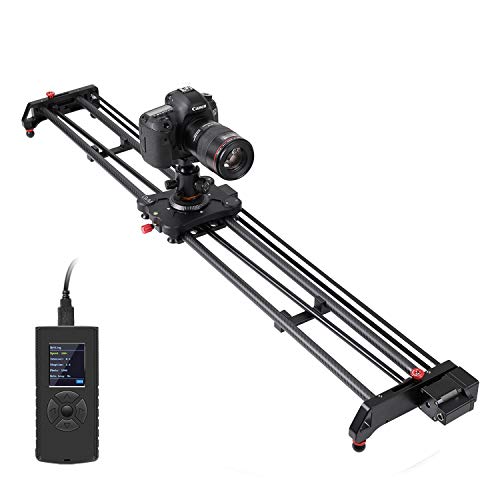
- 48-inch carbon-fiber travel length
- Programmable motorized and manual modes
- Includes battery, cables, remote, and bag
Best For: Automated long tracking shots and time-lapse production
Best Portable Manual Pick
Zecti 16-Inch Carbon Fiber Slider

- Compact 16-inch travel length
- Lightweight 600 g construction
- Adjustable legs and multiple mounting options
Best For: Traveling filmmakers using lightweight camera setups
Best App-Controlled Option
NEEWER ER1 31.5-Inch Motorized Slider

- App-controlled video and time-lapse modes
- Silent motor with 4400mAh battery
- Supports horizontal and 45-degree tilt shooting
Best For: Content creators and product-video workflows
Best Heavy-Duty Manual Pick

- Smooth ball-bearing slide mechanism
- Heavy-duty anodized aluminum platform
- Adjustable legs and tripod mounting options
Best For: Stable manual moves with heavier camera systems
Advanced Motorized Pick

- Eight-point programmable motion paths
- AI face and object tracking
- Quiet, stabilized multi-mode operation
Best For: Automated cinematic shots, interviews, and product videos
Best for Everyday Use

- Linear and circular wheel movement
- Quiet rubber wheels for tabletop use
- Compact 220g design with phone clamp
Best For: Portable phone, action-camera, and product shooting
Long-Rail Motorized Pick

- 48-inch/120cm carbon-fiber rail
- Six programmable shooting modes
- App control with adjustable mounting legs
Best For: Long tracking shots, time-lapse, and panoramic filming
Best Portable Rail Slider
NEEWER 16-Inch Carbon Fiber Camera Slider

- Four bearings deliver smooth, quiet manual movement
- Adjustable legs support varied shooting angles
- Includes ball head, phone clamp, and action-camera mount
Best For: Lightweight horizontal, vertical, or tilted camera moves
Best App-Controlled Slider
GVM 32-Inch Motorized Camera Slider

- Six modes include tracking, panoramic, time-lapse, and video
- App controls speed, endpoints, pauses, and dwell times
- Carbon-fiber rail supports multi-angle tripod setups
Best For: Programmable tracking shots and motion time-lapses
Best Long-Track Motorized Pick – GVM 48-Inch Motorized Slider
For filmmakers who want automated camera movement, the GVM 48-inch motorized slider is a feature-rich camera slider for filmmaking with programmable travel, time-lapse, panoramic, and tracking options. Its carbon-fiber rail, adjustable feet, and included battery make it suited to planned shots where smooth repeatable motion matters.
Best For: Long tracking shots, automated time-lapse work, panoramic moves, and filmmakers who need a generous 48-inch travel length.
Pros:
- Programmable start and end points, speed, interval, stop time, photo count, and auto looping.
- Supports manual and motorized operation, plus tracking, time-lapse, and panoramic shooting.
- Carbon-fiber construction, adjustable feet, and multiple 1/4-inch and 3/8-inch mounting ports.
- Includes a battery, charger, cables, remote, and carrying bag.
Cons:
- At 11.8 pounds and 48 inches long, it is less convenient for lightweight travel setups.
- It is not water resistant.
The GVM stands out when automated, extended camera movement is more important than portability. Its 5 kg maximum weight recommendation also gives it useful capacity for many camera setups, though its size makes it better suited to deliberate production work than quick run-and-gun filming.
Best Portable Manual Pick – Zecti 16-Inch Carbon Fiber Slider
The Zecti 16-inch is a compact manual camera slider for filmmaking designed for creators who value portability and flexible placement. Its carbon-fiber rails, adjustable legs, bubble level, and multiple mounting points support horizontal, vertical, and angled camera moves.
Best For: Travel filmmaking, lightweight DSLR or mirrorless setups, and creators who need a compact slider for ground or tripod use.
Pros:
- Lightweight 600 g design with a scratch-resistant carrying bag.
- Four precision bearings and a double interior carbon-fiber rail system support smooth movement.
- Removable adjustable legs, non-skid feet, and a bubble level help with positioning.
- Compatible with cameras, camcorders, mirrorless cameras, telephoto lenses, and smartphones with the appropriate holder.
Cons:
- Manual operation requires the user to control the camera movement.
- The supplied note warns that overtightened screws can cause noise or rough movement.
- The 4.4-pound maximum weight recommendation limits heavier camera builds.
With a 16-inch track and 1.3-pound listed weight, the Zecti is a practical choice when a full-size slider would be cumbersome. Check the adjustment screws before shooting, especially if the carriage feels noisy or does not move smoothly.
Best App-Controlled Option – NEEWER ER1 31.5-Inch Motorized Slider
The NEEWER ER1 is a versatile motorized camera slider for filmmaking that combines app control with manual and video modes. Its 31.5-inch carbon-fiber rail supports programmable movement, time-lapse shooting, 120-degree panoramas, and selected tilt setups, making it a strong fit for repeatable creator and product-video work.
Best For: Content creators, product videos, time-lapse photography, and shooters who want app-based control over camera movement.
Pros:
- App control supports manual, video, and time-lapse modes with adjustable speed, interval, and exposure.
- Silent stepper motor and four roller bearings are designed for smooth, quiet movement.
- Supports horizontal loads up to 11 pounds and 45-degree tilting loads up to 5.5 pounds.
- Includes a 4400mAh NP-F750 battery and offers 1/4-inch and 3/8-inch tripod mounting holes.
Cons:
- The 2.4G remote is not included.
- A 5V 2A Type-C portable charger is not included.
- Minor shake may occur during macro photography.
The ER1 offers a useful balance between automation and portability, with a folded size of 12 by 4 by 4 inches. It is especially appealing for repeatable motion and time-lapse workflows, but macro shooters should test the setup carefully for vibration.
Best Heavy-Duty Manual Pick – Fotodiox Pro SlideCam 800
The Fotodiox Pro SlideCam 800 is a professional-style manual camera slider for filmmaking, built around a ball-bearing slide mechanism and a double-layer anodized aluminum platform. Adjustable legs, a bubble level, and multiple mounting holes make it adaptable to flat-surface or tripod-based production setups.
Best For: Filmmakers using heavier camera systems who prioritize mechanical stability, flexible mounting, and smooth manual movement.
Pros:
- Ball-bearing slide system provides smooth mechanical movement horizontally or vertically.
- Double-layer anodized aluminum platform is designed for heavy-duty camera support.
- Adjustable legs, non-skid rubber feet, and a bubble level aid setup and alignment.
- Includes a carrying case and supports multiple 1/4-20 and 3/8-inch mounting points.
Cons:
- It is a manual slider, so movement is not motorized or programmable.
- The listed folded size is 4 by 6 by 43 inches, which may be less convenient for travel.
- It is not water resistant.
The SlideCam 800 is a solid choice when stability and compatibility with substantial camera systems take priority over automation. Its 32-inch format offers useful movement without the full 48-inch footprint of a longer slider, while the included case helps with transport.
Advanced Motorized Pick – IFOOTAGE Shark Nano II
For filmmakers who want automated, repeatable movement, the IFOOTAGE Shark Nano II is a feature-rich camera slider for filmmaking. Its 26-inch carbon-tube design combines multi-point programming, subject tracking, stabilization, and quiet motorized operation.
Best For: Cinematic tracking shots, interviews, product demonstrations, time-lapses, and macro work requiring precise automated movement.
Pros:
- Supports up to eight customizable motion points through the IPS touchscreen or Moco app.
- AI face and object tracking can help keep a subject centered.
- Quiet brushless motor, stabilization algorithms, and five shooting modes support varied production needs.
- Works with DJI gimbals through the included custom RS Adapter and supports USB-C PD 3.0 power.
Cons:
- Its advanced controls may be more than beginners need for simple manual slides.
- The supplied notes do not specify the maximum payload or complete included-accessory list.
The Nano II stands out when motion programming and automation matter more than a basic, lightweight setup. Its touchscreen and tracking features can reduce the need for extra control hardware on location.
Best for Everyday Use – NEEWER SD001 Camera Dolly
The NEEWER SD001 is a compact alternative to a full rail system for filmmakers seeking a portable camera slider for filmmaking. This manual tabletop dolly can travel in straight lines or circles, making it useful for controlled product, phone, and lightweight-camera movements.
Best For: Tabletop product videos, smartphone content, compact cameras, and portable straight-line or panoramic shots.
Pros:
- Adjustable wheels support linear or circular movement and panoramic shots.
- Soft rubber wheel rings provide smooth, quiet movement on floors, tables, and sliders.
- Includes a 360-degree rotating, 90-degree tilting ball head and a rotatable phone clamp.
- Pocket-sized aluminum construction weighs about 220g and supports up to 6.6 pounds.
Cons:
- It is manual, so it does not provide motorized repeatability or automated time-lapse movement.
- Not suitable for telephoto lenses.
- The action-camera adapter is sold separately.
Choose the SD001 when portability and flexible tabletop movement are priorities. Its wheel-angle adjustment adds creative options, while the compact form makes it easier to carry than a conventional rail slider.
Long-Rail Motorized Pick – GVM 48-Inch Motorized Slider
The GVM 48-inch motorized slider is a strong option for filmmakers who need longer travel from a camera slider for filmmaking. Its carbon-fiber rail, app control, adjustable legs, and multiple mounting points support tracking, panoramic, time-lapse, and vertical or angled setups.
Best For: Longer cinematic tracking shots, time-lapse work, panoramic movement, and productions using tripod-supported horizontal, vertical, or 45-degree positioning.
Pros:
- Provides a 48-inch/120cm motorized travel range for broad movement.
- Offers six shooting modes plus adjustable speed, interval, stop time, photo count, and looping.
- App control works through iOS or Android smartphones and tablets.
- Multiple 1/4-inch and 3/8-inch ports and adjustable legs support flexible mounting and leveling.
Cons:
- At about 4kg, it is less portable than a compact tabletop dolly.
- Battery life is listed at approximately two hours.
- It is not water resistant.
The GVM is most compelling when a long rail and programmable movement are more important than minimal carry weight. Its included carry bag and adjustable legs help with transport and setup, while app control keeps motion adjustments accessible from a mobile device.
Best Motorized Dolly – NEEWER 3-Wheels Wireless Video Camera Dolly
For filmmakers who want a compact camera slider for filmmaking with motorized movement, the NEEWER DL100 combines wireless controls with adjustable wheel positioning. It can move in straight or circular paths and supports horizontal, vertical, and creative bowl-head shooting setups.
Best For: Creators using cameras, smartphones, or action cameras who want portable, remotely controlled dolly movement.
Pros:
- Wireless remote adjusts direction, speed, and pause from up to 19.7 feet away.
- Three selectable speeds support controlled movement for different shots.
- Adjustable wheel angles enable straight-line or circular routes.
- Built-in 1800mAh battery provides up to six hours of service time.
Cons:
- Maximum recommended load is 6.6 pounds, so larger cinema setups may not be suitable.
- Accessories such as a smartphone holder and action-camera adapters are not included.
- The unit is not water resistant.
The DL100 is a practical choice when portability and remote-controlled movement matter more than having a conventional rail. Its adjustable wheel system is especially useful for creators experimenting with curved or circular camera paths.
Best Portable Rail Slider – NEEWER 16-Inch Carbon Fiber Camera Slider
The NEEWER CS1M is a compact camera slider for filmmaking designed for quiet, manual movement. Its 16-inch carbon-fiber rail, four bearings, adjustable legs, and included mounting accessories make it suitable for controlled shots in the studio or outdoors.
Best For: Lightweight setups using cameras, phones, or action cameras that need horizontal, vertical, or 45-degree sliding.
Pros:
- Four precision bearings provide smooth, noiseless sliding.
- Adjustable legs and a bubble level help with setup on uneven surfaces.
- Includes a 360-degree ball head, phone clamp, and action-camera mount.
- At 615g, it is easy to carry with the included storage bag.
Cons:
- Horizontal capacity is limited to 4.4 pounds, with lower limits for tilted or vertical use.
- The 16-inch rail provides less travel than longer sliders.
- Movement is manual rather than motorized.
The CS1M is a versatile pick for creators who value low weight and quiet operation. Its multiple mounting threads and included adapters make it especially flexible for mixed camera, phone, and action-camera kits.
Best App-Controlled Slider – GVM 32-Inch Motorized Camera Slider
The GVM 32-inch motorized camera slider is built for filmmakers who need programmable movement and longer travel. Its app control supports tracking, panoramic, time-lapse, and video modes, with adjustable start and end points, speed, pauses, and dwell times.
Best For: Studio, YouTube, film, and photography creators making repeatable tracking shots or motion time-lapses.
Pros:
- Six shooting modes provide flexible options for video and time-lapse work.
- Bluetooth app control allows detailed movement programming from iOS or Android devices.
- Multiple 1/4-inch and 3/8-inch ports support horizontal, vertical, and 45-degree setups.
- Carbon-fiber construction, adjustable legs, and a carry bag support portable use.
Cons:
- At 5 pounds, it is less lightweight than the shorter manual slider.
- App-based operation may be more involved than a simple manual rail.
- The supplied notes do not specify a maximum camera load or battery runtime.
The GVM offers the strongest control for repeatable camera moves among these options. Its longer rail and programmable app functions make it a good fit when cinematic tracking and time-lapse precision are priorities.
How We Picked the Best Camera Slider for Filmmaking
We evaluated these sliders by looking at the features that most directly affect real-world shooting: rail length, portability, drive system, motion consistency, payload suitability, mounting options, and included accessories. The selection covers short carbon-fiber tracks for compact cameras, longer rails for wider movement, manual systems for simplicity, and motorized models for repeatable moves and time-lapse work.
We also considered whether each design supports phones, action cameras, mirrorless bodies, or larger DSLR setups. A slider’s advertised length is only part of the story; usable travel, tripod compatibility, leveling, and how easily the unit can be transported can matter just as much.
Quick Comparison
| Type | Best For | Main Advantage | Potential Trade-Off |
|---|---|---|---|
| Compact manual slider | Travel and tabletop shots | Lightweight and quick to set up | Less automation |
| Long manual slider | Controlled cinematic moves | Simple, quiet operation | Requires manual consistency |
| Motorized slider | Repeatable video moves | Programmable motion | Needs power and setup |
| App-controlled slider | Time-lapse and solo shooting | Remote control and automation | More components to manage |
| Wheel-based dolly | Fast repositioning | Flexible movement on suitable surfaces | Surface quality affects results |
Key Buying Factors for a Camera Slider for Filmmaking
Length and Portability
Choose a rail length based on the movement you actually need. A 16-inch slider is easier to carry and works well for product shots, interviews, and compact setups. Rails around 26 to 32 inches offer a useful balance, while 48-inch models create longer moves but require more storage and support.
Manual or Motorized Control
Manual sliders are usually quieter, faster to deploy, and easier to use for spontaneous shots. Motorized models are better when you need consistent speed, programmed starts and stops, panoramic movement, or repeatable time-lapse sequences. Check battery and app requirements before buying.
Payload and Mounting
Confirm the slider can support your camera, lens, tripod head, cage, and accessories together. Look for stable mounting points and compatibility with a tripod or support system. Ball heads, phone clamps, and action-camera mounts add versatility but should not replace checking the total load rating.
Motion Quality and Setup
Ball-bearing carriages can provide smooth travel, while motorized rails add controlled speed. For professional-looking results, prioritize rigid construction, reliable leveling, low vibration, and enough support beneath longer rails.
Who Should Buy Which Camera Slider for Filmmaking?
Traveling creators and mobile shooters: Choose a compact carbon-fiber manual model for a lighter kit and fast setup.
Product and tabletop filmmakers: A short slider with a ball head, phone clamp, or action-camera mount offers convenient framing flexibility.
Solo filmmakers and time-lapse users: Select a motorized or app-controlled slider with repeatable movement and programmable controls.
DSLR and mirrorless users seeking longer moves: A 31.5-, 32-, or 48-inch rail can provide more dramatic travel, provided you have adequate support.
Budget-conscious beginners: Start with a manual dolly or bearing-based slider. It is simpler to learn, does not depend on batteries, and can reveal whether longer slider movement fits your shooting style before investing in automation.