
Camera lens adapters with focal reducers can do more than connect one mount to another. The right model can widen the effective field of view, increase light transmission, and help you use existing lenses or telescope accessories more efficiently.
This roundup includes camera-focused speed boosters for Canon EF, Micro Four Thirds, Fujifilm X, and Canon RF systems, plus telescope focal reducers for common 1.25-inch and dedicated optical setups. Use the buying guide below to narrow the choices by mount, optical purpose, and shooting style.
Best 10 Camera Lens Adapters with Focal Reducers Picks for 2026
Best M4/3 Speed Booster
VILTROX EF-M2 II 0.71x Adapter

- Adapts Canon EF lenses to Micro Four Thirds bodies
- Supports autofocus, aperture, EXIF, and IS functions
- Includes USB firmware upgrades and tripod foot
Best For: Micro Four Thirds users adapting Canon EF lenses
Best Astro Field Flattener
SVBONY SV193 0.8x Focal Reducer

- Combines 0.8x reduction with field flattening
- Designed for SV503 80ED and 102ED refractors
- Uses multi-coated optics and aluminum construction
Best For: Astrophotographers using compatible SV503 refractors
Best RF Cinema Adapter
Meike 0.71x EF-to-RF Speedbooster

- Adapts Canon EF lenses to compatible RF S35 and APS-C cameras
- Supports autofocus, aperture, anti-shake, and signal transmission
- Rotary lock and dustproof rubber ring aid usability
Best For: Canon RF S35 and APS-C users with compatible EF lenses
Best Budget Telescope Reducer

- Halves focal length for a significantly wider field
- Fits standard 1.25-inch eyepiece and photo adapters
- Uses fully multi-coated optics in a lightweight housing
Best For: Telescope users with compatible 1.25-inch accessories
Best Fuji X Focal Reducer
VILTROX EF-FX2 Pro 0.71x Adapter

- 0.71x reduction with approximately one extra stop
- Autofocus and camera-side aperture control
- USB firmware upgrade support
Best For: Fuji X users adapting Canon EF lenses
Best Telescope Imaging Reducer
SVBONY 0.5x 1.25 Focal Reducer

- 0.5x reduction for a wider telescope field
- Fully multi-coated two-element optics
- Metal body with M28.5x0.6 threads
Best For: Telescope observing and CCD photography
Best Micro Four Thirds Speed Booster

- Adapts Canon EF lenses to Micro Four Thirds
- Autofocus, aperture, and IS support
- USB updates and included tripod foot
Best For: Panasonic and Olympus M4/3 users with Canon EF glass
Compact C-Mount Telescope Booster
Astromania 0.5X C-Mount Reducer
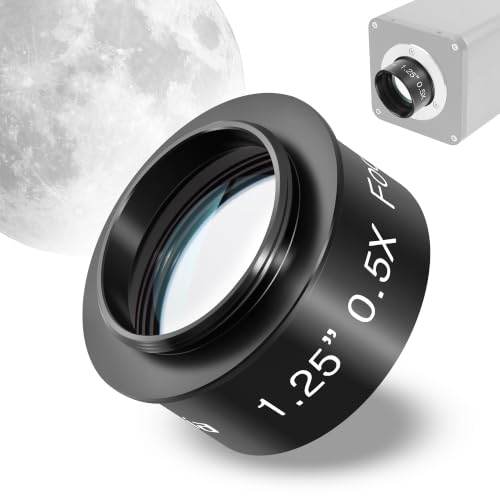
- 0.5x reduction with spacing-dependent results
- C-mount connection for compatible CCTV cameras
- 1.25-inch threading and 22.5mm clear aperture
Best For: Telescope imaging with C/CS-mount cameras
Best Heavy-Duty Pick

- Adapts Canon EF/EF-S lenses to Micro Four Thirds
- 0.71x reduction broadens the shooting range
- Electronic autofocus and aperture support
Best For: MFT users adapting Canon EF or EF-S lenses
1.25-Inch Astronomy Reducer
Astromania 0.5X Telescope Adapter

- Approximate 0.5x reduction at standard spacing
- Fits 1.25-inch eyepieces and camera adapters
- Threading on both sides for compatible accessories
Best For: Wider-field viewing and imaging with slower telescopes
Best M4/3 Speed Booster – VILTROX EF-M2 II 0.71x Adapter
If you need camera lens adapters with focal reducers for a Micro Four Thirds body, the VILTROX EF-M2 II connects Canon EF lenses while adding a 0.71x reduction. Its electronic contacts support autofocus, aperture control, EXIF transmission, and the lens’s IS function, making it a versatile option for adapting an existing EF collection.
Best For: Micro Four Thirds photographers using Canon EF lenses for wider framing, additional light, and electronic lens control.
Pros:
- 0.71x focal reduction can improve low-light performance and background blur.
- Supports autofocus, camera-controlled aperture, EXIF data, and IS functions.
- USB firmware upgrades and a built-in 1/4-inch tripod foot add practical flexibility.
Cons:
- Designed for Micro Four Thirds cameras and Canon EF lenses, not general-purpose mounting.
- Compatibility should be checked against the specific camera and lens combination.
Choose this adapter when electronic integration matters as much as focal reduction. Its broad listed Panasonic and Olympus compatibility makes it especially appealing for users who want to retain more of their EF lens functionality.
Best Astro Field Flattener – SVBONY SV193 0.8x Focal Reducer
The SVBONY SV193 is a telescope-focused choice among camera lens adapters with focal reducers. It combines 0.8x focal reduction with field flattening for compatible SV503 refractors, helping create a wider view, shorter focus, and cleaner star points toward the image edges.
Best For: Astrophotographers using SV503 80ED or 102ED refractors who want wider, flatter full-frame-ready imaging.
Pros:
- Combines 0.8x reduction with field flattening for refractor imaging.
- Supports wider views, shorter focus, and improved signal-to-noise potential.
- Offers multi-coated optics, a lightweight anodized aluminum body, and filter threading.
Cons:
- Compatibility is centered on SV503 80ED and 102ED telescopes.
- Requires attention to its 2-inch, M54x1, and M48x0.75 connection specifications.
This is the specialized pick for telescope imaging rather than a general camera-body adapter. Its field-flattening design and connection options make it a strong fit when edge star quality and accessory integration are priorities.
Best RF Cinema Adapter – Meike 0.71x EF-to-RF Speedbooster
For Canon RF S35 and APS-C systems, the Meike 0.71x is one of the more targeted camera lens adapters with focal reducers. It mounts Canon EF lenses to compatible RF cameras, reduces focal length by 0.71x, and supports autofocus, automatic aperture, and anti-shake functions.
Best For: Canon RF S35 and APS-C camera users adapting compatible Canon EF lenses for a wider, brighter setup.
Pros:
- 0.71x reduction can widen the view and increase aperture by about one stop.
- Supports autofocus, automatic aperture, anti-shake, and signal transmission.
- Rotary locking design helps speed lens changes, while the dustproof rubber ring adds protection.
Cons:
- Not compatible with RF full-frame cameras or EF-S APS-C lenses.
- Its compatibility is limited to specified RF S35 and APS-C camera bodies.
The Meike makes sense when you have the right RF camera and want to carry Canon EF glass into a smaller-format workflow. Confirming both camera format and lens type is essential before buying.
Best Budget Telescope Reducer – SVBONY 0.5x 1.25-inch Reducer
The SVBONY 0.5x is a compact telescope accessory for shoppers comparing camera lens adapters with focal reducers for eyepiece or astronomy-camera use. It fits standard 1.25-inch eyepiece and photo-adapter threads, cuts focal length in half, and expands the field of view for compatible setups.
Best For: Telescope users with standard 1.25-inch eyepieces or photo adapters who want wider framing and shorter astrophotography exposures.
Pros:
- 0.5x reduction substantially increases field of view and can shorten exposure times.
- Fits standard 1.25-inch accessories with M28x0.6 threads on both sides.
- Fully multi-coated optics and a lightweight black-anodized aluminum housing.
Cons:
- Not recommended for very fast telescopes or very wide-angle eyepieces for visual use.
- Manual-focus telescope accessory rather than an electronic camera lens adapter.
This reducer is a straightforward, lightweight option for compatible 1.25-inch astronomy equipment. Its strong reduction is useful for wider imaging, but users should follow the stated guidance for telescope speed and eyepiece angle.
Best Fuji X Focal Reducer – VILTROX EF-FX2 Pro 0.71x Adapter
For photographers building a Fuji X system around Canon EF glass, the VILTROX EF-FX2 Pro is one of the more feature-rich camera lens adapters with focal reducers. Its 0.71x optical reduction, electronic controls, and autofocus support are designed for compatible Fuji X-mount cameras.
Best For: Fuji X-mount users adapting Canon EF lenses who want autofocus, camera-side aperture control, and a wider effective field of view.
Pros:
- 0.71x focal reduction can provide a wider view and approximately one additional stop of aperture.
- Supports autofocus and camera-side control of aperture and other exposure settings.
- Lightweight 162g design with a USB port for firmware updates.
- Compatible with a broad range of listed Fuji X cameras.
Cons:
- Compatibility is specifically centered on Canon EF lenses and Fuji X-mount cameras.
- Electronic features may depend on firmware and lens-camera compatibility.
The EF-FX2 Pro is a practical choice when maintaining electronic lens communication matters as much as gaining focal reduction. Check the listed camera compatibility and firmware support before buying.
Best Telescope Imaging Reducer – SVBONY 0.5x 1.25 Focal Reducer
The SVBONY 0.5x 1.25 telescope focal reducer is a straightforward option for widening a telescope’s field of view. Among camera lens adapters with focal reducers, this model is aimed at telescope observing and photography rather than interchangeable-camera lens conversion.
Best For: Telescope users seeking a wider visual or imaging field with standard 1.25-inch equipment and compatible M28.5×0.6 threads.
Pros:
- 0.5x reduction substantially shortens the effective focal length for a wider field.
- Fully multi-coated optics are designed to improve contrast by reducing reflections.
- Metal construction with standard M28.5×0.6 threaded interfaces.
- Suitable for both visual use and CCD photography according to the supplied specifications.
Cons:
- Designed for telescopes and eyepieces, not Canon, Nikon, or mirrorless camera lens mounts.
- Manual-focus operation offers no electronic camera controls.
- Thread and equipment compatibility should be verified before purchase.
This reducer makes the most sense for telescope owners who prioritize a wider field and simple mechanical compatibility. Confirm that your eyepiece or imaging setup accepts its 1.25-inch and M28.5×0.6 interfaces.
Best Micro Four Thirds Speed Booster – VILTROX EF-M2 II 0.71x
The VILTROX EF-M2 II adapts Canon EF lenses to Micro Four Thirds cameras while adding 0.71x focal reduction. It stands out among camera lens adapters with focal reducers for combining autofocus, electronic aperture adjustment, image stabilization support, and firmware updating.
Best For: Micro Four Thirds users with compatible Panasonic or Olympus cameras who want to use Canon EF lenses with electronic control and a wider effective view.
Pros:
- 0.71x reduction can widen the field of view and increase the effective aperture by one stop.
- Provides autofocus and direct camera control of the adapted lens aperture.
- Includes electronic contacts, IS support, and a USB port for firmware upgrades.
- Metal bayonets and a 1/4-inch tripod foot add practical durability and support.
Cons:
- Limited to Canon EF lenses and compatible Micro Four Thirds cameras.
- Autofocus and stabilization performance can vary by lens and camera combination.
- Not weather-resistant according to the supplied specifications.
The EF-M2 II is a strong fit for M4/3 owners who already have Canon EF lenses and want more than a simple manual adapter. Verify your exact Panasonic or Olympus body and lens combination before relying on electronic functions.
Compact C-Mount Telescope Booster – Astromania 0.5X C-Mount Reducer
For buyers comparing camera lens adapters with focal reducers for telescope imaging, this Astromania model combines a 0.5x reduction factor with a C-mount connection. Its 1.25-inch filter-threaded side fits common telescope accessories, while spacing adjustments can change the resulting focal length and field of view.
Best For: Telescope users connecting C- or CS-mount CCTV cameras to longer-focal-ratio scopes, particularly refractors, Maksutovs, and Schmidt-Cassegrains around f/8 or slower.
Pros:
- 0.5x reduction can broaden the field of view and lower magnification.
- C-mount side supports compatible CCTV-style cameras.
- 1.25-inch filter thread and 22.5mm clear aperture suit many telescope setups.
- Coated two-lens design helps reduce chromatic aberration and internal reflections.
Cons:
- Compatibility is aimed at C/CS-mount cameras rather than interchangeable-lens camera systems.
- Performance and reduction depend on spacing, so additional spacers may be needed.
- Intended for longer focal-ratio telescopes and narrow-to-moderately wide fields.
This is a practical choice when your imaging chain already uses 1.25-inch telescope accessories and a C-mount camera. Confirm the camera thread and available spacing before buying, especially if you need a predictable reduction factor.
Best Heavy-Duty Pick – VILTROX EF-M2II 0.71x Adapter
Among camera lens adapters with focal reducers, the VILTROX EF-M2II is designed for using Canon EF and EF-S lenses on Micro Four Thirds cameras. Its 0.71x reducer broadens the effective shooting range, while electronic contacts support autofocus, aperture control, and lens-camera communication.
Best For: Micro Four Thirds owners adapting Canon EF or EF-S lenses who want a wider view, autofocus support, and adjustable aperture control.
Pros:
- 0.71x focal reduction helps broaden the field of view and reduce effective focal length.
- Supports Canon EF/EF-S lenses on listed Micro Four Thirds cameras.
- Electronic contacts provide autofocus and aperture adjustment options.
- Built-in USB interface allows firmware upgrades for compatibility with newer models.
Cons:
- Limited to the Canon EF/EF-S and Micro Four Thirds mount combination.
- Autofocus and other electronic functions depend on the specific lens and camera pairing.
- More system-specific than a simple mechanical adapter.
The EF-M2II is the strongest fit here for a conventional camera system rather than a telescope accessory setup. Check your exact Micro Four Thirds body and Canon lens combination before purchase, then use the firmware-update capability if support for newer equipment is required.
1.25-Inch Astronomy Reducer – Astromania 0.5X Telescope Adapter
If you need camera lens adapters with focal reducers for an astronomy setup, this Astromania 0.5x model is a straightforward 1.25-inch option. It can halve a telescope’s effective focal length at standard spacing, widening the view and increasing light per unit time for compatible visual or imaging configurations.
Best For: Users fitting 1.25-inch eyepieces or camera adapters to longer-focal-ratio telescopes and seeking a wider view for the Moon, nebulae, or open clusters.
Pros:
- Approximately 0.5x reduction can turn an f/10 scope into roughly f/5.
- 1.25-inch barrel fits standard eyepieces and telescope accessories.
- Threading on both sides supports compatible filters and other threaded accessories.
- Coated two-lens construction and a 22.5mm aperture support bright, corrected views.
Cons:
- Reduction varies with spacing, so the stated 0.5x result is not universal.
- Best suited to f/8 and slower telescopes and narrow-to-moderately wide fields.
- Manual, accessory-focused design does not provide camera autofocus or electronic control.
This reducer makes sense for a telescope owner who wants a simple, lightweight 1.25-inch path to a wider field and shorter exposures. Verify that your telescope, eyepiece or camera adapter, and filter accessories all use the required 1.25-inch standard.
How We Picked the Best Camera Lens Adapters with Focal Reducers
We grouped these 10 options by their intended use rather than treating every focal reducer as interchangeable. Camera speed boosters are evaluated primarily for mount compatibility, reduction factor, electronic communication, autofocus support, and build quality. Telescope reducers are considered separately because their threads, optical spacing, and field-flattening requirements differ from interchangeable-lens camera adapters.
We also looked for clear product specifications, practical use cases, and compatibility information. Because performance can vary by camera body, lens, telescope, and spacing, confirm the manufacturer’s supported combinations before ordering.
Quick Comparison
| Type | Typical reduction | Best for | Check before buying |
|---|---|---|---|
| EF to Micro Four Thirds | 0.71x | Using Canon EF lenses on M4/3 bodies | Body clearance, electronic functions, lens coverage |
| EF to Fujifilm X | About 0.7x | Expanding lens options on X-mount cameras | Autofocus and aperture compatibility |
| EF to Canon RF | 0.71x | Adapting EF lenses to RF cameras | Camera firmware and supported EF lenses |
| Telescope reducer | 0.5x–0.8x | Wider astronomical imaging fields | Thread size, back focus, and optical spacing |
Key Buying Factors for Camera Lens Adapters with Focal Reducers
Mount and Sensor Compatibility
Start with both sides of the connection: the lens mount and the camera mount. A Canon EF-to-Micro Four Thirds adapter is not suitable for RF or Fujifilm X bodies, even if the reducer value appears similar. Also verify that the reducer’s image circle covers your sensor without excessive vignetting.
Reduction Factor and Exposure Gain
A 0.71x reducer makes the effective focal length wider and typically concentrates more of the lens’s light onto the sensor. A 0.5x model creates a stronger reduction, but it may require more careful spacing and can introduce edge softness or vignetting. Treat advertised aperture gains as approximate and dependent on the lens and camera combination.
Electronic Functions
Some camera adapters pass electronic aperture control, EXIF data, or autofocus signals; others are fully manual. If you need reliable autofocus for video or moving subjects, choose a model that explicitly supports your camera system and lens type. Manual adapters can still be excellent for controlled photography, filmmaking, and astronomy.
Optical Quality and Spacing
Look for multi-element optics, field flattening where appropriate, and a secure locking mechanism. Telescope reducers are especially sensitive to back-focus distance. A reducer that fits the thread may still perform poorly if the spacing is wrong.
Who Should Buy Which Camera Lens Adapters with Focal Reducers?
Choose an EF-to-Micro Four Thirds speed booster if you already own Canon EF lenses and want a wider, brighter setup on a Panasonic or OM System-style body. An EF-to-Fujifilm X reducer makes sense for photographers building an X-mount kit around existing Canon glass. Pick an EF-to-RF model when moving from an older Canon DSLR lens collection to an RF mirrorless camera.
For astronomy, choose a 1.25-inch 0.5x reducer for a broader field with compatible telescope accessories, while a dedicated field flattener is better when edge correction matters with a specified telescope. If you are uncertain, prioritize exact thread, sensor, lens, and back-focus compatibility over the lowest price or strongest reduction.