
The right lens adapter can expand your camera kit without requiring a complete new set of lenses. Models with aperture control are especially useful when adapting older or third-party lenses that lack electronic communication with the camera body.
We selected 10 adapters covering popular Nikon F, Canon EF, Pentax K, Sony E, Canon RF, Micro Four Thirds, and C-mount combinations. The guide below explains the key compatibility, control, and performance factors to check before buying.
Best 10 Camera Lens Adapters with Aperture Control Picks for 2026
Electronic Nikon-to-Sony Choice

- Electronic aperture control from the Sony body
- Phase-detection autofocus on compatible cameras
- EXIF and VR support
Best For: Sony E-mount photographers adapting Nikon F lenses
Canon RF Electronic Adapter

- Direct camera-side aperture control
- Autofocus and stabilization support
- Works with Canon EF and EF-S lenses
Best For: Canon EOS R-series users with EF/EF-S lenses
Manual Nikon-to-RF Adapter
PHOLSY LensAdapter for Canon RF

- Manual aperture ring for Nikon G lenses
- Supports a broad range of Nikon F variants
- No glass and infinity focus capability
Best For: Canon RF users shooting Nikon lenses manually
Simple Pentax-to-Sony Adapter

- Built-in mechanical aperture dial
- Supports Pentax K AF to Sony E
- Infinity focus capability
Best For: Sony E-mount users adapting Pentax K AF lenses
Budget Macro Starter
Fotodiox 52mm Nikon Reverse Ring Kit

- Mechanical aperture control for Nikon G and DX lenses
- Reverses 52mm-threaded lenses for extreme macro
- Includes UV filter, cap, and two-year warranty
Best For: Nikon users starting manual reverse-lens macro photography
Flexible Nikon-to-Sony Adapter
K&F Concept Nikon F to Sony E Adapter
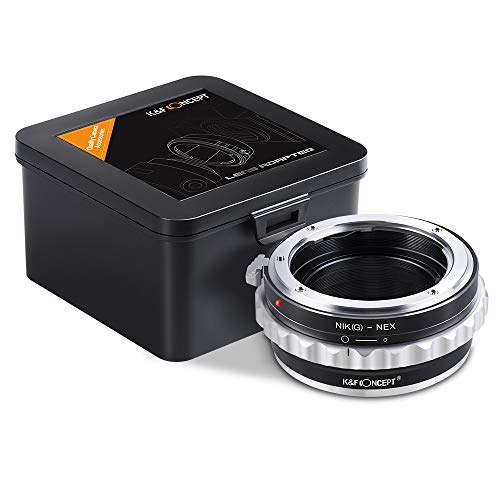
- Adapts Nikon G, F, AI, and AIS lenses to Sony E
- Aperture control ring for compatible G lenses
- Supports infinity focus and manual metering
Best For: Sony E-mount users adapting Nikon manual lenses
Pentax-to-Fuji Manual Control
K&F Concept PK/DA to FX Adapter

- Adapts Pentax K-family lenses to Fujifilm X bodies
- On/off aperture control ring for manual settings
- All-metal construction with infinity focus support
Best For: Fuji X users adapting Pentax K-mount lenses manually
Professional C-Mount Control

- Manual aperture dial for Nikon G lenses
- All-metal, high-tolerance construction
- Supports infinity focus on C-mount cameras
Best For: Cine, CCTV, machine-vision, and microscope setups
Wider, Faster M4/3 Setup
VILTROX Nikon G/D Speed Booster

- 0.71x focal reducer widens the view
- Adds one stop of aperture
- Manual aperture ring and focus control
Best For: M4/3 users adapting Nikon lenses for low-light shooting
Vintage Lens Flexibility
Fotodiox Nikon G to Canon EF Adapter
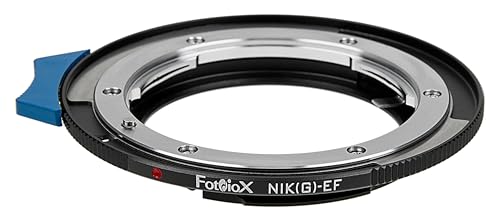
- Fits Canon EF and EF-S cameras
- Built-in aperture dial for G-type lenses
- All-metal build with infinity focus
Best For: Canon users adapting Nikon lenses manually
Electronic Nikon-to-Sony Choice – VILTROX NF-E1
If you want camera lens adapters with aperture control while retaining more electronic functionality, the VILTROX NF-E1 connects Nikon F lenses to Sony E-mount mirrorless cameras. It supports body-controlled aperture adjustment, phase-detection autofocus on compatible cameras, VR, and EXIF transmission.
Best For: Sony E-mount users adapting Nikon F lenses who want electronic aperture control and added camera communication.
Pros:
- Supports aperture control from compatible Sony camera bodies.
- Provides phase-detection autofocus on supported cameras.
- Transmits aperture, shutter speed, and exposure information through EXIF.
- Includes VR support and a durable aluminum-alloy build with a tripod screw.
Cons:
- Autofocus is limited to compatible phase-detection cameras.
- Compatibility is specific to Nikon F lenses and Sony E-mount cameras.
The NF-E1 is the more feature-oriented option here, especially for photographers who want to preserve stabilization and camera-readable lens data instead of relying entirely on manual operation.
Canon RF Electronic Adapter – EF-EOS R Mount Adapter
Lens Mount Adapter EF-EOS R for Canon EF/EF-S Lens to Canon EOS R RP R5 R6 R7 R10 Cameras
Check Price On AmazonThis EF-EOS R adapter is designed for Canon users who want camera lens adapters with aperture control for EF and EF-S lenses. It supports direct aperture adjustment from the camera, autofocus, image stabilization, and transmission of shutter, aperture, and ISO data.
Best For: Canon EOS R-series owners looking to use EF or EF-S lenses with electronic exposure and focusing functions.
Pros:
- Compatible with Canon EOS R, RP, R5, R6, R7, and R10 cameras.
- Allows aperture control directly from the camera side.
- Supports autofocus, stabilization, and EXIF signal transmission.
- Uses metal mounts and a dust- and water-resistant design.
Cons:
- Compatibility is limited to the listed Canon RF camera family and EF/EF-S lenses.
- Specific performance may vary by camera and lens combination.
For Canon mirrorless owners with an existing EF lens collection, this adapter focuses on maintaining familiar electronic controls rather than adding a manual-only conversion step.
Manual Nikon-to-RF Adapter – PHOLSY LensAdapter for Canon RF
The PHOLSY LensAdapter is a manual option among camera lens adapters with aperture control, pairing Nikon F, G, and related lenses with Canon RF cameras. Its built-in aperture ring gives Nikkor G lenses manual control, while the adapter preserves infinity focus without adding glass.
Best For: Canon RF photographers using Nikon or vintage lenses who prefer a mechanical aperture ring and fully manual shooting.
Pros:
- Supports Nikon G, F, AI, AIS, D, and AF-S lenses on Canon RF cameras.
- Built-in progressive-damping aperture ring enables manual aperture adjustment.
- No electronic contacts or glass, so there is no added optical degradation.
- Uses a lightweight aviation-grade aluminum and magnesium-alloy construction.
Cons:
- Does not provide autofocus.
- Settings must be adjusted manually.
- Electronic lens communication and EXIF transmission are not provided.
This adapter is a straightforward choice for deliberate, manual work: it offers aperture control and infinity focus while leaving autofocus and electronic metering features out of the design.
Simple Pentax-to-Sony Adapter – Fotodiox PKAF-SnyE
For Pentax K AF owners seeking camera lens adapters with aperture control, the Fotodiox PKAF-SnyE provides a mechanical bridge to Sony E-mount mirrorless cameras. Its built-in aperture dial supports manual aperture adjustment and infinity focus without relying on electronic communication.
Best For: Sony E-mount users adapting Pentax K AF lenses for manual aperture-controlled photography.
Pros:
- Designed for Pentax K AF lenses and Sony E-mount mirrorless bodies.
- Includes a built-in mechanical aperture control dial.
- Allows infinity focus or beyond.
- Anodized aluminum construction supports durability and includes a two-year limited warranty.
Cons:
- Provides mechanical aperture control rather than electronic aperture communication.
- The supplied notes do not indicate autofocus or EXIF transmission support.
The PKAF-SnyE keeps the conversion uncomplicated, making it suitable when the main requirement is adapting Pentax K AF glass to Sony E with a convenient physical aperture dial.
Budget Macro Starter – Fotodiox 52mm Nikon Reverse Ring Kit
If you want camera lens adapters with aperture control for inexpensive macro work, this Fotodiox kit is designed for Nikon F-mount cameras and lenses with a 52mm filter thread. It reverses the lens for extreme close-ups and includes the key accessories needed to get started.
Best For: Nikon users seeking a low-cost route into manual reverse-lens macro photography.
Pros:
- Provides mechanical aperture control for G and DX-type lenses.
- Reverse mounting enables extreme macro photography.
- Includes a 52mm UV filter and protective cap.
- Backed by a limited two-year manufacturer warranty.
Cons:
- Only fits lenses with a 52mm filter thread.
- Requires manual focus and offers no image stabilization.
- Designed specifically for Nikon F-mount cameras.
This is a focused, affordable macro accessory rather than a general-purpose adapter. Confirm your lens has a 52mm filter thread before buying, then use the included filter and cap for added convenience.
Flexible Nikon-to-Sony Adapter – K&F Concept Nikon F to Sony E Adapter
This K&F Concept adapter is one of the camera lens adapters with aperture control built for mounting Nikon G, F, AI, and AIS lenses on Sony E-mount and NEX bodies. Its aperture control ring and manual metering support make it useful for adapting older Nikon glass.
Best For: Sony E-mount users adapting Nikon G or F lenses while retaining manual aperture adjustment.
Pros:
- Supports Nikon G, F, AI, and AIS lenses on Sony E-mount cameras.
- Includes an aperture control ring for compatible Nikon G lenses.
- Allows infinity focus and supports AE priority or manual stop-down metering.
- Smooth surface is designed for effortless mounting.
Cons:
- Manual adapter operation does not provide autofocus or automatic diaphragm control.
- The aperture ring cannot be used with Nikon AI lenses according to the supplied notes.
- Not compatible with Sony a7S, a7 II, a7S II, or a7R II.
Its broad Nikon lens compatibility and aperture ring make it a practical manual-adaptation option, but camera compatibility is especially important here. Check your Sony body and Nikon lens type before ordering.
Pentax-to-Fuji Manual Control – K&F Concept PK/DA to FX Adapter
For photographers comparing camera lens adapters with aperture control for Fujifilm X cameras, this K&F Concept model connects Pentax K, PK, AF, PK DA, and A-mount lenses to Fuji X-series mirrorless bodies. Its on/off aperture control ring supports manual exposure with compatible lenses.
Best For: Fujifilm X-series users who want to adapt Pentax K-mount lenses with manual aperture control.
Pros:
- Fits Pentax K, PK, AF, PK DA, and A-mount lenses.
- Includes an on/off aperture control ring.
- Supports infinity focus.
- Uses an all-metal anodized aluminum and heavy-grade brass construction.
Cons:
- Manual operation does not support autofocus or automatic diaphragm control.
- Designed for Fujifilm X-series mirrorless cameras, not a universal mount.
- Manual aperture adjustment may require adapting to the lens and adapter controls.
This adapter is a solid choice when your priority is mounting Pentax K-family lenses on a Fuji X body while retaining a dedicated aperture-control feature. Verify both mounts before purchase and expect fully manual operation.
Professional C-Mount Control – Nikon G to C-Mount Adapter
Fotodiox Pro Lens Mount Adapter Compatible with Nikon F-Mount G-Type Lenses to C-Mount Cameras
Check Price On AmazonFor buyers seeking camera lens adapters with aperture control for cine, CCTV, machine-vision, or microscope setups, this Fotodiox Pro adapter connects Nikon F-mount G-type lenses to C-mount cameras. Its integrated dial provides manual aperture adjustment, while the all-metal construction is designed for a precise, secure fit.
Best For: Professionals using Nikon G lenses on C-mount cine, CCTV, machine-vision, or microscopy cameras.
Pros:
- Built-in aperture control dial for manual adjustment.
- Supports infinity focus.
- High-tolerance, all-metal construction with a chrome-plated brass mount.
- Designed for a solid connection with no reported play, gaps, or wiggling.
Cons:
- Manual operation disables autofocus, automatic exposure metering, and image stabilization.
- Compatibility is limited to Nikon F-mount G-type lenses and C-mount cameras.
- Requires manual focusing and exposure control.
This is a purpose-built option when mechanical reliability and aperture control matter more than electronic communication. The adjustable lens orientation and professional construction make it particularly suited to demanding fixed-camera and specialty imaging applications.
Wider, Faster M4/3 Setup – VILTROX Nikon G/D Speed Booster
The VILTROX NF-M43X is one of the more feature-rich camera lens adapters with aperture control for Nikon G and D lenses on Micro Four Thirds cameras. Its 0.71x focal reducer widens the effective view and increases maximum aperture by one stop, while the built-in ring provides manual exposure control.
Best For: Micro Four Thirds users who want to adapt Nikon lenses while gaining a wider field of view and improved low-light capability.
Pros:
- 0.71x focal reduction provides a wider field of view.
- Increases maximum aperture by one stop.
- Built-in aperture ring offers eight manual aperture settings.
- Maintains infinity focus and uses four groups of five optical-glass elements.
Cons:
- Manual focus and manual exposure are required.
- Provides no image stabilization.
- Limited to compatible Nikon G/D and Micro Four Thirds mount combinations.
Choose this adapter when the speed-booster effect is as important as mounting compatibility. It adds optical functionality beyond a simple mechanical adapter, but its fully manual design is best suited to photographers and filmmakers comfortable controlling focus and exposure themselves.
Vintage Lens Flexibility – Fotodiox Nikon G to Canon EF Adapter
This Fotodiox adapter lets Canon EOS EF and EF-S camera users mount Nikon F-mount G-type lenses, making it a practical choice among camera lens adapters with aperture control. Its built-in aperture dial allows manual control of G-type lenses, while the all-metal design supports infinity focus and a secure fit.
Best For: Canon EF or EF-S users who want to use Nikon G lenses and explore the character of vintage or manual-focus glass.
Pros:
- Compatible with Canon EOS EF and EF-S mount cameras.
- Built-in aperture dial controls Nikon G-type lenses.
- All-metal construction provides a solid connection.
- Allows infinity focus and supports a broad range of prime and zoom lenses.
Cons:
- Manual focus and manual exposure control are required.
- Electronic camera functions are not provided by this mechanical adapter.
- Compatibility is limited to the specified Nikon F and Canon EF/EF-S mounts.
This adapter is a straightforward way to expand a Canon system with Nikon F-mount G lenses. It is most appealing for photographers who value lens character and hands-on aperture control rather than autofocus or automated exposure features.
How We Picked the Best Camera Lens Adapters with Aperture Control
We focused on adapters that provide a practical way to use legacy lenses on newer camera bodies while retaining or adding usable aperture control. The selection includes electronic adapters with autofocus and EXIF transmission, manual adapters with built-in aperture rings, speed boosters, macro accessories, and options for specialized mounts.
Compatibility was the first filter: the lens mount, camera mount, lens type, and control method must all match. We also considered whether each design is intended for full-frame or crop-sensor use, whether it supports G-type lenses without an aperture ring, and whether it offers electronic communication or only mechanical operation.
Quick Comparison
- Best for electronic features: VILTROX NF-E1 for Nikon F lenses on Sony E cameras.
- Best for Canon RF users: EF-EOS R adapters for Canon EF and EF-S lenses.
- Best for manual Nikon G lenses: K&F Concept and Fotodiox G-to-Sony or G-to-Canon options.
- Best for extra light and wider framing: VILTROX NF-M43X 0.71x speed booster.
- Best for close-up experiments: Fotodiox 52mm macro reverse ring kit.
Key Buying Factors for Camera Lens Adapters with Aperture Control
Mount Compatibility
Confirm both sides of the adapter before ordering. “Nikon F to Sony E,” “Canon EF to RF,” and “Pentax K to Fujifilm X” are different configurations, and an adapter designed for one direction will not necessarily work in reverse.
Electronic Versus Manual Control
Electronic adapters may support autofocus, aperture adjustment from the camera, EXIF data, and image stabilization communication, but performance varies by lens and camera firmware. Manual adapters generally cost less and can be dependable, but aperture, focus, and exposure may need to be set directly on the lens or adapter.
Lens Type and Aperture Operation
Nikon G-type lenses and some modern lenses lack a traditional aperture ring, so they need an adapter with a mechanical control ring or electronic support. Check how precisely the ring operates and whether it provides marked or clickless settings.
Crop Factor, Clearance, and Optical Design
A basic adapter should preserve the lens’s intended angle of view only when the camera format is appropriate. Speed boosters reduce the effective focal length and can add light, but they introduce extra optics and require careful checking for coverage, sharpness, and clearance.
Who Should Buy Which Camera Lens Adapters with Aperture Control?
Choose an electronic adapter if autofocus, camera-controlled aperture, stabilization, or EXIF recording matters. Choose a manual adapter if you mainly shoot still subjects, video, or adapted vintage lenses and prefer a simpler, lower-cost setup. Choose a speed booster when you use Nikon lenses on Micro Four Thirds and want a wider field of view with a brighter effective aperture. Choose a macro reverse ring for experimental close-up photography rather than general-purpose lens mounting.
Before purchase, verify the exact camera model, lens version, sensor format, and desired control features. Also check for firmware requirements, autofocus limitations, infinity-focus support, and possible physical interference between the adapter, lens, and camera body.