
Great food photos depend on shape, texture, and color—and the right flash can make all three easier to control. This roundup compares 10 compact speedlights, mini flashes, and macro ring flashes suited to tabletop shooting.
Whether you photograph recipes at home, create restaurant content, or need consistent lighting for a food blog, the best choice depends on power, control, compatibility, and how closely you work to the subject.
Best 10 Camera Flashes for Food Photography Picks for 2026
Best Macro Ring Flash

- Even ring lighting helps reduce harsh food-photo shadows
- 11 manual brightness levels for controlled exposure
- Eight adapter rings fit 49–77mm lens threads
Best For: Close-up food and macro photography
Best Universal Manual Flash

- GN33 output gives useful reach for indoor food setups
- Eight power levels from 1/128 to full power
- S1/S2 optical modes support off-camera lighting
Best For: Manual tabletop and product photography
Best Ultra-Compact Flash

- Weighs just 0.07 pounds for highly portable shooting
- Built-in battery supports 500+ full-power flashes
- Four manual power levels with 97+ CRI color rendering
Best For: Portable close-range food and still-life photography
Compact Rechargeable Pick

- 20Ws output with 1/128-to-1/1 manual adjustment
- Built-in battery rated for up to 650 full-power flashes
- Lightweight design with S1/S2 optical slave modes
Best For: Portable tabletop food photography with manual exposure
Ultra-Lightweight Pick
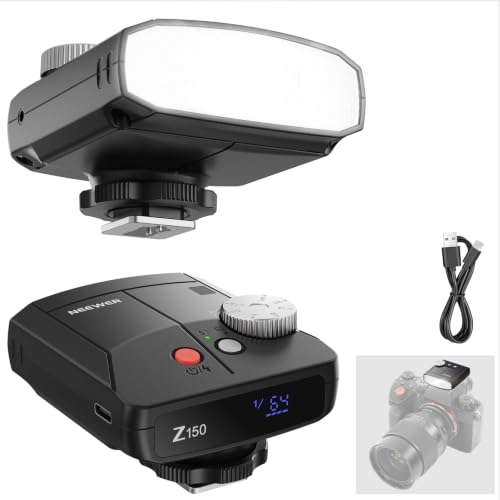
- Pocket-sized 3.6-ounce manual flash
- Built-in battery rated for up to 640 full-power flashes
- S1/S2 optical slave modes for simple wireless triggering
Best For: Close-up food shots and lightweight travel kits
Versatile Creator Pick

- 40W CRI 96+ COB light with soft diffuser
- Stepless brightness and bi-color adjustment
- Built-in phone/camera holder and rechargeable battery
Best For: Food creators shooting photos, videos, and social content
Compact Manual Pick
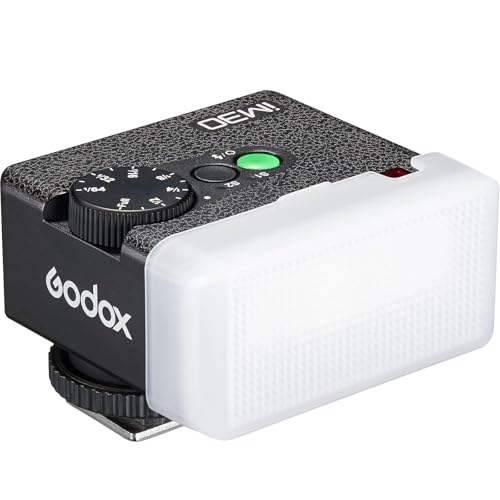
- GN15 output with seven manual power levels
- Includes diffuser for softer tabletop lighting
- 78g body with up to 230 flashes on two AAA batteries
Best For: Simple, portable food photography setups
Long-Running Budget Pick
NEEWER Z120 SE Manual Speedlite
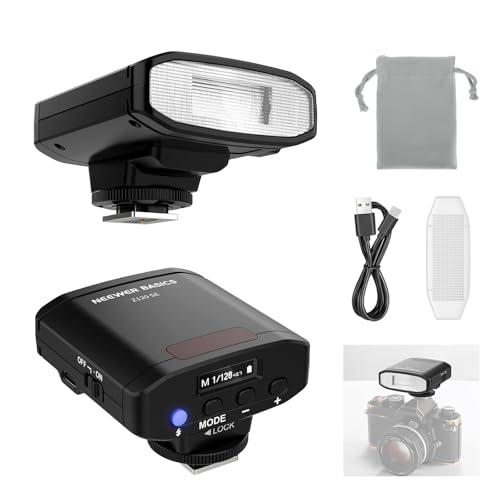
- Up to 500 full-power flashes from a 2000mAh battery
- GN12 output with 1/128–1/1 manual adjustment
- 5600K light, diffuser, and S1/S2 optical slave modes
Best For: Manual food photography with long shooting sessions
Best Macro Ring Flash – Godox ML150 II
For photographers looking at camera flashes for food photography, the Godox ML150 II offers surrounding, softened illumination that can reveal texture while reducing harsh shadows. Its manual controls and broad adapter-ring selection make it a practical choice for close-up tabletop work.
Best For: Macro food photography, close-ups, flowers, insects, portraits, and dental photography.
Pros:
- Ring-shaped lighting helps provide shadowless, even illumination around the lens.
- Diffuser softens the light, while 11 brightness levels support fine manual adjustment.
- Includes eight adapter rings for 49–77mm lens filter threads.
- Single-contact hot shoe is compatible with many camera systems.
Cons:
- Manual exposure control does not provide automatic TTL metering.
- Requires four AA batteries.
- Flash sync speed is listed at 1/200 second.
The ML150 II is a focused option when even, close-range lighting matters more than high-power off-camera versatility. Its included rings and straightforward controls are especially useful for food shots made at macro distances.
Best Universal Manual Flash – PHOTOOLEX FK300 Speedlite
The PHOTOOLEX FK300 is a straightforward speedlite for camera flashes for food photography when you want adjustable output and a standard hot-shoe fit. Its manual, S1, and S2 modes support simple on-camera or optical off-camera lighting for tabletop setups.
Best For: Food and product shots, indoor portraits, events, and basic multi-light setups across many camera brands.
Pros:
- GN33 output provides more reach than many entry-level mini flashes.
- Eight power levels range from 1/128 to full power for fill or stronger illumination.
- S1 and S2 optical modes enable off-camera triggering without a dedicated radio trigger.
- Includes a stand, pouch, and 12 color filters, plus a 24-month warranty.
Cons:
- Manual exposure control does not include TTL automation.
- Optical wireless triggering can require compatible line-of-sight setups.
- Not water resistant.
Choose the FK300 if you need a versatile, budget-oriented manual speedlite for food scenes and general photography. Its universal single-contact shoe is convenient, but camera compatibility should still be confirmed before purchase.
Best TTL Ring Flash for Sony – NEEWER RF1-S Macro Ring Flash
For Sony users comparing camera flashes for food photography, the NEEWER RF1-S combines TTL exposure with independently controlled ring tubes. Its broad 80-degree coverage can brighten small dishes evenly while helping minimize harsh shadows and vignetting.
Best For: Sony macro food photography, studio detail shots, plants, insects, and other close-up subjects.
Pros:
- TTL, manual, and MULTI modes accommodate automatic, controlled, and stroboscopic lighting.
- A/B flash tubes can be used independently or together to shape contrast.
- 1/1–1/128 manual output range and adjustable tube ratios support precise control.
- Includes focus-assist lights, four color gels, and eight lens adapter rings.
Cons:
- Designed for Sony Alpha cameras rather than universal compatibility.
- Requires four AA batteries and is not water resistant.
- Ring-flash design is specialized for close-up work.
The RF1-S is the most feature-rich choice here for Sony photographers who want both TTL convenience and directional control around the lens. Its adapter rings and focus lights further suit detailed tabletop compositions.
Best Ultra-Compact Flash – ULANZI SL01 Mini Flash
The ULANZI SL01 is a minimalist option among camera flashes for food photography, suited to portable still-life and tabletop work. Its low weight, built-in battery, and four manual power levels make it easy to carry when a small fill flash is more useful than high output.
Best For: Portable food, still-life, documentary, and casual tabletop photography with a single-contact hot shoe.
Pros:
- Ultra-light 0.07-pound design is convenient for travel and extended shooting.
- Built-in 250mAh battery provides more than 500 full-power flashes per charge.
- USB-C charging takes about 60 minutes and supports use while charging.
- 97+ CRI and four manual power settings support consistent color and basic exposure control.
Cons:
- No TTL or automatic exposure control.
- GN8 output is limited compared with larger speedlites.
- Compatibility depends on a single-contact hot shoe, and the charger and cable are not included.
The SL01 makes sense when portability and convenience are priorities for small food scenes. Its modest GN8 output is better suited to nearby subjects or fill light than large sets or long-distance illumination, so verify the camera’s hot-shoe compatibility carefully.
Compact Rechargeable Pick – NEEWER Z160 SE Manual Flash
If you want a small, rechargeable option among camera flashes for food photography, the NEEWER Z160 SE offers adjustable manual output in a lightweight body. Its 20Ws output, 35mm fixed focal length, and optical slave modes can suit simple tabletop setups, provided you are comfortable setting exposure manually.
Best For: Food photographers who want a compact on-camera or optical-slave flash with a built-in battery.
Pros:
- Built-in 1200mAh battery supports up to 650 full-power flashes.
- Manual output ranges from 1/128 to 1/1 for controlling tabletop lighting.
- Lightweight 5.3-ounce design and S1/S2 optical slave modes support portable setups.
Cons:
- No TTL, HSS, automatic flash exposure, or camera-menu control.
- Limited to a fixed 35mm focal length and approximately 2.8-second recycle time.
- Requires a standard center-contact hot shoe and mechanical shutter on compatible mirrorless cameras.
The Z160 SE is a practical choice for controlled food scenes where repeatable manual exposure matters more than automation. Confirm your camera’s hot-shoe compatibility before ordering, and note that the USB power adapter is not included.
Flexible Lighting Pick – NEEWER TT560 Speedlite
For food photographers who need more output and bounce control, the NEEWER TT560 is a traditional manual speedlite with a GN38 rating. Its tilting and rotating head makes it useful for directing light toward a ceiling, wall, or modifier during tabletop work, although exposure must be adjusted on the flash itself.
Best For: Photographers building a budget-friendly manual food-lighting setup with bounce or off-camera options.
Pros:
- GN38 output provides more reach than the compact 20Ws models in this roundup.
- Flash head tilts from 0° to 90° and rotates from 0° to 270° for bounce lighting.
- Supports eight manual power levels, S1/S2 optical slave modes, and PC sync.
Cons:
- No TTL, HSS, automatic exposure, or camera-menu control.
- Requires four AA batteries, which are not included.
- Shutter speeds should be set to 1/200 second or slower for reliable synchronization.
The TT560 is the stronger choice when flexible head positioning and higher output are more important than a built-in rechargeable battery. It can work well for food photography, but expect a more hands-on workflow when balancing flash power, ISO, aperture, and shutter speed.
Ultra-Lightweight Pick – NEEWER Z150 Mini Flash
The NEEWER Z150 is one of the most compact camera flashes for food photography, making it convenient for small tabletop kits and on-the-go shooting. It provides 20Ws of manual output, a built-in 1200mAh battery, and optical slave modes, but its GN15 rating is best suited to close-range fill rather than large scenes.
Best For: Casual food photographers who prioritize a pocket-sized flash for close-up fill light and portable shooting.
Pros:
- Very light at 3.6 ounces and easy to carry with a compact camera setup.
- Built-in 1200mAh battery is rated for up to 640 full-power flashes.
- Offers manual, S1, and S2 optical slave modes with 6000K ±200K color temperature.
Cons:
- No TTL, HSS, automatic exposure, or camera-menu control.
- GN15 output and 1/64-to-1/1 power range are better suited to close subjects.
- Supports a maximum shutter speed of 1/200 second and requires a compatible center-contact hot shoe.
The Z150 makes sense when portability is the main priority and your food subjects are close to the camera. For larger tables, stronger bounce lighting, or more working distance, the TT560 offers higher output and a more adjustable head.
Versatile Creator Pick – LENSGO 40SHB Retro Flash
For shoppers comparing camera flashes for food photography, the LENSGO 40SHB is a flexible lighting tool rather than a traditional hot-shoe speedlight. Its 40W COB lamp, CRI 96+ output, stepless brightness control, bi-color temperature adjustment, and included diffuser can help create soft, controlled illumination for food photos and videos.
Best For: Food creators who also need a phone holder, continuous light, and portable setup for video or social content.
Pros:
- 40W COB light with CRI 96+ output for detailed, natural-looking illumination.
- 0–100% stepless dimming and adjustable color temperature provide lighting flexibility.
- Built-in camera/phone stand, 1/4-inch thread, rechargeable battery, and included soft diffuser support portable shooting.
- Compatible with many Canon, Nikon, Sony, Fujifilm, Panasonic, Olympus, and smartphone setups.
Cons:
- Its approximately one-hour battery life may require recharging during longer sessions.
- It provides constant illumination rather than a conventional strobe flash.
- Not water resistant.
The LENSGO is especially appealing when food photography overlaps with reels, livestreams, or product videos. Choose it if continuous, diffused lighting and device versatility matter more than dedicated flash exposure automation.
Compact Manual Pick – Godox iM30 Mini Flash
The Godox iM30 is a small manual speedlight for photographers who want a simple hot-shoe flash among their camera flashes for food photography. Its GN15 output, seven power levels, and included diffuser offer basic control for adding fill light and reducing harsh shadows in tabletop scenes.
Best For: Photographers who want an inexpensive, lightweight flash for controlled food setups with compatible single-contact hot-shoe cameras.
Pros:
- Very compact 78g design is easy to carry and position around a tabletop setup.
- Seven power levels from 1/64 to 1/1 allow manual output adjustment.
- GN15 output provides useful fill light, while the included diffuser helps soften shadows.
- Two AAA batteries support up to 230 flashes, and S1/S2 optical slave modes add triggering flexibility.
Cons:
- Batteries are required but sold separately.
- It is manual and has a single-contact hot shoe, so compatibility should be checked before purchase.
- Wide-angle or telephoto lenses may produce shadows.
The iM30 suits deliberate, close-range food photography where you can set the power manually and refine the light with positioning or diffusion. Its small size is useful, but it is less suitable for automated exposure workflows or cameras without the specified hot-shoe type.
Long-Running Budget Pick – NEEWER Z120 SE Manual Speedlite
The NEEWER Basics Z120 SE is a practical manual speedlite for shoppers seeking camera flashes for food photography without automatic exposure features. Its GN12 output, 5600K daylight balance, translucent diffuser, built-in 2000mAh battery, and adjustable output can provide consistent fill light for tabletop work.
Best For: Budget-conscious photographers who are comfortable setting flash power manually and want extended battery capacity.
Pros:
- Built-in 2000mAh battery supports up to 500 full-power flashes.
- Manual output ranges from 1/128 to 1/1, with 0.1–1.8-second recycle time.
- 5600K output and included translucent diffuser help provide soft daylight-balanced fill light.
- S1 and S2 optical slave modes enable basic wireless triggering in manual mode.
Cons:
- No TTL, HSS, camera-menu control, or automatic flash exposure.
- Requires a standard single-contact hot shoe and works with Fujifilm and other mirrorless cameras only in mechanical-shutter mode.
- Best used with lenses 88mm or shorter; longer focal lengths may underexpose the lower frame.
The Z120 SE offers strong endurance and useful manual range for repeatable food-shoot setups. It is a good fit when you prefer hands-on control, but shoppers wanting TTL automation or high-speed sync should consider a different flash design.
How We Picked the Best Camera Flashes for Food Photography
We focused on flashes that fit practical food-photography setups, including compact tabletop kits, interchangeable-lens cameras, and close-up work. We considered guide number or watt-second output, manual power range, recycle performance, battery design, hot-shoe compatibility, wireless functions, and whether the flash offers useful control for shaping highlights and shadows.
Macro ring flashes were included for even, near-axis illumination, while conventional speedlights can be angled or bounced for softer, more dimensional results. Because food photographers often work indoors and at short distances, usability and control matter just as much as maximum output.
Quick Comparison
- Best for macro detail: Godox ML150 II or NEEWER RF1-S.
- Best for simple manual control: PHOTOOLEX FK300 or NEEWER TT560.
- Best compact travel options: ULANZI SL01, Godox iM30, or NEEWER Z120 SE.
- Best rechargeable midrange choices: NEEWER Z160 SE or NEEWER Z150.
- Best for a nostalgic, casual setup: LENSGO Retro Camera Flash.
Key Buying Factors for Camera Flashes for Food Photography
Power and Working Distance
A higher guide number gives you more flexibility when shooting through diffusion, bouncing from a wall, or using a small softbox. Compact flashes are often sufficient for close tabletop scenes, but larger dishes, darker spaces, and off-camera modifiers may require more output.
Manual Control and Exposure Consistency
Manual power settings help you repeat a lighting setup from one dish to the next. Look for a broad range such as 1/1 to 1/128 when you need fine control over highlights. TTL can speed up changing compositions, but it may vary as the scene’s bright plates, dark backgrounds, or reflective sauces change.
Light Quality and Direction
A standard speedlight can be bounced or placed off-camera to create directional shadows and texture. A ring flash produces more frontal, even light and can work well for close-ups, but it generally creates flatter illumination. Diffusers, softboxes, flags, and reflectors can be more important than raw power.
Compatibility, Sync, and Battery Life
Check the listed camera mount carefully, especially if you use Sony’s multi-interface shoe or switch between systems. Confirm whether the flash supports your preferred wireless trigger, front- or rear-curtain sync, and rechargeable batteries. Faster recycle times are useful when photographing a sequence of pours, garnishes, or plated dishes.
Who Should Buy Which Camera Flashes for Food Photography?
Choose a ring flash if you primarily shoot close-up details and want even illumination around the lens axis. Choose a conventional speedlight if you want more creative control over direction, bounce, and off-camera placement. Choose a mini flash for travel, phone-holder setups, casual recipe content, or cameras with limited space around the hot shoe.
For the most adaptable food-photography kit, prioritize a flash with manual output control, reliable mounting, and enough power to work through diffusion. Add a small stand, reflector, and modifier before spending heavily on features you may not use.