
Hands-on experiments can make physics easier to understand by turning abstract ideas into visible results. The best beginner physics experiment sets let students build, test, observe, and revise their own explanations.
We selected options covering electricity, magnetism, motion, and optics, with choices for younger learners, teens, classrooms, and more structured lab practice.
Best 10 Beginner Physics Experiment Sets Picks for 2026
Best Complete Electricity & Magnetism Kit
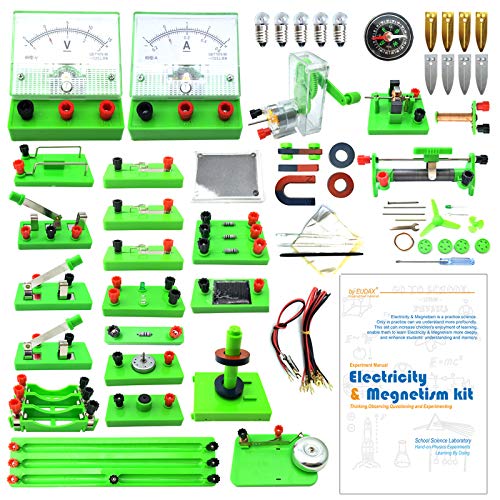
- 79 items for electricity and magnetism
- Build circuits, electromagnets, and generators
- Color manual and storage bag included
Best For: Older beginners and guided classroom or home labs
Best for Motion Concepts

- Explores inertia, friction, and circular motion
- Build six working models
- Includes theory, quizzes, and 3D app
Best For: Hands-on builders ages 9 and up
Best Simple Magnetism Starter

- Includes 14 magnets and accessories
- Covers basic magnetism and compass activities
- Compact set for home or classroom use
Best For: Beginners over 8 exploring magnetism
Best Variety STEM Activity Set

- Offers seven hands-on STEM projects
- Covers circuits, energy, and aerodynamics
- Step-by-step instructions included
Best For: Children ages 8–13 who prefer varied activities
Hands-On Optics Starter

- Explores reflection and refraction
- Includes lenses, prism, and mirrors
- Needs two AAA batteries, not included
Best For: Beginners focused on basic optics
Electricity & Magnetism Explorer
50-Piece Circuit and Magnetism Kit

- Includes 18 guided experiments
- Covers circuits and electromagnetism
- Designed for ages 8 to 18
Best For: Family and classroom STEM exploration
Advanced Optics Lab
37-Piece Imaging and Light Kit

- Includes a 60 cm no-assembly optical bench
- Explores imaging, refraction, and color
- Contains 37 optics-focused pieces
Best For: Older beginners and structured optics lessons
Most Complete Bundle
Electricity & Magnetism Starter Kit

- More than 50 hands-on experiments
- 55 items with illustrated manual
- Portable organized storage case
Best For: Teens seeking broad electricity and magnetism practice
Project-Focused Upgrade
EUDAX Electricity Experiment Kit

- Builds circuits, generators, and electromagnets
- Includes full-color learning manuals
- Transparent storage box for parts
Best For: Grades 7–11 exploring varied electricity projects
Simple Circuit Pick

- Teaches series and parallel circuits
- English instructions aid assembly
- Compact plastic storage box
Best For: Grades 7–9 learning electrical fundamentals
Best Complete Electricity & Magnetism Kit – EUDAX School Physics Labs
For learners ready to move beyond simple demonstrations, this EUDAX set is a substantial choice among beginner physics experiment sets. It combines electricity and magnetism components with a color manual, supporting hands-on projects such as series and parallel circuits, fruit batteries, electromagnets, and a hand-crank generator.
Best For: Students in grades 9–11, older beginners, and guided home or classroom lab work.
Pros:
- Includes 79 items spanning electricity and magnetism experiments.
- Supports projects involving circuits, Ohm’s law, electromagnetism, and generators.
- Comes with a color-page manual and storage bag.
Cons:
- Three AA batteries are required and are not included.
- The broad project range may benefit from adult or teacher guidance.
With its unusually wide topic coverage, this is a strong option for beginners who want a kit that can grow into more structured physics exploration. The included materials and manual make it more lab-oriented than a typical introductory toy.
Best for Motion Concepts – Engino Physics Laws
Engino makes physics approachable through construction and movement, making it a practical pick among beginner physics experiment sets for children who learn by building. The kit explores inertia, friction, and circular motion through six working model options, including a rocket launcher and crash test rig.
Best For: Children ages 9 and up who enjoy building models while learning motion principles.
Pros:
- Offers six working model options focused on motion laws.
- Includes theory, experiments, facts, and a four-page quiz section.
- Provides an interactive 3D app for virtual building support.
Cons:
- Its focus is primarily inertia, friction, and circular motion rather than electricity.
- Plastic construction may appeal more to builders than to children seeking traditional lab equipment.
This set is a good fit when the goal is to connect abstract physics ideas with visible, working mechanisms. The combination of models, theory, quizzes, and app support gives young learners several ways to reinforce the concepts.
Best Simple Magnetism Starter – Sntieecr Labs Magnetism Set
For a focused introduction to magnetism, this compact Sntieecr set keeps the setup simple. It is one of the more accessible beginner physics experiment sets because it supplies basic magnets, a compass, magnetic cars, and an iron filings box while encouraging learners to add everyday items such as paper, rulers, and pens.
Best For: Beginners over age 8, classroom demonstrations, and low-prep home investigations of magnetism.
Pros:
- Includes 14 magnets and accessories for introductory investigations.
- Features bar, U-shaped, and ring magnets, plus a compass and magnetic cars.
- Compact design and everyday add-on materials make setup straightforward.
Cons:
- It is limited to magnetism rather than covering multiple physics areas.
- Some experiments require household tools and materials not included in the set.
This is a sensible choice for learners who need a concentrated, easy-to-manage starting point. Its smaller component set leaves room for observation and creative experimentation without overwhelming a first-time student.
Best Variety STEM Activity Set – 7-in-1 Science Experiments
Families looking for variety may prefer this multi-project option among beginner physics experiment sets. It combines seven activities—including a Newton’s cradle, telegraph, fruit battery, color wheel, spin art machine, and flying-saucer launcher—to introduce circuitry, energy conversion, aerodynamics, and related physics ideas.
Best For: Children ages 8–13 who enjoy short, varied building and experimentation activities.
Pros:
- Provides seven different STEM experiments in one kit.
- Introduces circuitry, energy conversion, and aerodynamics through projects.
- Includes clear, step-by-step instructions for assembly.
Cons:
- The electric buoyancy ball, color wheel, spin art machine, and flying experiment share one motor kit.
- Its broad activity mix offers less depth in any single physics topic.
This set works well for keeping younger learners engaged and letting them sample several areas of physics and engineering. It is especially practical for family activities, homeschooling, or classrooms where project variety matters.
Hands-On Optics Starter – Acrylic Light Experiment Set
For shoppers seeking beginner physics experiment sets focused on light, this compact optics kit offers a practical introduction to reflection and refraction. Its acrylic lenses, prism, mirrors, and battery-powered linear light source support demonstrations for learners aged 14 and up.
Best For: Beginners studying core optics concepts at home or in classroom demonstrations.
Pros:
- Includes lenses, a triangular prism, mirrors, and a three-way adjustable linear light source.
- Supports experiments covering refraction, prism effects, plane-mirror reflection, and curved-mirror reflection.
- Compact 8-piece format includes an English color manual and storage color box.
Cons:
- Recommended for ages 14 and up, so it may not suit younger beginners.
- Requires two AAA batteries, which are not included.
- The kit is primarily dedicated to optical experiments rather than broader physics topics.
This is a straightforward choice for beginners who want a focused optics set with familiar components and a modest footprint. Choose it when light behavior is the priority rather than electricity, magnetism, or a wider range of physics activities.
Electricity & Magnetism Explorer – 50-Piece Circuit and Magnetism Kit
Among beginner physics experiment sets, this 50-piece kit stands out for covering both electricity and magnetism through 18 guided activities. The included meters, wires, switches, magnets, motor model, and 40-page manual give learners ages 8 to 18 a broad, hands-on starting point.
Best For: Children, teens, and families exploring circuits and electromagnetism together.
Pros:
- Offers 18 experiments, including fruit batteries, an electric bell, and a hand-crank generator.
- Includes a wide range of components, such as an ammeter, voltmeter, switches, resistors, magnets, compass, solenoid, and motor model.
- The full-color 40-page manual supports parent-child discovery and guided learning.
Cons:
- The large component count may feel more involved than a simple starter set.
- Its 14.7-inch-long case requires more storage space than compact kits.
- The supplied notes do not indicate that batteries are included.
This is the most versatile option of the three for learners who want to move beyond a single topic. Its combination of circuit-building and magnetism activities makes it a strong pick for family STEM sessions, school projects, and progressive exploration.
Advanced Optics Lab – 37-Piece Imaging and Light Kit
This 37-piece optics kit is a more extensive choice among beginner physics experiment sets for learners ready to investigate light in greater depth. It combines an integrated 60 cm optical bench with lenses, mirrors, screens, a water lens, and components for imaging and primary-color experiments.
Best For: Older beginners, home labs, and instructors wanting a broad optics teaching setup.
Pros:
- Covers reflection, refraction, convex-lens imaging, pinhole imaging, and light’s three primary colors.
- The integrated optical bench requires no assembly and includes three bright, adjustable light sources.
- Includes a broad collection of optics components, including mirrors, lenses, screens, a periscope, water boxes, and a syringe.
- Acrylic components are described as durable, shatterproof, and suitable for hands-on learning.
Cons:
- The manufacturer-recommended age is 14 and up, limiting its suitability for younger children.
- Its larger component collection may be more than a casual learner needs.
- The supplied details do not specify included batteries or the complete age range beyond 14 and up.
Choose this set when a basic prism-and-lens kit feels too limited and imaging activities are important. The no-assembly optical bench and extensive components make it especially useful for structured lessons, though its scope may be excessive for very first experiments.
Most Complete Bundle – Electricity & Magnetism Starter Kit
For shoppers comparing beginner physics experiment sets, this Mysterystone kit offers a broad introduction to electricity and magnetism through more than 50 hands-on projects. Its illustrated manual explains both what to do and why it works, making it a practical choice for guided exploration.
Best For: Students ages 13–18 who want a wide-ranging electricity and magnetism kit with organized storage.
Pros:
- Includes up to 55 items and more than 50 DIY experiments.
- Covers circuits, electromagnets, magnetic switches, LED projects, and Joule’s first law.
- Illustrated manual supports learning, experimentation, and independent exploration.
- Solid storage case keeps components organized and portable.
Cons:
- The kit is recommended for ages 13–18, so it may be advanced for younger children.
- The broad selection may require more setup and sorting than a simple circuit set.
With its extensive component selection and explanatory manual, this is the strongest option here for learners who want to go beyond basic circuits and explore several physics topics in one package.
Project-Focused Upgrade – EUDAX Electricity Experiment Kit
This EUDAX upgrade kit is a focused choice among beginner physics experiment sets for students building practical electricity and magnetism skills. It includes parts for progressively varied projects, from simple circuits to a hand-crank generator and wind-powered car.
Best For: Junior and senior high school students, teachers, and learners in grades 7–11 who want multiple circuit-building projects.
Pros:
- Supports simple, series, parallel, switch, electromagnet, and generator projects.
- Includes components such as switches, wires, bulbs, and LEDs.
- Full-color manuals explain basic principles and guide experimentation.
- Components store in a transparent box for convenient organization.
Cons:
- Requires two AA batteries, which are not included.
- The recommended age range is approximately 14–17, limiting its fit for younger beginners.
The upgrade version makes sense for learners who want more project variety than basic series and parallel circuits, while still keeping the focus on hands-on electrical concepts.
Simple Circuit Pick – EUDAX Basic Electricity Kit
For beginners who want a straightforward entry point, this EUDAX basic kit concentrates on assembling series and parallel circuits. It is suited to classroom, homeschool, science-fair, and STEM activities where clear instructions and fundamental current concepts matter most.
Best For: Students in roughly grades 7–9 who are learning foundational electricity concepts and circuit construction.
Pros:
- Focuses on basic series and parallel circuit projects.
- English instructions make assembly easier to follow.
- Supports hands-on learning, creativity, and understanding of electrical rules.
- Accessories come in a plastic storage box.
Cons:
- Has a smaller 17-piece component set than the other kits listed.
- Two AA batteries are not included.
- Its project scope is centered on basic circuits rather than broader magnetism activities.
This is the most approachable pick for learners who need to master core circuit ideas before moving to more advanced electricity and magnetism experiments.
How We Picked These Beginner Physics Experiment Sets
We focused on kits that support real experimentation rather than simple demonstrations. The selection includes circuit-building sets, magnetism activities, motion and force projects, and optics experiments involving reflection, refraction, lenses, mirrors, and color. We also considered the likely age range, clarity of the activities, flexibility for repeat use, and whether the kit suits independent learning, family projects, or classroom instruction.
Because included components and instructions can vary, check the current product listing before buying. Confirm the recommended age, experiment scope, required household supplies, and whether batteries or other consumables are included.
Quick Comparison
| Best For | Look For |
|---|---|
| Young beginners | Large, straightforward components and guided activities |
| Electricity learners | Reusable circuit parts, switches, lights, motors, or magnetic components |
| Optics practice | Light sources, mirrors, lenses, prisms, and clear alignment instructions |
| Older students | More variables, repeatable trials, and room to record measurements |
| Classrooms | Durable parts, multiple activities, and easy organization |
Key Buying Factors for Beginner Physics Experiment Sets
Topic Coverage
Choose a kit that matches the learner’s current goal. Electricity sets are useful for series and parallel circuits, conductivity, and electromagnetism. Motion kits introduce inertia, friction, and circular motion, while optics kits focus on how light behaves through lenses, mirrors, and prisms.
Age and Difficulty
A younger child may benefit from color-coded parts and short, highly guided experiments. Older students can use kits with less structure and more opportunities to change variables, make predictions, and calculate or compare results. A kit that is too advanced may become frustrating; one that is too simple may lose its value quickly.
Safety and Supervision
Review the instructions before the first activity. Battery-powered circuits are generally more suitable for beginners than mains electricity, but learners should still avoid short circuits, protect eyes during light experiments, and use small components under appropriate supervision.
Reusability and Organization
Reusable components offer better long-term value than one-time projects. Look for sturdy connectors, labeled pieces, storage solutions, and activities that can be repeated with different configurations. Also check whether batteries, tape, paper, or other basic supplies are needed separately.
Who Should Buy Which Beginner Physics Experiment Sets?
Families starting with basic STEM activities should prioritize accessible circuit or magnetism kits with guided projects. Learners interested in engineering and mechanics may prefer a set centered on inertia, friction, and circular motion. Students studying light should choose an optics kit with several lenses, mirrors, prisms, and a dependable light source.
For teachers, prioritize breadth, durable parts, and experiments that can be demonstrated or repeated by small groups. For older students preparing for more formal physics work, choose the most flexible kit available, especially one that encourages measurement, written observations, and controlled comparisons.