
The best beginner engineering building sets turn STEM concepts into something kids can build, test, and improve. This roundup covers approachable projects ranging from bridges and skyscrapers to hydraulic arms, robots, electronics, and working engine models.
To choose confidently, match the set’s recommended age, build complexity, power requirements, and learning focus with the child’s interests. The guide below highlights the practical differences that matter before you buy.
Best 10 Beginner Engineering Building Sets Picks for 2026
Creative Starter

- 141 snap-fit pieces with 40 guided models
- Includes moving designs and open-ended rebuilding
- Portable suitcase-style storage box
Best For: Young beginners learning basic construction and spatial reasoning
Structural Explorer
Bridges & Skyscrapers Engineering Set

- Build 20 structural models
- Explores compression, tension, and load
- Includes 287 pieces and a 36-page manual
Best For: Learners interested in bridges, skyscrapers, and structural physics
Solar Builder

- 190 parts create 12 robot and vehicle models
- Explores solar power and engineering concepts
- Works with sunlight or a strong artificial light
Best For: Kids interested in robotics and renewable energy
Hands-On Mechanic

- Builds a water-powered working robotic arm
- Six axes and up to 270-degree rotation
- Includes a controllable gripper and suction parts
Best For: Older learners ready for a multi-hour hydraulics project
Hands-On Metal Mechanics
Beginner Metal Engineering Kit

- 194 precision-engineered metal pieces
- Illustrated instructions and included tools
- Build one of two off-road designs
Best For: Kids ages 8+ exploring mechanical assembly
Build-and-Experiment Robotics

- Supports 10 robotics projects
- Includes 100+ components
- Explores LEDs, switches, and robot functions
Best For: Ages 8-12 trying robotics and electronics
Build Your Own Broadcast
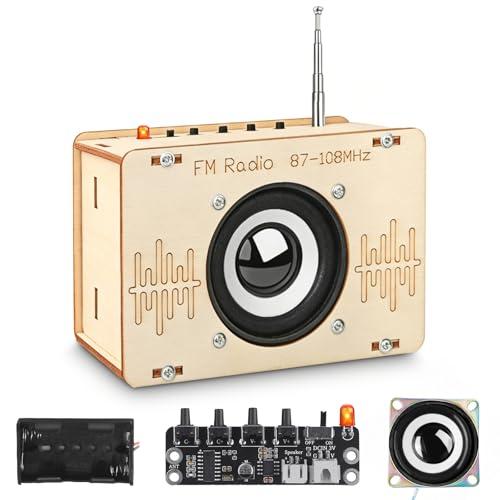
- Assemble a working FM radio
- Laser-cut wooden parts and instructions
- Requires two AA batteries, not included
Best For: Ages 8+ learning introductory electronics
Best Starter Motor Set
107-Piece Motorized Erector Kit

- 107 parts with motor, tools, instructions, and storage
- 10 vehicle and robot designs, built one at a time
- Designed for creative STEM play and beginner builders
Best For: Young beginners and family building sessions
Best Mechanical Model
Running V8 Engine Building Set

- 478-piece replica with moving pistons and valve train
- Transparent cover shows the engine’s internal motion
- Includes motor and battery box; six AA batteries required
Best For: Older beginners and mechanical-model enthusiasts
Best Robotics Introduction

- Combines wooden assembly with motors, wiring, and a controller board
- No soldering required for the robotics project
- Builds problem-solving and introductory circuit skills
Best For: Ages 8+ exploring robotics and mechanical movement
Creative Starter – K'NEX 40-Model Building Set
For shoppers comparing beginner engineering building sets, the K’NEX 40 Model Building Set offers an approachable introduction to construction through 141 snap-fit rods and connectors. Step-by-step instructions cover 40 models, while the pieces can also be rebuilt into original designs.
Best For: Young beginners who want guided builds, creative freedom, and portable storage.
Pros:
- Includes 141 pieces and instructions for 40 models.
- Snap-fit parts can be assembled, disassembled, and reused.
- Models such as cars and airplanes include moving parts.
- Suitcase-style storage supports cleanup and portability.
Cons:
- The manufacturer recommends it for ages 5–8, while the listing also describes a 5–12 range.
- Its introductory format may be less suitable for advanced builders.
This is a practical first step into STEM construction, combining structured projects with open-ended building. It is especially useful when easy storage and repeated rebuilding matter.
Structural Explorer – Bridges & Skyscrapers Engineering Set
Among beginner engineering building sets, this Thames & Kosmos kit focuses on how structures handle force. Builders can create 20 models while exploring load, compression, tension, and related mechanical-physics concepts with more than 285 interchangeable pieces.
Best For: Children ages 8–14 ready for a more focused introduction to structural engineering.
Pros:
- Builds 20 bridge and skyscraper-inspired structural models.
- Explains force, load, compression, and tension.
- Includes over 285 interchangeable building pieces.
- Comes with a 36-page illustrated experiment and assembly manual.
Cons:
- The listed skill level is intermediate rather than purely introductory.
- The educational focus is narrower than a general-purpose construction set.
This kit is a strong choice for learners who want building activities tied directly to structural principles. The manual and model variety provide a clearer lesson path than an entirely open-ended set.
Solar Builder – 12-in-1 Solar Robot Kit
This Sillbird 12-in-1 kit gives beginner engineering building sets a renewable-energy angle. With 190 parts, children can assemble 12 models of increasing difficulty, including robots and cars, then power them with sunlight or a strong artificial light source.
Best For: Kids ages 8 and up who enjoy robotics, DIY projects, and learning about solar power.
Pros:
- Offers 12 build options with gradually increasing challenge.
- Uses a larger solar panel designed to capture more sunlight.
- Can operate outdoors in sunlight or indoors under a strong light.
- Clear step-by-step instructions support independent or family building.
Cons:
- Performance depends on sufficient sunlight or a strong artificial light source.
- The manufacturer recommends ages 10 and up, despite the title’s 8–13 range.
For children drawn to robots and renewable energy, this set adds a motivating real-world theme to hands-on construction. Its tiered models also make it easier to continue progressing after the first build.
Hands-On Mechanic – Teach Tech Hydrobot Arm
For older learners seeking beginner engineering building sets with a working mechanism, the Teach Tech Hydrobot Arm offers a deeper project. Builders assemble a water-powered robotic arm with six axes, 270-degree rotation, and a controllable gripper without using batteries.
Best For: Ages 12 and up who are ready for a multi-hour mechanical-engineering project.
Pros:
- Demonstrates hydraulics, fluid power, mechanics, and engineering.
- Six axes allow the arm to rotate up to 270 degrees.
- Levers control a gripper that opens and closes.
- Includes replaceable suction components for picking up objects.
Cons:
- Assembly is in-depth and may take multiple hours.
- It is recommended for ages 12 and up, making it unsuitable for younger beginners.
- Instructions are supplied in English.
This is less of a quick-play construction toy and more of a structured STEM project. Choose it when the learner is prepared to follow detailed assembly steps and wants to operate a functioning hydraulic arm.
Hands-On Metal Mechanics – Beginner Metal Engineering Kit
For beginners comparing engineering building sets, this 194-piece metal kit offers a practical introduction to mechanical assembly. Designed for ages 8 and up, it includes illustrated instructions, a screwdriver, and a wrench for building one of two off-road vehicle designs at a time.
Best For: Kids ages 8+ who enjoy hands-on mechanical builds, spatial reasoning, and experimenting with custom structures.
Pros:
- Durable metal components with smooth finishes.
- Step-by-step illustrated guidance supports beginners.
- Encourages logic, concentration, spatial imagination, and creativity.
- Includes tools needed for assembly.
Cons:
- Only one of the two designs can be built at a time.
- Manual assembly may require adult help for some younger builders.
This is a solid choice for a child ready to move beyond simple block construction into tool-assisted mechanical projects. Its metal parts and two-design format offer replay value, while the compact build focuses on careful assembly rather than electronics.
Build-and-Experiment Robotics – 10-in-1 STEM Electronics Kit
This 10-in-1 robotics kit is a versatile option among beginner engineering building sets for children ages 8-12. With more than 100 components, step-by-step instructions, and projects involving wires, switches, connectors, and LEDs, it introduces basic robotics and electronics through hands-on builds.
Best For: Young beginners who want to try multiple robotics projects and explore line-following, obstacle-avoidance, electronics, and mechanics.
Pros:
- Offers 10 different STEM robotics projects.
- Includes more than 100 components for varied activities.
- Clear instructions are intended to make builds accessible.
- Introduces practical concepts in robotics, electronics, and mechanics.
Cons:
- The supplied notes do not specify a battery or power source.
- Wooden construction may be less durable than a metal engineering set.
The main advantage is variety: children can sample several project types instead of repeating one build. It is a good fit for families seeking an introductory robotics experience, particularly when guided experimentation matters more than advanced circuitry.
Build Your Own Broadcast – DIY FM Radio Engineering Kit
For beginners interested in how electronic devices work, this FM radio kit gives engineering building sets a functional twist. The laser-cut wooden parts and included components assemble into a working radio that automatically searches the 87-108 MHz range, with step-by-step instructions and a mini screwdriver included.
Best For: Kids and teens ages 8+ who want a focused electronics project with a working result they can decorate and display.
Pros:
- Builds a functional FM radio rather than a display-only model.
- Includes precision laser-cut wooden pieces and assembly instructions.
- Supports curiosity about circuits and radio operation.
- Finished radio can be colored, decorated, and displayed.
Cons:
- Requires two AA batteries, which are not included.
- Offers one primary project rather than multiple builds.
- Electronic assembly may need supervision for younger beginners.
This kit is especially appealing when the goal is to connect building with a real-world function. The single radio project provides a clear learning outcome, while the wooden enclosure leaves room for personalization after assembly.
Best Starter Motor Set – 107-Piece Motorized Erector Kit
For shoppers comparing beginner engineering building sets, this 107-piece motorized kit offers an approachable way to explore construction, vehicles, and simple powered movement. It includes blocks, wheels, nuts, bolts, tools, instructions, and a storage box, with 10 possible designs such as robots, helicopters, planes, cars, and trucks. Only one model can be built at a time.
Best For: Young beginners and families looking for a flexible, motorized STEM building activity with multiple vehicle-style projects.
Pros:
- Includes 107 parts, an electric motor, hand tools, instructions, and storage.
- Offers 10 design options for varied building and imaginative play.
- Made from plastic and TPR described as free of lead, BPA, and phthalates.
- Motorized models add moving-function interest beyond static construction.
Cons:
- Only one of the 10 models can be assembled at a time.
- The motor requires batteries, though the supplied notes do not specify their inclusion.
- The broad age-range marketing may mean younger builders need adult guidance.
This is a practical entry point for children who want variety without committing to one advanced project. Its storage case and multiple build concepts make it especially suitable for shared parent-child sessions.
Best Mechanical Model – Running V8 Engine Building Set
Among beginner engineering building sets, this 478-piece V8 model is a more focused introduction to mechanical systems. The build recreates piston movement, valve-train action, a turbocharger, and an exhaust system, while its transparent cylinder cover lets builders watch the internal motion after assembly.
Best For: Builders ages 8 and up, teens, adults, and mechanical enthusiasts who want a detailed engine-focused STEM project.
Pros:
- 478-piece design provides a substantial assembly and troubleshooting project.
- Transparent cylinder cover makes piston movement and internal operation visible.
- Includes an L-type motor and battery box for a working display model.
- ABS construction is described as non-toxic, odorless, and tested to ASTM and CPSIA standards.
Cons:
- Requires six AA batteries, which are not included.
- Its detailed engine design may be demanding for very young or completely new builders.
- The project centers on one V8 model rather than multiple alternate builds.
This set is best viewed as a concentrated mechanical learning project rather than an open-ended construction box. The see-through design adds educational value by connecting the assembly process with observable engine motion.
Best Robotics Introduction – DIY Wooden Robot Arm Kit
This robot arm kit gives beginner engineering building sets a hands-on electronics and mechanics angle. Builders assemble wooden pieces, motors, a PCB microcontroller board, and wires, then operate the completed arm to explore how circuits control mechanical movement. No soldering is required.
Best For: Children ages 8 and up, teens, adults, and families seeking a more challenging introductory robotics or science project.
Pros:
- Combines a 3D wooden puzzle with motors, wiring, and circuit basics.
- Includes assembly accessories and a detailed tutorial, with no soldering required.
- Encourages problem-solving, patience, logical thinking, and hands-on STEM skills.
- Can suit home projects, school science classes, clubs, and family activities.
Cons:
- Requires six AA batteries, which are not included.
- Its precise wooden assembly may be challenging for younger beginners.
- The supplied details describe one robot-arm project rather than multiple alternate models.
Choose this kit when the goal is to move beyond basic block building into robotics and circuits. It has a stronger project-building focus, so younger children may benefit from adult help during assembly and testing.
How We Picked These Beginner Engineering Building Sets
We selected sets that offer a clear entry point into engineering while providing meaningful hands-on activity. The lineup includes mechanical construction, structural design, robotics, electronics, hydraulics, solar power, and motorized models, so families can choose a project that fits a child’s interests rather than buying a generic building toy.
We also considered recommended age ranges, project variety, the likelihood of repeat play, assembly demands, and whether the finished model demonstrates a visible engineering principle. Because “beginner” means different things at different ages, the list includes simpler construction sets as well as more advanced kits suitable for older children and teens.
Quick Comparison
- Best for basic construction: K’NEX 40 Model Building Set
- Best for structures: Thames & Kosmos Bridges & Skyscrapers
- Best solar project: Sillbird 12-in-1 Solar Robot Kit
- Best hydraulics introduction: TEACH TECH Hydrobot Arm
- Best for electronics: Butterfly EduFields Electronics Robotics Kit
- Best FM radio project: Poraxy Build Your Own FM Radio Kit
- Best for a working engine model: WINGIFT V8 Engine Building Set
- Best for robot-arm projects: Robot Arm Kits for Kids and Teens
Key Buying Factors for Beginner Engineering Building Sets
Age and Build Complexity
Use the age recommendation as a starting point, not a guarantee. Younger builders generally benefit from larger parts, fewer steps, and projects with quick visual results. Older children can handle smaller components, wiring, troubleshooting, and longer construction sessions.
Engineering Concept
Choose the learning focus deliberately. Structural kits demonstrate balance, load distribution, and stability. Motorized and robotic sets introduce gears, motion, and control. Electronics kits develop circuit and connection skills, while hydraulic projects show how fluid pressure can create movement.
Power and Supervision
Check whether the kit requires batteries, sunlight, tools, or adult help. Electronics, motors, and small parts may need closer supervision, particularly for younger children. Confirm that batteries and any required tools are included or available before starting.
Variety and Replay Value
Multi-model kits can provide more value, but only if the instructions are clear and the alternative builds feel meaningfully different. A single detailed project may be the better choice for a child who prefers completing one impressive model over switching between smaller builds.
Who Should Buy Which Beginner Engineering Building Sets?
For a first engineering set or a younger builder, start with a straightforward construction or motorized erector kit. Children interested in buildings and real-world design may prefer the bridges-and-skyscrapers set. Solar robot kits suit kids who enjoy transforming energy into motion, while hydraulic and robot-arm kits are better for builders who want to control movement directly.
Choose an electronics or FM radio kit for a child curious about circuits and how devices work. For older children, teens, or experienced builders, the metal engineering kit and working V8 model offer more demanding mechanical projects. When in doubt, prioritize the child’s strongest interest and select a set slightly below—not far above—their current building experience.