
Choosing among astrophotography mounts for long-exposure photography means balancing tracking accuracy, payload capacity, portability, setup time, and budget. The right mount can make the difference between sharp, detailed exposures and blurred stars.
This roundup covers compact camera trackers, versatile GoTo mounts, and heavier equatorial systems for deep-sky imaging. Use the guide below to match each mount style to your camera, telescope, observing location, and experience level.
Best 10 Astrophotography Mounts for Long Exposure Photography Picks for 2026
Best Portable GoTo Pick

- Full GoTo mount with built-in Wi-Fi
- Includes tripod, pier extension, and counterweight
- Illuminated polar scope for alignment
Best For: Portable astrophotographers wanting a complete computerized kit
Best Compact Camera Tracker

- Lightweight 3.3-pound mount
- Automatic R.A. tracking with multiple rates
- Includes polar scope and padded bag
Best For: Traveling camera users shooting wide-field night skies
Best Modular Wide-Field Platform
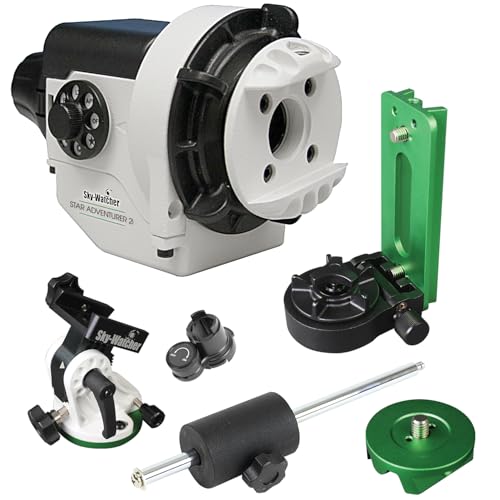
- Designed for wide-field astrophotography
- Wi-Fi smartphone control via SAM Console
- Works with existing photographic tripods
Best For: Photographers wanting a flexible modular tracker
Best Stable Tripod Base
Bresser Photo Mount Tracking System

- Stable stainless-steel field tripod
- Integrated adjustable polar wedge
- 3.5 kg maximum weight recommendation
Best For: Camera users prioritizing a sturdy alignment base
Best Portable Tracker

- 2.2-pound compact all-metal design
- Supports up to 11 pounds when balanced
- Up to 20 hours of internal battery operation
Best For: Mobile camera-and-lens astrophotography
Best High-Capacity Mount

- 44-pound payload capacity
- Belt-driven computerized GoTo operation
- 42,000-plus object database
Best For: Large telescope and imaging configurations
Best DIY-Style Compact Tracker
TeSeek Equatorial Star Tracker

- Custom, stellar, and lunar rotation speeds
- Northern and southern hemisphere support
- USB-C powered and time-lapse capable
Best For: Experimenters with lightweight camera setups
High-Capacity Hybrid

- 44-pound payload capacity
- EQ, Alt-Az, and dual-OTA modes
- Belt drive with PPEC and dual encoders
Best For: Large, flexible imaging and observing setups
Portable GoTo Equatorial

- 30-pound payload capacity
- Illuminated polar finderscope
- 42,000-plus-object SynScan database
Best For: Beginning astrophotographers and lighter imaging rigs
Strainwave Imaging Kit
Sky-Watcher Wave 100i Pro Mount

- Strainwave GoTo mount head
- Dual-saddle Alt-Az and imaging EQ modes
- Includes steel tripod and extension tube
Best For: Flexible EQ-capable setups using a strainwave mount
Best Portable GoTo Pick – Star Adventurer GTi Mount Kit
For photographers seeking astrophotography mounts for long exposure photography, the Sky-Watcher Star Adventurer GTi combines computerized GoTo operation with a tripod, pier extension, counterweight, and illuminated polar scope. Its built-in Wi-Fi and multiple tracking rates add flexibility for portable setups.
Best For: Portable astrophotographers who want a complete GoTo tracking kit with included support hardware.
Pros:
- Includes mount head, tripod, pier extension, counterweight bar, and 5-pound counterweight.
- Built-in GoTo functionality and Wi-Fi support.
- Illuminated polar scope helps with polar alignment.
- Portable design with a listed 26-pound item weight.
Cons:
- Heavier and more involved than a compact camera-only tracker.
- Not water resistant.
This is the most complete option in the group for users who want GoTo convenience without assembling a separate tripod and counterweight system. Its included accessories make it practical for mobile deep-sky and wide-field imaging setups.
Best Compact Camera Tracker – iOptron SkyTracker Pro
The iOptron SkyTracker Pro is a compact option among astrophotography mounts for long exposure photography. It provides automatic right-ascension tracking, a built-in polar scope, and a stated 6.6-pound payload, while keeping the mount itself to 3.3 pounds.
Best For: Travelers and camera users who need a lightweight tracker for wide-field night-sky photography.
Pros:
- Lightweight 3.3-pound mount with a compact folded size.
- Supports camera and cellphone use.
- Offers 1X sidereal, half-speed, solar, and lunar tracking modes.
- Includes a polar scope and padded bag.
Cons:
- Mount-only package does not include a tripod in the supplied listing.
- Limited to a stated 6.6-pound payload.
- No viewfinder is listed.
Choose this model when portability matters more than GoTo features or a bundled support system. Its automatic R.A. tracking and multiple rates make it a straightforward entry point for camera-based night-sky work.
Best Modular Wide-Field Platform – Star Adventurer 2i Pro Pack
The Sky-Watcher Star Adventurer 2i Pro Pack is a modular choice for astrophotography mounts for long exposure photography. It is designed for wide-field imaging, time-lapse video, and telescopic use, with Wi-Fi smartphone control through the Sky-Watcher SAM Console app.
Best For: Photographers who want a flexible tracking platform that can work with an existing photographic tripod.
Pros:
- Supports wide-field astrophotography, time-lapse video, and telescopic use.
- Modular design integrates with existing photographic tripods.
- Built-in Wi-Fi enables smartphone control.
- Deluxe equatorial base assists with polar alignment.
Cons:
- The supplied notes do not list a payload capacity.
- Its modular setup may require separately owned tripod equipment.
This Pro Pack suits users who already have compatible camera support and want a versatile motorized tracking platform. Its smartphone control and equatorial base add convenience without requiring the larger bundled configuration of the GTi kit.
Best Stable Tripod Base – Bresser Photo Mount Tracking System
The Bresser Photo Mount emphasizes a stable foundation for astrophotography mounts for long exposure photography. Its stainless-steel field tripod includes an integrated polar wedge, bubble level, and adjusters for pole height and azimuth, with a listed maximum weight recommendation of 3.5 kg.
Best For: Camera users prioritizing a sturdy, adjustable tripod and polar-alignment base.
Pros:
- Stable stainless-steel tripod construction.
- Integrated polar wedge with pole-height and azimuth adjustment.
- Built-in circular bubble level supports setup.
- Includes installation tools and uses 1/4-inch photo-thread connections.
Cons:
- The listed maximum weight recommendation is 3.5 kg.
- The supplied notes do not specify GoTo or Wi-Fi features.
- Its 3.5 kg item weight may be less convenient for lightweight travel.
This system is a practical pick when tripod stability and alignment adjustment are the main priorities. It provides a substantial base for a compatible camera-tracking setup, but buyers should confirm mount compatibility and the total equipment weight.
Best Portable Tracker – SkyGuider Pro Full Package
For photographers seeking astrophotography mounts for long exposure photography without carrying a full-size observatory setup, the iOptron SkyGuider Pro emphasizes portability, stability, and straightforward polar alignment. Its all-metal construction, illuminated polar scope, and rechargeable battery make it a practical option for mobile night-sky sessions.
Best For: Portable camera-and-lens astrophotography setups and photographers who prioritize compact transport.
Pros:
- Compact 2.2-pound design fits easily in a camera bag or backpack.
- Supports up to 11 pounds when properly balanced.
- Illuminated AccuAlign polar scope and adjustable base help simplify alignment.
- Internal rechargeable battery provides up to 20 hours of operation at 20°C.
Cons:
- Requires careful balancing to achieve its stated weight capacity.
- It is not water resistant.
- The supplied specifications list a maximum shutter speed of 30 seconds.
The SkyGuider Pro is a strong fit when portability matters as much as tracking support. Its compact body and long battery rating are particularly useful for remote shooting, while the adjustable base and polar scope address the setup demands of long-exposure work.
Best High-Capacity Mount – Sky-Watcher EQ6-R Pro
The Sky-Watcher EQ6-R Pro is designed for photographers who need a substantial computerized platform among astrophotography mounts for long exposure photography. Its German equatorial design, belt-driven motors, illuminated polar finder, and 44-pound payload capacity make it suited to larger camera and telescope configurations.
Best For: Larger astrophotography rigs and users who want computerized GoTo control with a broad object database.
Pros:
- 44-pound payload capacity accommodates most optical tubes and substantial imaging setups.
- Belt-driven stepper motors provide quiet slewing and precise tracking.
- SynScan controller includes a database of more than 42,000 celestial objects.
- Built-in illuminated polar finderscope and transport handle support setup and portability.
Cons:
- At 44 pounds, the mount is considerably less portable than compact camera trackers.
- It requires a 12V power source with a minimum 4-amp rating.
- The package arrives in two boxes and includes a separate tripod and counterweights, adding setup logistics.
The EQ6-R Pro is the most capable choice here for heavier equipment and automated operation. Its capacity and GoTo system are compelling, but buyers should plan for the mount’s weight, external power requirement, and more involved setup.
Best DIY-Style Compact Tracker – TeSeek Equatorial Star Tracker
The TeSeek Equatorial Mount Star Tracker offers a compact, open-source approach to astrophotography mounts for long exposure photography. It supports stellar, lunar, and custom rotation speeds, can switch between hemispheres, and doubles as a gimbal head for time-lapse work, though camera mounting requires compatible hardware.
Best For: Experimenters and lightweight camera setups seeking customizable tracking and USB-C power.
Pros:
- Supports stellar, moon, and custom rotation speeds.
- Switches between northern and southern hemisphere operation.
- Can function as a gimbal head for time-lapse photography.
- Compact PETG-and-carbon-fiber shell and power-bank compatibility support portable use.
Cons:
- No built-in battery; it requires external USB power.
- A ball head is required to connect a camera, and a 1/4-to-3/8-inch sleeve may be needed.
- It prohibits USB-C-to-USB-C power cables and has threadlocked screws that should not be disassembled.
This tracker is best viewed as a compact, configurable platform rather than a ready-made heavy-duty mount. Its flexible speed settings and dual-hemisphere support are useful, but buyers should account for the required ball head, cable restrictions, and external power source.
High-Capacity Hybrid – Sky-Watcher AZ-EQ6 Mount
The Sky-Watcher AZ-EQ6 is a flexible choice among astrophotography mounts for long exposure photography, combining German equatorial tracking with Alt-Az and dual-OTA modes. Its 44-pound payload rating, belt drive, and permanent periodic error correction make it suited to larger imaging setups.
Best For: Astrophotographers who need high payload capacity and the option to run different mount configurations.
Pros:
- 44-pound payload capacity supports a broad range of optical tube assemblies.
- EQ, Alt-Az, and dual-OTA modes provide useful setup flexibility.
- Belt drive, PPEC, and low backlash support smooth, quiet operation.
- Dual encoders allow manual movement without losing alignment.
Cons:
- Its 44-pound weight makes it less portable than a lightweight mount.
- The larger capacity may be more than needed for compact imaging rigs.
- It is not water resistant.
Choose the AZ-EQ6 when capacity and versatility matter more than minimizing equipment weight. The included tripod, counterweights, saddles, and SynScan controller make it a substantial all-around mounting package.
Portable GoTo Equatorial – Sky-Watcher HEQ5 Mount
The Sky-Watcher HEQ5 is a practical entry point for astrophotography mounts for long exposure photography, offering computerized German equatorial operation in a comparatively lightweight design. Its 30-pound payload rating, illuminated polar finderscope, and SynScan database support guided setup and object finding.
Best For: Beginning astrophotographers and experienced users who want a lighter computerized equatorial mount.
Pros:
- 30-pound payload capacity suits many optical tube assemblies.
- Built-in illuminated polar finderscope helps with polar alignment.
- Heavy-duty roller bearings support both right ascension and declination axes.
- SynScan controller includes a database of more than 42,000 objects.
Cons:
- Its 30-pound capacity is lower than the AZ-EQ6 in this roundup.
- The mount is designed as a German equatorial system rather than a multi-mode mount.
- It uses a rolled-steel tripod, which may add bulk for travel.
The HEQ5 balances computerized features with a manageable format. It is a sensible option when you want equatorial capability, built-in polar alignment assistance, and a sturdy tripod without moving to a higher-capacity mount.
Strainwave Imaging Kit – Sky-Watcher Wave 100i Pro Mount
The Sky-Watcher Wave 100i Pro is a strainwave-based option among astrophotography mounts for long exposure photography. This kit pairs the Wave 100i GoTo head with an EQ6 steel tripod, adapter, and extension tube, creating a ready-to-configure package for users who want dual-saddle Alt-Az and imaging EQ functionality.
Best For: Astrophotographers seeking a strainwave GoTo mount kit with an included heavy-duty steel tripod and extension hardware.
Pros:
- Strainwave design provides a modern mount architecture.
- Supports both Alt-Az and imaging EQ configurations.
- Includes a 2-inch steel-leg EQ6 tripod for a solid support platform.
- Adapter and extension tube add compatibility and setup flexibility.
Cons:
- The supplied notes do not specify a payload capacity.
- The kit’s multiple components may require more setup planning.
- Manual focus is listed as the focus type.
The Wave 100i Pro stands out for its strainwave design and included support hardware. It is worth considering if you want an EQ-capable GoTo kit with dual-saddle flexibility and a steel tripod rather than a basic mount head alone.
How We Picked the Best Astrophotography Mounts for Long Exposure Photography
We selected these mounts across the main categories used for long-exposure imaging: portable star trackers, camera-focused equatorial mounts, computerized German equatorial mounts, and hybrid EQ/AZ systems. We considered advertised payload capacity, tracking and GoTo features, polar-alignment tools, included accessories, portability, and suitability for cameras or telescopes.
For astrophotography, payload ratings are only a starting point. A mount carrying a camera lens may perform very differently from one carrying a long telescope, guide scope, filter wheel, and other accessories. Stability, balance, alignment accuracy, and setup quality all affect real-world results.
Quick Comparison
| Mount type | Best suited to | Main advantage | Trade-off |
|---|---|---|---|
| Compact star tracker | Wide-field cameras and travel | Lightweight and portable | Limited payload and automation |
| Camera-focused GoTo tracker | Camera lenses and small optical tubes | More convenient target finding | Less robust than full-size mounts |
| Mid-size German equatorial mount | Dedicated deep-sky setups | Better stability and tracking capacity | Heavier transport and setup |
| Large computerized EQ mount | Long focal lengths and heavier rigs | High capacity and precise control | Higher cost and less portability |
| Hybrid EQ/AZ or strain-wave mount | Flexible imaging and visual use | Versatile operation and modern design | Feature sets and payload behavior vary |
Key Buying Factors for Astrophotography Mounts for Long-Exposure Photography
Payload Capacity and Focal Length
Choose a mount with comfortable capacity above your fully assembled imaging rig, not merely the camera or telescope’s listed weight. Longer focal lengths magnify tracking errors, so heavier deep-sky systems generally benefit from a sturdier mount.
Tracking, Guiding, and Alignment
Look for dependable sidereal tracking, a stable polar scope or electronic alignment process, and compatibility with autoguiding when you plan longer exposures. GoTo is convenient, but accurate alignment and good mechanical tracking remain more important for image quality.
Portability and Setup
Travel trackers are easier to carry and deploy, while full-size mounts offer greater stability at the cost of bulk. Consider whether you will image from a backyard, dark-sky site, balcony, or remote location. A mount that is too difficult to transport may be used less often.
Power, Controls, and Compatibility
Check the required power supply, controller or app support, tripod and pier options, camera attachment hardware, and compatibility with your existing telescope or ball head. Included counterweights and extension components can substantially improve value.
Who Should Buy Which Astrophotography Mounts for Long Exposure Photography?
For Travel and Wide-Field Camera Imaging
Choose a compact tracker such as the iOptron SkyTracker Pro, Sky-Watcher Star Adventurer 2i Pro, Bresser Photo Mount, or a small ball-head tracker. These are appropriate for lightweight cameras and lenses when portability matters most.
For a More Automated Camera Setup
The Star Adventurer GTi and iOptron SkyGuider Pro are better choices when you want more control, improved framing flexibility, or a platform that can grow with a modest imaging kit.
For Serious Telescope Imaging
The HEQ5, EQ6-R, and AZ-EQ6 are aimed at users who need stronger support for longer focal lengths, larger optical tubes, and guiding equipment. The EQ6-R and AZ-EQ6 are especially suitable when capacity and stability take priority over portability.
For Flexible Modern Setups
The Wave 100i Pro is worth considering for buyers who want a compact, versatile mount with EQ imaging capability and broader visual-use options. Select it when its control system, payload requirements, and portability align with your equipment.