
Choosing your first anemometer can be surprisingly confusing: similar-looking meters may differ in sensor design, measurement range, display readability, and extra features.
We’ve gathered 10 approachable options for beginners, from compact digital meters to durable outdoor models, so you can match the instrument to your activities and budget.
Best 10 Anemometers for Beginners Picks for 2026
Best All-Around Digital Pick
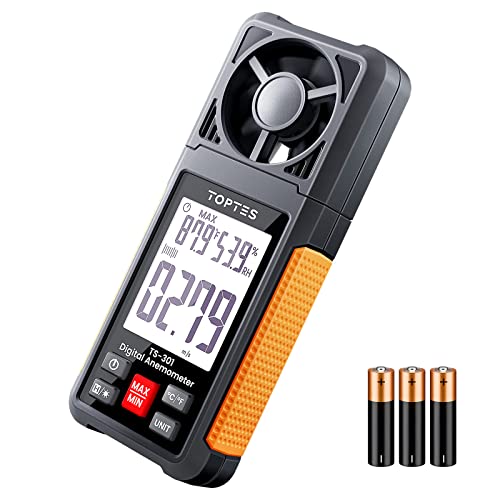
- Large 2.26-inch backlit display
- Six wind-speed measurement units
- Adds temperature and humidity readings
Best For: Beginners needing a versatile handheld meter
Best Simple Classroom Option

- Mechanical revolving-cup design
- Weather-resistant construction
- Compact size for classrooms and field studies
Best For: Hands-on educational wind-speed demonstrations
Best for HVAC and Tripod Use

- Five wind-speed measurement units
- Wind temperature and wind-chill readings
- Threaded mount for tripod use
Best For: HVAC checks and hands-free outdoor measurements
Best Ultra-Compact Meter

- Weighs just 1.92 ounces
- Current, maximum, and average modes
- Backlit display with wind-chill readings
Best For: Portable everyday wind and temperature checks
Versatile Starter Pick
HoldPeak 866B Digital Anemometer

- 0.67–67.1 mph range with ±2% stated accuracy
- Measures wind speed, temperature, and wind chill
- Includes tripod mount, pouch, strap, and batteries
Best For: Beginners needing a versatile outdoor and basic HVAC wind meter
Simple 3-in-1 Value

- Measures wind speed, temperature, and wind level
- Displays speed and temperature together
- Includes unit switching, data hold, and backlight
Best For: First-time users wanting basic multi-function wind readings
High-Wind Cup Design
AIOMEST 881M Handheld Anemometer

- Measures wind up to 93 mph with ±4% stated accuracy
- 360° cup sensor eases directional positioning
- Adds compass, tripod mount, wind chill, and Beaufort scale
Best For: Beginners needing convenient indoor and higher-wind outdoor testing
Best with Extra Features
Mcbazel 3-in-1 Handheld Anemometer

- Displays wind speed, temperature, and Beaufort level
- Offers five selectable wind-speed units
- Includes hold, MAX/MIN/AVG, and backlight functions
Best For: Beginners learning wind measurements for HVAC and outdoor activities
Simple Measurement Pick
Digital Handheld Wind Speed Meter

- Measures speeds from 0.3 to 30 m/s
- Shows wind speed and air temperature
- Includes hold, MAX/MIN, backlight, and auto-off
Best For: Beginners needing portable HVAC and outdoor airflow checks
Feature-Rich Beginner Pick

- Measures wind speed, temperature, and humidity
- Supports six wind-speed units up to 30 m/s
- Adds a large backlit screen and storage bag
Best For: Beginners wanting broader environmental readings for outdoor and HVAC use
Best All-Around Digital Pick – TopTes TS-301
For beginners comparing anemometers for beginners, the TopTes TS-301 is a straightforward handheld option with a large backlit display, multiple measurement units, and extra temperature and humidity readings. Its compact design and included batteries and pouch make it ready for field use.
Best For: Beginners who want an easy-to-read meter for outdoor activities and basic HVAC airflow checks.
Pros:
- Large 2.26-inch backlit LCD is easy to read.
- Measures wind speed in six selectable units.
- Also records temperature and relative humidity.
- Includes three AAA batteries, a manual, and a carry pouch.
Cons:
- Temperature and humidity sensors may need at least 30 minutes to adjust to a new environment.
- Automatic shutoff occurs after 10 minutes of inactivity.
The TS-301 offers a beginner-friendly mix of readability, portability, and useful environmental data. It is a practical choice when you want more than wind speed alone without moving to a more specialized instrument.
Best Simple Classroom Option – Eisco Small Anemometer
For shoppers seeking simple anemometers for beginners, the Eisco Small Anemometer uses a traditional revolving-cup design to demonstrate and measure wind speed. With no display or electronic settings, it keeps the learning process direct and hands-on.
Best For: Classrooms, science labs, and field studies where a durable mechanical teaching tool is preferred.
Pros:
- Simple revolving wind cups are easy to understand and use.
- Corrosion-resistant, weather-resistant construction supports outdoor use.
- Compact 7-inch height and 8.5-inch diameter suit classroom or field work.
- Useful for students and professional meteorology demonstrations.
Cons:
- Has no display, so readings are not presented digitally.
- Best results require placement at least four feet above ground and away from obstructions.
The Eisco is less about convenience features and more about visibly showing how wind measurement works. It is a sensible beginner choice for educational settings, provided you can install it in a suitable location.
Best for HVAC and Tripod Use – BTMETER BT-100
The BTMETER BT-100 is one of the more capable anemometers for beginners who want to explore both outdoor wind readings and indoor airflow. It provides five speed units, wind temperature, wind chill, a backlit screen, and a threaded tripod mount for hands-free measurements.
Best For: Beginners working with HVAC vents, CFM calculations, drones, or outdoor activities who value mounting flexibility.
Pros:
- Measures wind speed in five units and displays temperature in Celsius or Fahrenheit.
- Includes wind-chill information and a low-battery indicator.
- Tripod thread supports continuous hands-free measurements.
- Includes a case, neck strap, batteries, and instruction manual.
Cons:
- Temperature range is limited to 14°F–113°F.
- Its one-year warranty is shorter than the TS-301’s listed warranty.
With its sensitive vane design, tripod hole, and HVAC-oriented airflow capability, the BT-100 gives beginners room to expand beyond casual outdoor use. It is especially appealing if steady positioning or duct and vent checks matter.
Best Ultra-Compact Meter – BTMETER BT-816B
For beginners who prioritize portability, the BTMETER BT-816B is a mini digital anemometer with a backlit LCD, selectable speed units, and current, maximum, and average modes. It also adds temperature and real-time wind-chill readings in a lightweight 1.92-ounce body.
Best For: Beginners who want a pocket-sized meter for outdoor activities, quick HVAC checks, or low-light readings.
Pros:
- Very compact and lightweight for one-handed use.
- Offers current, maximum, and average wind-speed modes.
- Backlit display supports readings in low-light conditions.
- Includes temperature, wind chill, low-battery indication, and selectable units.
Cons:
- Listed measurement accuracy is ±5% of the reading.
- Package contents are more limited, including the meter, manual, and lanyard.
The BT-816B is a convenient entry-level choice when size and quick access matter most. Its mode selection and wind-chill feature add useful context, while the small form factor makes it easy to carry on hikes, at the range, or during field checks.
Versatile Starter Pick – HoldPeak 866B Digital Anemometer
For beginners comparing anemometers for beginners, the HoldPeak 866B is a practical handheld option with a broad 0.67–67.1 mph measurement range. It combines wind speed and temperature readings with straightforward controls, making it useful for both outdoor activities and basic HVAC airflow checks.
Best For: Beginners who want one meter for outdoor wind monitoring, drone flying, boating, and basic duct-vent measurements.
Pros:
- Measures wind speed, wind chill, and temperature with stated accuracy of ±2% of readings.
- Offers multiple wind-speed units, plus maximum, minimum, and average readings.
- Includes a backlight, tripod hole, hand strap, carrying pouch, and two AAA batteries.
Cons:
- Its feature set may be more than needed for simple, occasional breeze checks.
- The supplied range is specified in mph, so users preferring metric-only specifications may need to switch units.
The 866B stands out as a well-equipped entry-level meter: its wide range and included accessories support varied use, while the tripod mount can help with hands-free readings. It is a strong choice if you want a beginner-friendly device that can also handle light HVAC-related measurements.
Simple 3-in-1 Value – Soonkoda Handheld Anemometer
Among anemometers for beginners, the Soonkoda offers a clear starting point by combining three core readings: wind speed, wind temperature, and wind level. Its double-line display shows wind speed and temperature together, while common measurement functions keep routine checks simple.
Best For: First-time users who want a straightforward meter for HVAC, sailing, surfing, flying, and general outdoor wind checks.
Pros:
- Provides wind speed, temperature, and Beaufort wind level in one device.
- Supports m/s, km/h, knots, ft/s, and mph, with a 0.06–30.0 m/s range.
- Includes maximum, minimum, average, data hold, backlight, auto power-off, and low-battery indicators.
Cons:
- The supplied notes do not specify measurement accuracy.
- The listed product dimensions of 0.01 inches appear incomplete, so physical size is unclear.
The Soonkoda focuses on useful beginner functions without limiting the user to a single wind-speed unit. Its broad application list and simultaneous speed-and-temperature display make it a sensible option for learning the basics, provided you are comfortable with the limited published detail about accuracy and dimensions.
High-Wind Cup Design – AIOMEST 881M Handheld Anemometer
For beginners choosing anemometers for beginners, the AIOMEST 881M offers a cup-style sensor designed to capture airflow from any horizontal direction without needing to be pointed directly into the wind. It also covers higher wind speeds up to 93 mph, making it suitable for both indoor airflow checks and outdoor monitoring.
Best For: Beginners who want easier directional testing, higher wind-speed capacity, and features for HVAC, boating, drone flying, or weather observation.
Pros:
- Measures 1.5–93 mph, or 0.7–42 m/s, with 0.1 resolution and stated ±4% accuracy.
- 360° cup sensor can simplify readings when airflow direction changes.
- Adds wind chill, temperature, Beaufort scale, data hold, tripod mounting, and a built-in compass.
Cons:
- Its stated ±4% accuracy is less precise than the HoldPeak 866B’s supplied specification.
- The cup-style design and extra features may be unnecessary for users who only need occasional low-wind checks.
The 881M is particularly approachable when positioning a traditional vane meter would be inconvenient. Its high upper range, compass, tripod thread, backlit display, and included case make it a capable beginner tool for users who expect to move between indoor HVAC work and outdoor wind measurement.
Best with Extra Features – Mcbazel 3-in-1 Handheld Anemometer
For beginners comparing anemometers for beginners, the Mcbazel 3-in-1 is a practical option for learning basic wind measurements. It displays wind speed, wind temperature, and Beaufort wind level together, while its compact handheld design suits indoor and outdoor checks.
Best For: Beginners who want simple wind, temperature, and Beaufort-scale readings for HVAC, sailing, fishing, or general outdoor use.
Pros:
- Measures wind speed, temperature, and Beaufort level simultaneously.
- Supports m/s, km/h, knots, ft/s, and mph.
- Includes MAX/MIN/AVG, data hold, backlight, and low-battery indicator.
Cons:
- AAA batteries are required but not included.
- Its feature set may be more than needed for users seeking only basic wind-speed readings.
The double-line display and straightforward functions make this a useful learning tool. Auto power-off also helps conserve battery life during occasional measurements.
Simple Measurement Pick – Digital Handheld Wind Speed Meter
Among anemometers for beginners, this handheld meter keeps the essential readings easy to access. It measures wind speeds from 0.3 to 30 m/s, displays air temperature, and adds hold, MAX, and MIN functions for checking changing airflow.
Best For: New users who need a portable meter for HVAC, ventilation, weather, sailing, drone flying, or quick field checks.
Pros:
- Measures wind speed in m/s, km/h, ft/min, knots, and mph.
- Displays air temperature from 0–45°C with stated ±2°C accuracy.
- Compact 120 g design with a backlit four-digit display.
Cons:
- It requires two AAA batteries, although they are included.
- Temperature measurement is limited to the stated 0–45°C range.
The two-readings-per-second sampling rate and data-hold function help beginners capture useful readings without a complicated interface. Automatic shutoff after 15 minutes supports battery conservation.
Feature-Rich Beginner Pick – HT605 Digital Anemometer
For beginners who want more environmental information than wind speed alone, the HT605 combines wind, temperature, and humidity readings in a handheld format. Its large backlit LCD, six wind-speed units, and simple interface make it approachable for outdoor activities and home or industrial checks.
Best For: Beginners who want a broader weather and airflow snapshot for sailing, surfing, drone flying, HVAC, hiking, or other outdoor activities.
Pros:
- Measures wind speed, temperature, and humidity.
- Supports six wind-speed units and a stated range up to 30 m/s.
- Provides MAX/MIN/average, data hold, backlight, low-battery indication, and a storage bag.
Cons:
- Its broader feature set may be unnecessary for basic wind-speed testing.
- Auto power-off activates after 10 minutes without operation or a measurement signal.
The large display and easy-to-understand interface reduce the learning curve, while the low-friction, eight-blade design is intended to support responsive readings. A 36-month warranty adds reassurance for regular use.
How We Picked the Best Anemometers for Beginners
We focused on products that are straightforward to operate, portable, and suitable for common beginner uses such as checking outdoor conditions, tuning HVAC airflow, sailing, surfing, flying drones, and educational experiments. We also considered measurement range, readable displays, unit options, airflow functions, temperature readings, data hold, maximum/minimum recording, and stated durability.
Because specifications and included accessories can vary by seller or version, check the current listing before buying. Pay particular attention to battery requirements, calibration information, warranty coverage, and whether the meter measures air velocity only or also calculates volumetric airflow such as CFM.
Quick Comparison
| What to Compare | Best For | Why It Matters |
|---|---|---|
| Compact digital meter | General beginners | Simple controls and quick readings |
| Large backlit display | Outdoor use | Easier viewing in changing light |
| Wide speed range | Wind sports and field work | Handles more conditions without exceeding the meter’s limit |
| CFM or airflow functions | HVAC checks | Useful for evaluating air movement through vents and ducts |
| Wind-cup design | Open-air measurements | Can be practical when measuring variable outdoor wind |
Key Buying Factors for Anemometers for Beginners
Measurement Range and Accuracy
Choose a range that covers your intended conditions. A basic meter is usually sufficient for household checks and learning, while sailing, drone flying, and exposed outdoor work may call for a higher maximum reading. Accuracy matters most when you are comparing readings over time, so look for published tolerances and a clear calibration policy.
Display, Controls, and Units
A backlit screen helps outdoors or in dim spaces, while large digits reduce reading errors. Multiple units—such as mph, knots, meters per second, km/h, and ft/min—make the device more useful across hobbies. A simple interface is often more valuable than a long list of modes.
Useful Functions
Data hold freezes a reading, and maximum/minimum memory helps capture changing conditions. Temperature measurement can be convenient, but it should not replace a dedicated thermometer when precision is important. For HVAC work, confirm that the product supports the airflow measurement you need, not just wind speed.
Build and Portability
Consider whether you need a pocket-sized instrument, a protective case, or a wind-cup sensor. Weather-resistant construction is helpful outdoors, but “weather-resistant” does not necessarily mean waterproof. Keep the sensor protected from rain, sand, and impacts unless the manufacturer explicitly approves those conditions.
Who Should Buy Which Anemometers for Beginners?
For a first general-purpose meter, choose a compact digital model with a clear display, common units, and data hold. Outdoor enthusiasts should prioritize a broad range, backlighting, and a sturdy design. HVAC beginners should select a model that clearly lists CFM or airflow capability and supports the measurement method they plan to use. Teachers, students, and occasional users may prefer a durable, uncomplicated instrument with minimal setup. If your work involves strong or rapidly changing winds, choose the widest suitable range and verify the manufacturer’s operating limits before measuring.