
Air quality data loggers help you track CO2, particles, temperature, humidity, and other conditions over time—not just at a single moment. That makes them far more useful than basic spot-check meters when you want patterns, alerts, or proof of improving air quality.
In this roundup, we focus on models that are practical for homes, offices, schools, and more specialized monitoring needs, so you can choose the right balance of accuracy, logging, connectivity, and ease of use.
Best 10 Air Quality Data Loggers Picks for 2026
Best for Long Battery Life
Aranet4 Home Wireless Indoor Air Quality Monitor
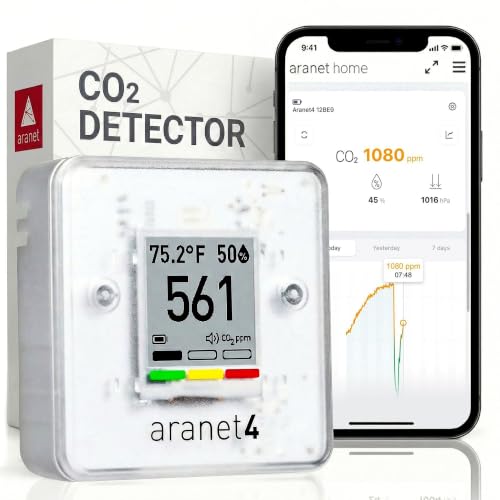
- Monitors CO2, temperature, humidity, and pressure
- Up to 4 years of battery life with an e-ink display
- App provides 90 days of historical data and graphs
Best For: Homes, offices, and classrooms that need a low-maintenance indoor monitor.
Best for Long-Term Monitoring
HOBO MX1101 Temperature/Humidity Logger

- Long storage capacity for extended logging sessions
- Bluetooth access simplifies data retrieval
- LCD screen shows live readings and status
Best For: Facilities and labs needing dependable temperature and humidity monitoring over time.
Best for Data Export

- Measures CO2, PM2.5, PM10, temperature, and humidity
- Exports readings via USB for CSV-based analysis
- Audio alarm and color display help with quick checks
Best For: People who want a portable monitor with exportable readings for practical air-quality tracking.
Best for Pharma Transit Monitoring
Frigga V5B 4G/5G Temp Data Logger

- Live temperature, location, and route monitoring
- 4G/5G with 2G fallback for transit reliability
- Dual PDF reports plus USB backup for traceability
Best For: Temperature-sensitive pharmacy, medical, and laboratory shipments that need real-time tracking.
Best for CO2 Trend Tracking
Extech CO250 Portable Indoor Air Quality CO2 Meter

- NDIR CO2 sensing from 0 to 5,000 ppm
- Measures temperature, humidity, dew point, and wet bulb
- Stores 99 readings for quick trend tracking
Best For: HVAC technicians, inspectors, and facility teams needing portable CO2 and environmental checks.
Best for Continuous CO2 Monitoring
Lascars Wireless CO2 & Air Quality Logger

- Tracks CO2, temperature, and humidity in one device.
- Custom alarms help catch air quality issues fast.
- USB power plus AA backup supports continuous logging.
Best For: Schools, offices, homes, and grow rooms that need dependable CO2 monitoring with remote data access.
Best for Multi-Region AQI Tracking
Davis AirLink Professional Air Quality Sensor

- Global AQI standards for multiple countries and regions
- Minute-by-minute cloud-connected readings over Wi-Fi
- Works standalone or with a Davis weather station
Best For: Buyers who want a connected air quality monitor with global AQI support and Davis ecosystem compatibility.
Best for Data Logging
Smart Air Quality Monitor 12-in-1

- Logs 10W+ readings to a TF card for later review
- Monitors CO2, PM1.0, PM2.5, PM10, TVOC, and HCHO
- Portable design works well for room-to-room checks
Best For: Buyers who want a portable indoor monitor with built-in data logging for longer-term tracking.
Best for Real-Time Tracking
GoveeLife Smart Air Quality Monitor

- 2-second refresh for PM2.5, temp, and humidity
- WiFi/Bluetooth with 2-year exportable history
- Works with compatible GoveeLife smart devices
Best For: People who want fast indoor air monitoring with app logs and smart-home automation.
Best for Multi-Parameter Monitoring

- Measures PM2.5, PM10, formaldehyde, VOCs, humidity, temperature, and AQI.
- Histogram view plus exportable logs help track air trends over time.
- Good fit for buyers who want broad monitoring in one device.
Best For: Home or office users who want broad air quality monitoring with simple logging and export.
Best for Long Battery Life – Aranet4 Home Wireless Indoor Air Quality Monitor
If you need one of the most practical air quality data loggers for everyday indoor monitoring, Aranet4 Home stands out for its long battery life, clear CO2 readout, and easy historical tracking. It’s a strong fit for homes, offices, and classrooms where knowing when to ventilate matters more than adding complex setup steps.
Best For: People who want a reliable, portable indoor monitor with multi-day data history and minimal maintenance.
Pros:
- Tracks CO2, temperature, humidity, and atmospheric pressure in real time
- Up to 4 years of battery life with a cable-free e-ink display
- App stores up to 90 days of history with simple graphs and trends
- NDIR sensor technology delivers precise CO2 measurements
Cons:
- Focused on indoor use rather than full multi-sensor environmental logging
- Higher upfront cost than basic CO2 meters
- Display is information-rich, but not as detailed as app-based dashboards
For buyers comparing air quality data loggers, Aranet4 Home is a smart pick if you value accuracy, portability, and low upkeep over advanced automation. It gives you the core data you need to improve ventilation and indoor comfort without constant charging or complicated setup.
Best for Long-Term Monitoring – HOBO MX1101 Temperature/Humidity Logger
The HOBO MX1101 is a solid pick for air quality data loggers when you need dependable temperature and humidity tracking over long periods. With Bluetooth access, a built-in LCD, and large onboard storage, it’s easy to check readings and keep logging without constant maintenance.
Best For: Facilities, labs, greenhouses, and other spaces that need reliable environmental monitoring with minimal upkeep.
Pros:
- Measures temperature from -20°C to 70°C with strong stated accuracy.
- Tracks relative humidity from 1% to 90% for broader environmental insight.
- 128 KB memory supports up to 84,650 measurements for extended logging.
- Bluetooth Low Energy makes it easier to retrieve data within about 100 feet.
Cons:
- Logs temperature and humidity, but not gases or particulate levels.
- Not a full indoor air quality monitor for multi-sensor pollution tracking.
For buyers comparing air quality data loggers, this model stands out for straightforward, long-run temperature and humidity monitoring rather than broad sensor coverage. It’s a practical choice when stability, storage, and easy access matter more than advanced air testing.
Best for Data Export – Temtop M2000C 2ND Air Monitor
If you need air quality data loggers that can do more than show a live reading, the Temtop M2000C 2ND is a practical pick. It tracks CO2, PM2.5, PM10, temperature, and humidity, then lets you export readings for deeper review, making it useful for classrooms, offices, homes, and small business environments.
Best For: Buyers who want a portable monitor with exportable air quality data for ongoing analysis and ventilation decisions.
Pros:
- Tracks CO2, PM2.5, PM10, temperature, and humidity in one unit
- USB data export helps with long-term tracking and analysis
- Audio alarm and TFT display make alerts easy to notice
- Rechargeable design improves portability for multi-room use
Cons:
- Not a full professional logging system for advanced calibration workflows
- Best suited to spot monitoring and export rather than continuous networked logging
For shoppers comparing air quality data loggers, this model stands out for combining portable measurement, simple alerts, and straightforward CSV export. It is a strong fit when you want actionable readings without adding a more complex monitoring platform.
Best for Pharma Transit Monitoring – Frigga V5B 4G/5G Temp Data Logger
If you need air quality data loggers for regulated shipping workflows, the Frigga V5B is more of a cold-chain temperature tracker than a general-purpose sensor. It focuses on real-time alerts, location tracking, and cloud reporting, making it a strong fit for high-value medical and pharmaceutical shipments where immediate intervention matters.
Best For: Temperature-sensitive pharmacy, medical, and laboratory transport that needs live monitoring and route visibility.
Pros:
- Real-time temperature, location, and route tracking with cloud alerts
- 4G/5G connectivity with 2G fallback for wider transit coverage
- Dual PDF reporting and USB backup help reduce data loss risk
- Long 60-day runtime supports extended shipments
Cons:
- Single-use design may not suit repeat in-house monitoring
- Centered on temperature logistics, not broader environmental sensing
- Requires cloud/app workflow for the full feature set
For buyers comparing air quality data loggers, this model stands out less for indoor IAQ use and more for transport compliance and shipment traceability. It is a better choice when the priority is protecting sensitive products in transit rather than logging ambient room conditions.
Best for CO2 Trend Tracking – Extech CO250 Portable Indoor Air Quality CO2 Meter
If you need one of the more practical air quality data loggers for indoor diagnostics, the Extech CO250 combines CO2 monitoring with temperature, humidity, dew point, and wet bulb readings in a compact handheld format. It is a useful fit for quick inspections where you want more than a single-number reading.
Best For: HVAC technicians, inspectors, and facility teams that need portable CO2 and environment tracking with basic onboard logging.
Pros:
- Measures CO2 from 0 to 5,000 ppm with an NDIR sensor for dependable readings
- Tracks temperature, humidity, dew point, and wet bulb for broader indoor assessment
- Stores up to 99 readings for simple trend checks and compliance notes
- Large backlit LCD and handheld design make it easy to use in the field
Cons:
- 99-record storage is modest compared with dedicated long-term loggers
- Focused on CO2 and environmental spot checks rather than advanced logging workflows
For buyers comparing air quality data loggers, this model stands out for its balance of portability, multi-parameter sensing, and straightforward logging, especially when CO2 accuracy matters more than deep memory capacity.
Best for Continuous CO2 Monitoring – Lascars Wireless CO2 & Air Quality Logger
If you need air quality data loggers that track CO2, temperature, and humidity in one unit, this Lascars model is a practical all-around choice. It’s built for ongoing monitoring in spaces where conditions can change quickly, with app access for viewing and downloading data from anywhere.
Best For: Schools, offices, homes, and growing areas that need reliable CO2 tracking with remote access.
Pros:
- Monitors CO2, temperature, and humidity together.
- Custom high/low alarms help flag problems quickly.
- USB power with AA battery backup supports uninterrupted logging.
- EasyLog app makes data viewing and export simple on the go.
Cons:
- CO2-focused monitoring may be more than some basic users need.
- AA battery backup adds another maintenance point.
For buyers comparing air quality data loggers, this model stands out for combining remote access, alarm settings, and dual-power reliability in a single monitoring package. It’s a good fit when you want more than a basic reader and need data you can check over time.
Best for Multi-Region AQI Tracking – Davis AirLink Professional Air Quality Sensor
If you need air quality data loggers that can report more than just a basic particulate reading, the Davis Instruments AirLink is built for flexible indoor or outdoor monitoring. It delivers real-time AQI, temperature, humidity, dew point, and heat index, while sending updates to your phone and computer over Wi-Fi.
Best For: Buyers who want a connected air quality monitor with global AQI support and easy integration with Davis weather setups.
Pros:
- Supports multiple regional AQI standards, including US, EU, UK, Canada, and more
- Updates readings every minute through Davis Cloud access
- Measures fine particulates down to 0.3 micrometers
- Can work as a standalone sensor or alongside a Davis weather station
Cons:
- Requires Wi-Fi and Davis Cloud for full connected functionality
- More of a sensor platform than a simple plug-and-play logger
For buyers comparing air quality data loggers, this model stands out for its broad AQI coverage and flexible deployment options. It is a strong fit if you want a monitoring system that can scale from a single location to a more complete Davis-based weather and air quality setup.
Best for Data Logging – Smart Air Quality Monitor 12-in-1
If you need one of the more capable air quality data loggers for home or office monitoring, this 12-in-1 smart meter combines particle counting, gas sensing, and onboard storage in a compact unit. It tracks CO2, PM1.0, PM2.5, PM10, TVOC, and HCHO, making it useful for checking indoor air trends and documenting changes over time.
Best For: Buyers who want a portable indoor monitor with built-in data logging for longer-term air quality tracking.
Pros:
- Built-in TF card logging stores 10W+ data records for later analysis
- Tracks multiple key metrics, including CO2, particulate matter, TVOC, and formaldehyde
- Laser particle sensor measures fine dust across several particle sizes
- Compact design is easy to move between rooms or take on the go
Cons:
- More feature-rich than a basic monitor, so it may be overkill for simple checks
- Data review requires exporting files from the memory card
This is a practical pick if you want air quality data loggers that do more than just show a live reading. Its mix of sensors and onboard storage makes it a stronger fit for people comparing indoor air patterns, not just spotting one-time spikes.
Best for Real-Time Tracking – GoveeLife Smart Air Quality Monitor
For buyers comparing air quality data loggers, this GoveeLife monitor stands out for its quick 2-second refresh rate, PM2.5 sensing, and built-in temperature and humidity tracking. It’s a practical wired option for keeping an eye on day-to-day indoor conditions in a home, office, or shared room.
Best For: Anyone who wants fast, easy-to-read indoor air monitoring with app-based logging and smart home automation.
Pros:
- 2-second updates help you catch fast changes in PM2.5, temperature, and humidity.
- WiFi and Bluetooth support remote viewing plus 13-day charts and 2-year exportable history.
- Can trigger compatible GoveeLife purifiers, humidifiers, heaters, and fans automatically.
- LED display with clock, night mode, and air-quality level indicators.
Cons:
- Requires постоянный power via Type-C cable; no built-in battery.
- Clock display needs 2.4GHz Wi-Fi.
As an air quality data logger, this model is strongest when you want frequent updates, remote access, and long-term logging without paying for a more advanced multi-gas sensor setup. It’s a smart fit if you care most about PM2.5 trends and simple automation rather than full professional calibration.
Best for Multi-Parameter Monitoring – Temtop Air Quality Monitor
If you want one of the more complete air quality data loggers for home or office use, this Temtop monitor is built to track the basics and the extras in one unit. It measures PM2.5, PM10, formaldehyde, VOCs, humidity, temperature, and AQI, then lets you review trends with histogram data and export readings for easier analysis.
Best For: Buyers who want a single indoor/outdoor monitor with broad pollutant coverage, built-in logging, and simple exportable records.
Pros:
- Tracks PM2.5, PM10, formaldehyde, VOCs, temperature, humidity, and AQI.
- Includes histogram view and data export for reviewing logged readings.
- Designed for long-term use with a laser particle sensor rated for extended lifespan.
- Clear display makes real-time readings easy to check at a glance.
Cons:
- Formaldehyde readings can be affected by alcohol, cleaners, and air fresheners.
- Exported data is basic, so it may not suit advanced analysis workflows.
For shoppers comparing air quality data loggers, this Temtop stands out for its wide sensor mix and straightforward reporting rather than deep pro-grade analytics. It’s a practical pick if you want reliable everyday monitoring with enough logging to spot patterns over time.
How We Picked These Air Quality Data Loggers
We prioritized devices that make long-term monitoring easier, not just easier readings. Key factors included sensor mix, logging and export options, connectivity, portability, battery life, alert functions, and whether the device fits a home, workplace, or more technical use case.
Because air quality needs vary widely, we also looked for a range of formats: compact indoor monitors, wireless connected loggers, professional meters, and remote monitoring tools for specialized environments.
Quick Comparison: Which Type Fits Your Needs?
If you need everyday awareness in a room, a compact indoor monitor with CO2 and particle sensing may be enough. If you need records for compliance, troubleshooting, or facility management, choose Air Quality Data Loggers with exportable logs and stable long-term tracking. For remote sites, cellular or wireless monitoring is often more useful than a purely portable meter.
Key Buying Factors for Air Quality Data Loggers
Sensor Types
Look for the pollutants and conditions you actually need. CO2 is helpful for ventilation, PM2.5 and PM10 matter for dust and smoke, and TVOC or HCHO readings can be useful for indoor chemical concerns. Temperature and humidity are common supporting measurements.
Logging and Data Access
Good logging should be easy to retrieve and interpret. Check whether data can be exported, stored in the cloud, reviewed on-device, or shared with a mobile app. Longer retention matters if you want trend analysis instead of just live readings.
Connectivity and Power
WiFi, Bluetooth, or cellular options change how flexible a logger is. Battery-powered units are convenient for portable use, while plug-in or network-connected models are better for continuous monitoring.
Accuracy and Use Environment
Choose a logger designed for your setting. Indoor monitors are usually optimized for occupied rooms, while professional or outdoor-capable sensors are better for facilities, warehouses, or mixed environments. Also consider calibration needs and sensor response time.
Who Should Buy Which Air Quality Data Loggers?
Homeowners and renters should lean toward easy-to-read indoor monitors with clear alerts and simple app access. Offices, classrooms, and property managers often benefit from connected Air Quality Data Loggers with long-term data storage and remote visibility. Technical users, industrial teams, and facilities staff may prefer more advanced units with exportable records, multi-parameter sensing, and broader deployment options.
If your main goal is improving comfort and ventilation, choose a straightforward CO2-focused model. If you need deeper environmental insight, prioritize devices that combine particle, gas, and climate measurements in one logger.