
The best advanced science experiment sets turn curiosity into repeatable, hands-on learning. This roundup compares chemistry labs, circuit kits, energy projects, and broad STEM collections for different ages and skill levels.
Use the guide below to match experiment depth, equipment, safety features, and educational support with the learner’s goals—whether they are starting with guided activities or ready for more independent lab work.
Best 10 Advanced Science Experiment Sets Picks for 2026
Advanced Chemistry Pick

- 333+ experiments in inorganic, organic, and electrochemistry
- Includes real lab equipment, chemicals, and safety goggles
- Detailed 192-page manual for ages 12+ with adult supervision
Best For: Serious young scientists and homeschool chemistry students
Three-in-One Explorer
National Geographic Mega Science Lab
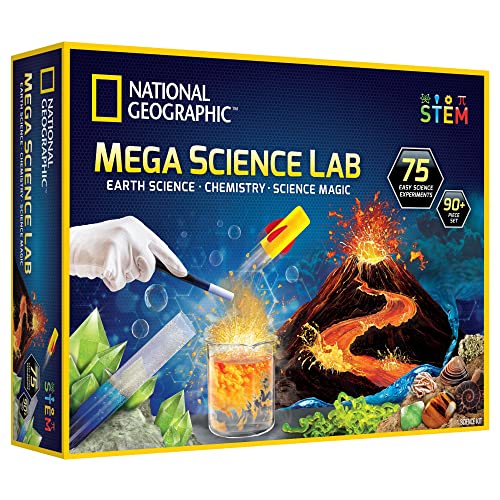
- Combines Earth science, chemistry, and science magic
- Includes 75 experiment ideas and real rock specimens
- Designed for children ages 8 and up
Best For: Families seeking varied, approachable STEM activities
Clean Energy Builder

- Build solar, wind, and hand-crank energy models
- Includes 24 NGSS-aligned experiments
- Modular parts support repeated reconfiguration
Best For: Renewable-energy lessons at home or in classrooms
High-Volume STEM Fun

- Offers 272 chemistry, physics, and STEM activities
- Includes plastic lab-style tools and illustrated instructions
- Suitable for children ages 8 and up
Best For: Families wanting lots of accessible, varied experiments
Intermediate Chemistry Lab

- 250 real chemistry experiments
- Includes alcohol burner and lab equipment
- 128-page manual with safety guidance
Best For: Ages 11+ ready for intermediate chemistry with adult supervision
Hands-On Physics Builder

- Builds circuits and magnetic models
- Includes 27 organized components
- Manuals explain electricity principles
Best For: Grades 7–11 learning practical circuits and magnetism
Classic Chemistry Starter

- 28 guided chemistry experiments
- Includes basic lab supplies
- Full-color explanations for beginners
Best For: Ages 10–15 starting hands-on chemistry
Best All-Around Experiment Variety
Doctor Jupiter Ultimate Science Kit

- More than 135 included experiments
- 90+ additional household-item activities
- Illustrated, step-by-step instructions
Best For: Kids seeking varied science activities with family participation
Best Real Chemistry Starter Set

- 125 experiments in 10 chemistry chapters
- Real lab equipment and seven chemicals
- 80-page manual with integrated safety guidance
Best For: Learners age 10+ ready for structured chemistry
Advanced Chemistry Pick – CHEM C3000 Chemistry Set
For learners ready to move beyond introductory activities, the CHEM C3000 is one of the most advanced science experiment sets in this roundup. It combines more than 333 experiments with real lab-style equipment, chemicals, and a detailed manual covering inorganic, organic, and electrochemistry.
Best For: Aspiring chemists, homeschoolers, and students ages 12 and up who can experiment with adult supervision.
Pros:
- Offers more than 333 experiments across 27 chapters.
- Includes glassware, electrodes, an alcohol burner, goggles, and other authentic lab equipment.
- The 192-page manual provides substantial scientific background and step-by-step guidance.
Cons:
- Requires adult supervision throughout.
- Some experiments require common household additions.
- Its advanced chemistry focus may be more than younger beginners need.
With its broad subject coverage and genuine chemical reactions, this is the strongest choice for a serious, long-term home chemistry setup. Buyers should be prepared to follow the included safety, first-aid, labeling, and disposal guidance carefully.
Three-in-One Explorer – National Geographic Mega Science Lab
The National Geographic Mega Science Lab is a versatile option for families comparing advanced science experiment sets for children ages 8 and up. It combines Earth science, chemistry, and science magic, with 45 included activities plus 30 additional ideas using household items.
Best For: Kids ages 8 and up who want variety, including rocks and minerals, chemistry reactions, and entertaining science demonstrations.
Pros:
- Combines three categories in one kit: Earth science, chemistry, and science magic.
- Includes 75 total experiment ideas, including household-material activities.
- Features a volcano, glow-in-the-dark crystal, fossil, rock specimens, and chemistry projects.
Cons:
- The experiments span several topics rather than providing a deep focus in one science field.
- Some of the additional activities rely on common household items.
This kit is a practical pick when engagement and variety matter more than specialized depth. Its mix of collecting, reactions, and visual demonstrations gives children multiple ways to explore STEM concepts.
Clean Energy Builder – Renewable Energy Lab
For learners interested in how power is generated, the Renewable Energy Lab stands out among advanced science experiment sets for its project-based focus. It uses modular parts to explore solar and wind energy while building models such as a windmill, solar car, hand-crank generator, and LED buzzer.
Best For: Students ages 8 to 14, classrooms, and families exploring renewable energy and NGSS-aligned STEM activities.
Pros:
- Includes 24 experiments aligned with several Next Generation Science Standards.
- Modular components can be swapped, combined, and reconfigured for multiple projects.
- Includes a solar panel, motor/generator, turbine blades, and voltage/current meter.
Cons:
- The micro:bit compatibility requires a micro:bit sold separately.
- The included illustrated manual is 32 pages, shorter than some comprehensive kits.
This is a strong choice for hands-on learners who prefer constructing working models over performing standalone demonstrations. Printable worksheets and classroom resources add value for structured instruction.
High-Volume STEM Fun – UNGLINGA 272 Experiments Kit
The UNGLINGA kit offers a large menu of accessible activities for families looking for advanced science experiment sets with broad STEM variety. Its 272 experiments include volcanoes, crystal growing, holographic projection, walking water, and chemistry and physics demonstrations.
Best For: Children ages 8 and up who enjoy frequent, easy-to-follow activities and want to experiment with family, friends, or classmates.
Pros:
- Provides 272 experiment ideas in a single kit.
- Covers chemistry, physics, crystals, volcanoes, and visual STEM activities.
- Includes child-sized plastic lab tools and an illustrated instruction manual.
Cons:
- The tools are made from plastic rather than laboratory glass.
- The supplied notes do not specify the complete materials required for every experiment.
This kit emphasizes quantity, accessibility, and shared activity time. It is well suited to children who benefit from short, varied projects and clear visual instructions rather than a single in-depth science curriculum.
Intermediate Chemistry Lab – CHEM C2000
For shoppers seeking advanced science experiment sets, the Thames & Kosmos CHEM C2000 is a substantial step beyond beginner chemistry kits. It combines 250 experiments, real lab equipment, an alcohol burner, and a 128-page manual covering topics such as acids and bases, electrochemistry, chromatography, food chemistry, and luminol.
Best For: Aspiring young chemists ages 11 and up who are ready for intermediate, hands-on chemistry with adult supervision.
Pros:
- Includes 250 real chemistry experiments across 18 themed chapters.
- Provides professional-style equipment, including beakers, test tubes, goggles, tubing, and electrolysis components.
- The alcohol burner enables heat-based experiments involving combustion, evaporation, and crystallization.
- Detailed safety, first-aid, labeling, and waste-disposal guidance is integrated into the manual.
Cons:
- Adult supervision is required, particularly for experiments involving chemicals and an alcohol burner.
- Its intermediate scope may be more demanding than necessary for beginners.
With its unusually broad experiment count and genuine laboratory setup, the CHEM C2000 is a strong long-term choice for families, homeschoolers, or students building a foundation for high school chemistry.
Hands-On Physics Builder – EUDAX Circuit Kit
The EUDAX upgrade kit is a practical option among advanced science experiment sets for students exploring electricity and magnetism. Its 27-piece collection supports projects ranging from series and parallel circuits to electromagnets, a hand-crank generator, wind power car, LEDs, and traffic-light models.
Best For: Students in grades 7–11, especially those learning basic electrical and magnetic concepts through guided construction.
Pros:
- Supports a variety of circuit, electricity, and magnetism projects.
- Includes switches, wires, bulbs, LEDs, and other components needed to begin building.
- Parts store in a transparent box for easier organization.
- Full-color manuals help explain the underlying principles.
Cons:
- Two AA batteries are required but not included.
- The kit focuses on basic electricity and magnetism rather than advanced electronics.
This is a compact, reusable learning set for students who benefit from physically wiring models and testing how circuits work, though buyers should plan to supply the required batteries.
Classic Chemistry Starter – CHEM C500
The Thames & Kosmos CHEM C500 offers a guided introduction for shoppers comparing advanced science experiment sets with more approachable chemistry options. It includes 28 classic experiments, basic lab supplies, and a 48-page full-color guide covering acids and bases, reactions between solids, liquids, and gases, foaming reactions, and invisible ink.
Best For: Beginners ages 10–15 who want structured chemistry activities with clear explanations.
Pros:
- Provides 28 guided experiments with straightforward setup instructions.
- Introduces colorful acid-base reactions, gases, solids, liquids, and invisible ink.
- Includes beakers, test tubes, chemicals, stoppers, and pipettes.
- The full-color manual explains both what happened and why.
Cons:
- Offers substantially fewer experiments and less advanced equipment than larger intermediate kits.
- Its introductory scope may not satisfy students seeking complex chemistry projects.
The CHEM C500 is best viewed as a structured starting point rather than a full advanced laboratory. Its manageable experiment count and explanatory manual make it a sensible choice for first-time chemistry learners.
Best Electronics Exploration Kit – Hands-On Circuit Building
For families seeking advanced science experiment sets with a strong electronics focus, this 66-piece kit offers a tool-free way to explore circuits. Color-coded, numbered parts snap onto the included grid, and the guide presents more than 1,200 project possibilities for children learning through hands-on construction.
Best For: Kids over age 6, especially aspiring young engineers interested in introductory circuitry and screen-free STEM play.
Pros:
- Offers more than 1,200 possible electronic projects.
- Requires no soldering, batteries, or extra tools.
- Color-coded pieces and an illustrated guide support independent building.
- Encourages creativity, problem-solving, and practical circuit skills.
Cons:
- The plastic components may provide less of a real-lab experience than chemistry-focused sets.
- The broad age messaging is inconsistent; the manufacturer recommends it for ages 6 and up.
This is a practical choice when you want advanced science experiment sets centered on repeatable electronics projects rather than chemical experiments. Its snap-together design makes it approachable while still offering plenty of room for experimentation.
Best All-Around Experiment Variety – Doctor Jupiter Ultimate Science Kit
This Doctor Jupiter kit is one of the more versatile advanced science experiment sets for children who want to try many different activities. It combines more than 135 experiments with materials for color changes, glowing water, underwater volcanoes, potions, and additional activities using common household items.
Best For: Children ages 8 and up who enjoy broad science variety and families looking for a parent-child activity set.
Pros:
- Includes more than 135 experiments and access to over 90 bonus activities.
- Step-by-step instructions and illustrations make activities easier to follow.
- Separate leak-proof bottles help organize the included ingredients.
- Supports extended, screen-free learning and shared parent-child projects.
Cons:
- Some bonus experiments rely on additional household items.
- Its emphasis on variety may offer less formal lab equipment than a dedicated chemistry set.
Choose this kit if experiment count and variety matter most. It provides a gentle introduction to multiple science topics and can deliver substantial activity time without requiring a specialized laboratory setup.
Best Real Chemistry Starter Set – Thames & Kosmos Chem C1000
For older children ready to move beyond basic kitchen activities, the Thames & Kosmos Chem C1000 is a more structured option among advanced science experiment sets. It includes 125 experiments, real lab equipment, seven chemicals, and an 80-page illustrated manual covering laboratory technique, indicators, electrochemistry, crystals, gases, and more.
Best For: Curious learners ages 10 and up, homeschool families, and aspiring young scientists who want a genuine introductory chemistry experience.
Pros:
- Provides 125 hands-on experiments arranged across 10 themed chapters.
- Includes glass test tubes, graduated beakers, safety goggles, and other lab equipment.
- Covers substantive topics including chromatography, electrochemistry, electrolysis, and food chemistry.
- Includes safety rules, hazard labeling, first-aid guidance, and disposal instructions.
Cons:
- Adult supervision is required.
- The chemistry activities are intended for ages 10 and up, making it unsuitable for younger children.
- Some supplies, such as an alkaline battery, may be needed for certain experiments.
This is the strongest fit for buyers prioritizing authentic technique and depth over simple demonstrations. Its equipment, chemicals, manual, and safety guidance make it a serious first chemistry set, provided an adult is available to supervise.
How We Picked These Advanced Science Experiment Sets
We selected sets that offer substantially more than a single demonstration or novelty project. The lineup includes chemistry kits with real lab-style equipment, physics and electronics sets for building circuits, renewable-energy activities, and broad experiment collections for younger learners. We considered the number and variety of activities, the clarity of the instructions, included components, age guidance, opportunities for repeat use, and how well each kit supports concepts taught in school.
Experiment counts are not directly comparable: some kits count small variations as separate activities, while others provide fewer but more structured investigations. Adult supervision, replacement supplies, and local safety requirements should also be part of the buying decision.
Quick Comparison
| Best For | Look For | Strong Fit From This Roundup |
|---|---|---|
| Beginner chemistry | Clear instructions, manageable experiments, basic equipment | Thames & Kosmos Chem C1000 |
| Intermediate chemistry | More reagents, lab techniques, and detailed guidance | Thames & Kosmos Chem C2000 |
| Advanced chemistry | Broad component selection and room for exploration | Thames & Kosmos Chem C3000 |
| Physics and circuits | Modular parts, wiring practice, and repeatable builds | EUDAX Physics Lab or Electronics Exploration Kit |
| Broad STEM exploration | Many guided activities across multiple science topics | National Geographic Mega Science Lab or Doctor Jupiter |
| Energy and sustainability | Hands-on demonstrations of renewable power systems | Thames & Kosmos Renewable Energy Lab |
Key Buying Factors for Advanced Science Experiment Sets
Age, Skill Level, and Supervision
Choose by demonstrated readiness rather than experiment count alone. Younger children generally benefit from short, highly guided activities, while older students may prefer open-ended chemistry, circuit troubleshooting, or measurement-based projects. Chemistry sets can require continuous adult supervision, protective eyewear, ventilation, and careful storage.
Experiment Depth and Educational Support
A substantial manual can matter more than a large parts count. Look for explanations of variables, observations, expected results, and the science behind each activity. Sets that encourage recording data or changing one variable at a time provide stronger preparation for classroom lab work.
Equipment, Consumables, and Repeat Use
Check whether the kit includes measuring tools, containers, wires, connectors, power sources, and protective items. Also confirm which ingredients or batteries are not included. Reusable components support ongoing projects, whereas consumable-heavy chemistry kits may need replenishment before every experiment is complete.
Safety and Storage
Review warnings, recommended protective equipment, age limits, and disposal instructions before purchase. A compartmented case or organized storage system can prevent missing pieces and make supervised setup faster.
Who Should Buy Which Advanced Science Experiment Sets?
Choose a beginner chemistry set such as the Chem C1000 for a learner who wants a structured introduction to reactions and lab methods. The Chem C2000 suits students ready for a larger experiment library and more independence, while the Chem C3000 is the better choice for advanced learners who want the broadest chemistry-focused setup.
For children who need variety across science topics, the National Geographic Mega Science Lab, Doctor Jupiter kit, or UNGLINGA collection can provide an accessible starting point. Choose the renewable-energy lab for sustainability-focused projects, and select the EUDAX or electronics kit when the main goal is understanding circuits, components, and electrical problem-solving.
For classroom use or family learning, prioritize durable parts, clear manuals, and activities that can be repeated with different variables. For a gift, match the kit to the child’s current ability and interests instead of choosing solely by the highest advertised experiment count.