
The best advanced physics experiment sets turn difficult concepts into experiments learners can see, measure, and repeat. This roundup covers practical kits for electricity, magnetism, optics, motion, and introductory radiation science.
Use the comparison and buying advice below to match the kit’s complexity, safety requirements, and learning goals with the student or home lab setup.
Best 10 Advanced Physics Experiment Sets Picks for 2026
Best for Core Electromagnetism
School Physics Labs Electricity & Magnetism Kit
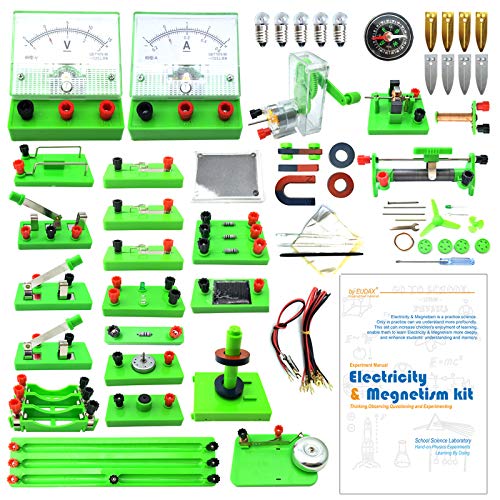
- 79 components for electricity and magnetism projects
- Includes circuits, Ohm’s law, electromagnet, and generator activities
- Color manual and storage bag included
Best For: Grades 9–11 students and introductory physics labs
Best for Energy Conversion Projects

- Explores electricity, magnetism, and energy conversion
- Includes solar panel, hand-crank generator, ammeter, and voltmeter
- Illustrated manual and portable case included
Best For: Ages 8–16 and science-fair or classroom projects
Best for Hands-On Optics
Multifunction Physics Optical Experiment Set

- Demonstrates reflection and refraction with lenses, mirrors, and a prism
- Includes an adjustable three-way linear light source
- Recommended for ages 14 and up
Best For: Teen optics lessons and teacher demonstrations
Best for Motion and Building

- Builds six models illustrating motion-related physics laws
- Covers inertia, friction, and circular motion
- Includes theory, experiments, quizzes, and a 3D app
Best For: Ages 9+ and hands-on engineering learners
Best Advanced Optics Kit

- 37-piece kit covers reflection, refraction, lenses, imaging, and color.
- Assembled 60 cm optical bench helps simplify setup.
- Includes adjustable lights, acrylic optics, screens, mirrors, and storage.
Best For: Ages 14+, STEM classrooms, home labs, and optics-focused learners
Best Atmospheric Physics Set

- Compact chamber supports hands-on observation of physics phenomena.
- Includes a manual and power adapter for the chamber.
- Radioactive source and ethanol are not included and require precautions.
Best For: Adults and 16+ STEM enthusiasts building a supervised home lab
Best Electricity and Magnetism Kit

- 50-piece set supports 18 circuit and magnetism experiments.
- Includes ammeter, voltmeter, motors, magnets, generator, and components.
- 40-page illustrated manual suits guided family or classroom learning.
Best For: Ages 8–18, beginners, parent-child activities, and school projects
Advanced Electromagnetism Pick
Electromagnetic Coil Accelerator

- Models circular particle acceleration
- Compact metal-and-acrylic build
- Designed for older STEM learners
Best For: Physics demonstrations focused on electromagnetism and acceleration
Advanced Optics Lab Pick

- Includes 15+ light experiments
- Features lenses, mirrors, and prisms
- Comes with a 32-page manual
Best For: Structured optics learning at home or in the classroom
Advanced Circuit Learning Pick

- Includes 50+ DIY experiments
- Provides 55 circuit and magnetism items
- Uses an organized storage case
Best For: Hands-on electricity and magnetism learning for teens
Best for Core Electromagnetism – School Physics Labs Electricity & Magnetism Kit
For students who need a structured introduction to electricity and magnetism, this advanced physics experiment set offers 79 components and a color manual for hands-on projects. It covers circuit building, Ohm’s law, electromagnetism, and energy generation, while requiring three AA batteries that are not included.
Best For: Students in grades 9–11, home STEM practice, and introductory classroom labs.
Pros:
- Supports series and parallel circuits, fruit batteries, resistor measurements, and electromagnet experiments.
- Includes 56 electricity items, 21 magnetism items, repair tools, and a storage bag.
- Color-page instructions support exploration and independent learning.
Cons:
- Requires three AA batteries, which are not included.
- The product is more focused on electricity and magnetism than on broader physics topics.
This is a practical choice when you want a substantial circuit-and-magnetism kit with enough components for repeated projects. Its recommended age range is broad, but younger users may benefit from adult guidance.
Best for Energy Conversion Projects – 71-Piece Advanced Physics Lab
This advanced physics experiment set is designed for learners who want to investigate electricity, magnetism, and energy conversion in one package. Its 71 components include measuring instruments, a hand-crank generator, and a solar panel, with an illustrated manual for guided experiments.
Best For: Ages 8–16, aspiring young scientists, science-fair preparation, and repeated home or classroom use.
Pros:
- Combines circuit building, electromagnetism, and mechanical- and light-to-electric energy conversion.
- Includes an ammeter, voltmeter, solar panel, hand-crank generator, electric bell, rheostat, and other circuit parts.
- Full-color instructions and a portable storage case support organized, independent learning.
Cons:
- The wide 8–16 age range means some experiments may need adult explanation or supervision.
- The kit concentrates primarily on electricity, magnetism, and energy rather than covering all physics areas.
Choose this set if renewable-energy demonstrations and measurement tools are priorities. It offers more varied electrical exploration than a basic circuit kit while remaining accessible through step-by-step instructions.
Best for Hands-On Optics – Multifunction Physics Optical Experiment Set
For learners focused on light rather than circuits, this advanced physics experiment set provides lenses, mirrors, a prism, and a three-way linear light source for demonstrating reflection and refraction. It is recommended for ages 14 and up and needs two AAA batteries, which are not included.
Best For: Teen students, teacher demonstrations, and introductory optics lessons.
Pros:
- Covers plane-mirror, diffuse, convex-mirror, and concave-mirror reflection.
- Includes biconvex, concave, and convex lenses, an acrylic tile, triangular prism, reflector, and light source.
- Compact 8-piece format is suited to indoor demonstrations and focused optics practice.
Cons:
- Requires two AAA batteries, which are not included.
- Its scope is limited to optical experiments rather than general physics.
- The recommended age is 14 and up, so it may be unsuitable for younger children.
This set makes sense when the goal is to visualize how light behaves through lenses, mirrors, and prisms. The adjustable light source adds flexibility, although the compact component count favors demonstrations over a broad laboratory curriculum.
Best for Motion and Building – Engino Physics Laws STEM Kit
This advanced physics experiment set takes a construction-based approach to inertia, friction, and circular motion. Instead of concentrating on electrical components, it lets children build six working models, including a rocket launcher, crash-test rig, and sharpening wheel, supported by theory, experiments, quizzes, and a 3D app.
Best For: Children ages 9 and up who learn best through building, testing, and revising working models.
Pros:
- Explores practical examples of inertia, friction, and circular motion.
- Offers six model options and includes theory, experiments, and a four-page quiz section.
- Interactive 3D app adds a virtual building component alongside the physical kit.
Cons:
- It does not focus on electricity, magnetism, or optics.
- Model building may require more patience and hands-on assembly than a demonstration kit.
- The included app may not suit every learner or device setup.
Pick this kit for a more mechanical, engineering-oriented introduction to physics. Its combination of working models and explanatory material makes abstract motion laws tangible, particularly for creative builders.
Best Advanced Optics Kit – Hands-On Light Experiments
For shoppers comparing advanced physics experiment sets, this 37-piece optics kit offers a broad way to explore reflection, refraction, lenses, imaging, and primary colors. Its integrated 60 cm optical bench arrives assembled, making it practical for home learning, classroom demonstrations, or lab use.
Best For: Learners aged 14 and up, STEM educators, and families focused on hands-on optics.
Pros:
- Covers plane, diffuse, convex and concave mirror reflection, refraction, lens imaging, pinhole imaging, and color experiments.
- Includes three adjustable light sources and acrylic lenses and prisms.
- Comes with a storage box, manual, optical bench, screens, mirrors, lenses, water components, and other experiment accessories.
- The assembled bench reduces setup time.
Cons:
- The product is recommended for ages 14 and up, so it may be too advanced for younger children.
- The large component assortment may require organized storage and careful handling.
This is a strong choice when variety matters most. It focuses specifically on optics and provides the components needed for repeated demonstrations rather than just a single activity.
Best Atmospheric Physics Set – Wilson Cloud Chamber
Among advanced physics experiment sets, this Wilson cloud chamber is designed for observing particle tracks and creating a compact home-lab experience. The lever-operated chamber includes a power adapter and manual, but the radioactive source and absolute ethanol must be supplied separately.
Best For: Adults, learners aged 16 and up, educators, and STEM enthusiasts prepared to follow radiation and flammability precautions.
Pros:
- Provides a hands-on way to explore physics phenomena with a dedicated source box.
- Compact metal design measures approximately 7.87 by 7.09 by 7.09 inches.
- Includes the cloud chamber, power adapter, and manual.
- Lever-operated construction is intended for straightforward experimentation.
Cons:
- Radioactive source is not included and must be obtained and handled separately.
- Absolute ethanol is flammable and requires careful use.
- Experiments require waiting at least five minutes between the first and second activity.
This is a specialized option rather than a general-purpose kit. It can be compelling for serious physics enthusiasts, but buyers should account for the additional materials and strict operating precautions before purchasing.
Best Electricity and Magnetism Kit – 18 Circuit Experiments
For families seeking advanced physics experiment sets with a gentler introduction, this 50-piece electricity and magnetism kit combines circuits, measurement, motors, magnets, and generators. It includes 18 activities and a 40-page full-color manual for structured learning at home or in school.
Best For: Children ages 8 to 18, parent-child science activities, school projects, and introductory electricity and magnetism.
Pros:
- Offers 18 hands-on experiments, including a fruit battery, electric bell, hand-crank generator, and double-rail activity.
- Includes an ammeter, voltmeter, bulbs, switches, resistors, potentiometer, wires, and battery holders.
- Magnetism components include bar and horseshoe magnets, a compass, solenoid, motor, fan blade, and iron filing box.
- The full-color 40-page manual supports guided activities and family learning.
Cons:
- It is designed for ages 8 to 18, making it less suitable for advanced adult laboratory work.
- Some experiments require batteries or other setup materials not specifically listed among the included components.
This kit is a practical pick for learners who want breadth across basic circuits and magnetism. Its measurement tools and varied modules offer more depth than a single-topic electrical toy while remaining accessible to younger students.
Advanced Electromagnetism Pick – Electromagnetic Coil Accelerator
For learners seeking advanced physics experiment sets focused on electromagnetism, this compact coil accelerator offers a visual model of circular particle acceleration. Its metal-and-acrylic construction suits demonstrations at home or in a classroom, while its 15+ recommended-age positioning makes it better suited to older students, hobbyists, and educators.
Best For: Older STEM learners, physics enthusiasts, and classroom demonstrations of acceleration and electromagnetism.
Pros:
- Demonstrates the concept of repeated acceleration in a circular orbit.
- Compact 9.5-by-9.5-by-2.5-inch design for home or classroom use.
- Sturdy metal and acrylic construction with a high-tech appearance.
Cons:
- Provides a focused demonstration rather than a broad collection of experiments.
- Recommended for ages 15 and up, limiting its suitability for younger children.
This is a specialized teaching model rather than a general-purpose laboratory kit. Choose it when the goal is to make particle acceleration and electromagnetic principles easier to visualize through a hands-on display.
Advanced Optics Lab Pick – Physics & Optics Science Kit
This optics-focused option stands out among advanced physics experiment sets for its broad selection of lenses, mirrors, prisms, light sources, and transparent blocks. With more than 15 experiments and a 32-page illustrated manual, it gives students a structured way to investigate reflection, refraction, image formation, and color effects.
Best For: Students ages 8–16, homeschoolers, and classrooms exploring practical optics concepts.
Pros:
- Includes more than 25 components for a wide range of optical activities.
- Supports experiments involving prisms, lenses, mirrors, refraction, and image formation.
- Step-by-step, 32-page manual helps connect activities with physics concepts.
Cons:
- Its focus is primarily optics, rather than electricity, magnetism, or mechanics.
- The plastic construction may be less durable than a metal laboratory setup.
For buyers prioritizing light experiments, this kit offers a well-organized assortment of components and guided activities. It is especially practical when learners need both hands-on materials and clear explanations.
Advanced Circuit Learning Pick – Electricity & Magnetism Kit
For buyers comparing advanced physics experiment sets that emphasize electricity and magnetism, this kit offers more than 50 projects and 55 components. Its circuit board, electromagnet, magnetic switch, LED, and Joule’s first law module support guided exploration, while the storage case makes the set easier to organize and transport.
Best For: Students ages 13–18, beginners building circuit knowledge, and hands-on STEM projects.
Pros:
- Offers more than 50 DIY experiments across electricity and magnetism topics.
- Includes 55 items, including circuit, electromagnetism, lighting, and magnetic-switch components.
- Illustrated manual explains both what to do and why the experiments work.
- Solid storage case keeps components organized for transport.
Cons:
- Focused on foundational electricity and magnetism rather than a broad range of physics topics.
- The large component count may require careful sorting and setup.
This is a strong choice for learners who want repeated practice rather than a single demonstration. Its project volume, explanatory manual, and portable case make it useful for independent study, classroom work, or group exploration.
How We Picked These Advanced Physics Experiment Sets
We focused on kits that support genuine hands-on investigation rather than simple demonstrations. The selection spans core physics areas, including circuits, electromagnetism, geometric optics, motion, inertia, friction, circular motion, and cloud-chamber observation. We also considered the age range, breadth of experiments, included components, likely classroom or home-lab use, and how easily learners can connect each activity to a clear physics principle.
Because product contents and instructions can vary, check the current listing before buying. Adult supervision is especially important for electrical projects, small parts, powerful magnets, moving mechanisms, and any kit involving specialized equipment.
Quick Comparison
| Best For | Look For |
|---|---|
| Electricity and magnetism | Modular circuit parts, coils, magnets, switches, and clear wiring diagrams |
| Optics | Light source, mirrors, lenses, prism, screen, and adjustable holders |
| Motion and mechanics | Reusable components for inertia, friction, circular motion, and force experiments |
| Radiation science | A cloud chamber with clear instructions; verify whether a radioactive source is included |
| Broad STEM exploration | A varied activity count, organized components, and age-appropriate explanations |
Key Buying Factors for Advanced Physics Experiment Sets
Subject Coverage and Progression
Choose a focused kit if the learner already has a specific interest, such as optics or electromagnetism. A broader set is more useful for beginners who need to sample several branches of physics. Look for experiments that progress from observation to measurement and explanation.
Component Quality and Adjustability
Optical experiments benefit from stable mounts and an aligned light source, while circuit kits need secure connectors and clearly labeled parts. Reusable, modular components usually provide more long-term value than one-time demonstrations.
Instructions and Measurement
Strong instructions explain what to change, what to observe, and why the result occurs. For older students, prioritize kits that encourage recording data, comparing variables, calculating results, or testing a prediction.
Safety and Supervision
Review voltage, heat, moving parts, magnets, small components, and any chemical or radiation-related requirements before purchase. A cloud chamber kit, for example, may require separate equipment or a source that is explicitly not included. Follow the manufacturer’s guidance and use protective equipment when recommended.
Who Should Buy Which Advanced Physics Experiment Sets?
Choose an electricity and magnetism kit for learners interested in circuits, motors, coils, or magnetic fields. Optics-focused sets suit students fascinated by lenses, mirrors, color, imaging, and refraction. A mechanics-oriented engineering kit is a better fit for exploring motion and force through building projects.
For younger learners or first-time experimenters, prioritize clear instructions, sturdy parts, and a manageable number of activities. Older students, homeschoolers, and serious hobbyists should look for adjustable equipment, repeatable experiments, and opportunities to collect quantitative data. Educators may prefer a versatile set with enough component variety to support demonstrations, small-group work, and follow-up investigations.