
Choosing the right distribution amplifier can make a 4K system easier to expand, troubleshoot, and operate. The best model depends on more than resolution: output count, bandwidth, HDCP support, signal type, distance, and control features all matter.
We compared 10 distribution amplifiers spanning compact HDMI splitters, professional 4K units, SDI hardware, and models with long-distance extension or audio de-embedding. Use the guide below to narrow the options by installation size and system requirements.
Best 10 4K Video Distribution Amplifiers Picks for 2026
Best Compact HDMI Pick
2-Output 4K Distribution Amplifier

- 18Gbps HDMI with HDR and HDCP 2.2
- Optional 4K-to-1080p down-conversion
- Includes mounting brackets and power supply
Best For: Two-display signage and monitoring installations
Best Four-Display HDMI Pick

- Four HDMI outputs with 18Gbps bandwidth
- Supports 4K@60Hz, HDR, and HDCP 2.2
- Auto scaling and cascading up to 10 layers
Best For: Four-screen HDMI and expandable enterprise systems
Best Long-Run SDI Pick

- Supports SD, HD, and 3G-SDI up to 1080p60
- Reclocks all four outputs
- Long-distance transmission for SDI cabling
Best For: Broadcast and production SDI installations
Best Commercial-Ready Pick

- 4K/HDR HDMI distribution
- EDID communication management
- Works in commercial or residential setups
Best For: Two-display HDMI distribution with installation-friendly EDID control
Best Feature-Packed 1x2 Splitter
Monoprice Blackbird 4K HDMI Amplifier

- Splits one source to two displays
- Supports 4K@30Hz and 3D video
- Handles 48-bit Deep Color and 7.1 LPCM
Best For: Two-display home entertainment systems with broad format support
Best for Multi-Display Systems
KanexPro 4K UHD 1x8 HDMI Distribution Amplifier

- Feeds up to eight displays
- Supports 4K UHD and 1080p
- HDCP 2.2 and lossless audio support
Best For: Large single-source HDMI installations with up to eight displays
Best with Extra Features

- Compact 7.38 x 4.53 x 1-inch footprint
- Lightweight 14.1-ounce design
- HDMI audio/video distribution amplifier
Best For: Space-conscious HDMI audio/video installations
Feature-Rich 2x8 Splitter
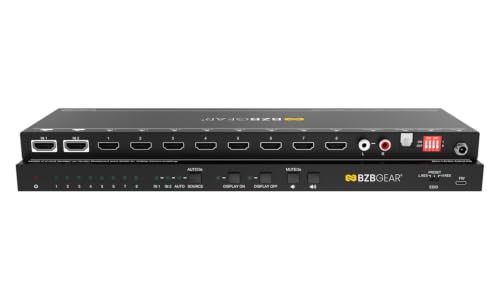
- Supports 4K at 60 Hz with 4:4:4 chroma
- Distributes to eight HDMI outputs
- Includes audio de-embedding and EDID controls
Best For: Multi-display 4K systems with flexible audio handling
Long-Range 4K Extender

- Splits one HDMI source to four outputs
- Supports 4K at 60 Hz over up to 70 meters
- Adds IR, RS-232, ARC, and audio de-embedding
Best For: Long-distance 4K distribution to four displays
Best Compact HDMI Pick – 2-Output 4K Distribution Amplifier
For smaller installations, the KD-DA1X2DC is a practical choice among 4k video distribution amplifiers. It sends one HDMI source to two displays and supports 18Gbps bandwidth, HDR, and HDCP 2.2. Its optional 4K-to-1080p down-conversion can help when connected displays have different capabilities.
Best For: Digital signage, surveillance monitoring, and professional AV installations needing two HDMI outputs.
Pros:
- Supports 4K, HDR, HDCP 2.2, and 18Gbps bandwidth.
- Offers optional 4K-to-1080p down-conversion.
- Includes a Full Buffer System™ and mounting brackets.
Cons:
- Limited to two HDMI outputs.
- Designed for indoor use.
The KD-DA1X2DC is a focused, installation-friendly option when two-screen distribution is enough. Its format support and down-conversion feature add flexibility without requiring a larger distribution system.
Best Audio Distribution Pick – Four-Channel Stereo Amplifier
The Rolls DA134 is an audio-focused distribution amplifier rather than a video splitter, so it is not a direct substitute for 4k video distribution amplifiers. It accepts stereo sources such as an iPad, iPod, or laptop and provides four channels with front-panel volume controls and mono or stereo operation.
Best For: Installations distributing line-level stereo audio to multiple channels.
Pros:
- Provides four distribution channels.
- Supports mono or stereo operation with front-panel volume controls.
- Includes stereo pass-through for connecting another DA134.
Cons:
- Does not distribute HDMI or 4K video.
- Listed with a 90-day warranty.
Choose the DA134 only when your distribution requirement is audio. Its compact metal design and source flexibility make it useful in multi-channel audio setups, but video buyers should consider one of the HDMI or SDI models instead.
Best Four-Display HDMI Pick – 4K HDR Splitter
The SIIG CE-H22Y11-S1 is a strong fit for buyers comparing 4k video distribution amplifiers for four HDMI displays. It supports up to 4K at 60Hz, HDR formats, 18Gbps bandwidth, and simultaneous 4K and 1080p output through automatic video scaling.
Best For: Four-display HDMI systems, enterprise installations, and setups that may expand through cascading.
Pros:
- Distributes one HDMI source to four displays.
- Supports 4K@60Hz, HDR, HDCP 2.2, and 18Gbps bandwidth.
- Offers auto scaling, EDID management, firmware updates, and cascading up to 10 layers.
Cons:
- Does not downscale 4K2K@60 4:2:2 to 1080p.
- Its feature set may be more than needed for a basic two-display setup.
With four outputs and broad compatibility controls, this SIIG splitter is well suited to larger HDMI deployments. The metal housing, three-year limited warranty, and TAA compliance add practical value for business and government environments.
Best Long-Run SDI Pick – 1×4 3G/HD/SDI Amplifier
The AVMATRIX SD1141 is an SDI alternative for professional video systems evaluating 4k video distribution amplifiers. It accepts SD, HD, and 3G-SDI signals, supports video up to 1080p at 60Hz, and reclocks each output for reliable transmission over extended cable runs.
Best For: Broadcast, production, and other SDI installations requiring four outputs and long-distance signal distribution.
Pros:
- Supports SD, HD, and 3G-SDI signals up to 1080p60.
- Provides four outputs with signal reclocking.
- Transmission distances are listed up to 400m for SD, 200m for HD, and 120m for 3G-SDI.
Cons:
- It is an SDI device, not an HDMI 4K splitter.
- It does not support video beyond 1080p60 according to the supplied specifications.
For SDI workflows, the SD1141 emphasizes reach and signal stability rather than consumer HDMI compatibility. Its detachable wall-mounting bracket, three-year warranty, and lifetime technical support are useful for permanent installations.
Best Commercial-Ready Pick – Atlona Rondo 442 4K/HDR 1×2
The Atlona Rondo 442 is a practical choice among 4k video distribution amplifiers when you need to send an HDMI source to two displays. It is designed for reliable distribution in both commercial and residential installations, with EDID management to help coordinate supported audio formats and video resolutions.
Best For: Installers and home users distributing HDMI from a Blu-ray player, gaming console, computer, or other source to two displays.
Pros:
- Supports 4K/HDR HDMI signal distribution.
- Manages EDID communications for compatible formats and resolutions.
- Suitable for commercial and residential applications.
Cons:
- Limited to a 1×2 distribution layout.
- The supplied notes do not specify detailed refresh-rate or HDCP capabilities.
The Rondo 442 stands out for installation flexibility and EDID management rather than a large output count. Choose it when dependable two-display distribution is the main requirement.
Best Feature-Packed 1×2 Splitter – Monoprice Blackbird 4K HDMI Amplifier
Monoprice Blackbird 4K 1x2 HDMI Amplifier Splitter - 48-bit Deep Color, 3D Video Support, Black
Check Price On AmazonThe Monoprice Blackbird is a compact option among 4k video distribution amplifiers for splitting one HDMI input between two displays. It supports 4K at 30Hz, 3D video, 48-bit Deep Color, and a broad selection of digital audio formats, making it suited to compatible home entertainment setups.
Best For: Television-focused systems using one HDMI source with two displays and support for 4K@30Hz, 3D, or multichannel audio.
Pros:
- Splits one HDMI input to two HDMI displays.
- Supports 4K@30Hz, 1080p@120Hz, and 3D video formats.
- Supports 48-bit Deep Color and several digital audio formats, including 7.1-channel LPCM.
Cons:
- 4K support is specified up to 30Hz.
- Uses the HDCP 1.4 protocol rather than the newer HDCP 2.2 standard.
This Blackbird model offers useful video, color, and audio support at a modest two-output scale. It is a strong fit for older or mid-generation HDMI systems, but users needing 4K at higher refresh rates or HDCP 2.2 should look elsewhere.
Best for Multi-Display Systems – KanexPro 4K UHD 1×8 HDMI Distribution Amplifier
The KanexPro HDSP184K is built for larger installations that need one HDMI source distributed to as many as eight displays. Among 4k video distribution amplifiers, it is notable for HDCP 2.2 compliance, 4K UHD support, and compatibility with lossless audio formats such as Dolby TrueHD and DTS-HD.
Best For: Home theater, commercial, or presentation systems that need to feed one HDMI source to up to eight televisions or displays.
Pros:
- Distributes 4K HDMI video and audio to up to eight displays.
- Supports 4K UHD and Full HD 1080p video.
- HDCP 2.2 compliant with support for Dolby Digital, DTS-HD, and Dolby TrueHD.
Cons:
- Designed for a single source rather than multiple HDMI inputs.
- Larger output capacity may be unnecessary for a basic two-display setup.
Choose the HDSP184K when output count is the priority. Its eight-output design and HDCP 2.2 support make it better suited to extensive display distribution than compact 1×2 alternatives.
Best with Extra Features – Kramer VM-2H2
The Kramer VM-2H2 is a compact HDMI distribution amplifier for straightforward video-splitting setups. Its supplied details identify it as an audio/video product with a small 7.38 x 4.53 x 1-inch product footprint, making it a practical option when installation space matters.
Best For: Buyers seeking a compact HDMI distribution amplifier for a simple audio/video installation.
Pros:
- Compact product dimensions for space-conscious installations
- Designed as an HDMI distribution amplifier
- Lightweight 14.1-ounce product weight
Cons:
- The supplied notes do not specify 4K resolution support
- The supplied notes do not list output count or advanced control features
This model may suit buyers prioritizing a compact form factor, but shoppers specifically comparing 4K video distribution amplifiers should verify resolution and port specifications before purchasing.
Feature-Rich 2×8 Splitter – BZBGEAR BG-UHD-DA2X8
BZBGEAR 2x8 4K UHD HDMI Splitter/Distribution Amplifier w/CEC Turn On/Off TV - BG-UHD-DA2X8
Check Price On AmazonThe BZBGEAR BG-UHD-DA2X8 is a 2×8 HDMI splitter and distribution amplifier aimed at more involved 4K video distribution amplifier setups. It supports up to 4K at 60 Hz with 4:4:4 chroma sampling and adds audio de-embedding, video scaling, volume control, and customizable EDID.
Best For: Installations that need 4K distribution to multiple displays plus flexible audio and EDID management.
Pros:
- Supports resolutions up to 4K at 60 Hz with 4:4:4 chroma sampling
- Provides eight ports for multi-display distribution
- Includes RCA and Toslink audio outputs with volume control
- Offers customizable EDID and 4K-to-1080p downscaling
Cons:
- At 2.6 pounds, it is less lightweight than compact distribution amplifiers
- The supplied details identify television compatibility but do not specify rack-mount hardware
With its eight-port design and broad signal-management features, this is the most versatile option here for larger 4K display systems, especially where separate audio output is useful.
Long-Range 4K Extender – BZBGEAR BG-UDAIC-E14
The BZBGEAR BG-UDAIC-E14 combines 1×4 HDMI distribution with transmission over category cable. For 4K video distribution amplifier applications, it supports up to 4K at 60 Hz, reaches up to 70 meters, and includes IR passthrough, RS-232 control, ARC, and audio de-embedding.
Best For: Installations distributing one 4K HDMI source to four displays over longer cable runs.
Pros:
- Splits one HDMI input to four HDMI outputs
- Supports up to 4K at 60 Hz and is HDMI 2.0 and HDCP 2.2 compliant
- Transmits HDMI signals up to 70 meters over category cable
- Includes bidirectional IR, RS-232 control, ARC, and audio de-embedding
Cons:
- Requires category-cable infrastructure for its long-range transmission feature
- Its 1×4 layout offers fewer outputs than an eight-port distribution amplifier
- The supplied notes do not identify the supported category-cable type
This model is a strong fit when display distance and control flexibility matter more than maximizing output count. Its loop-out, EDID options, and protection features add installation flexibility.
How We Picked These 4K Video Distribution Amplifiers
We selected products that cover the most common distribution tasks, from sending one HDMI source to two displays to feeding larger multi-screen systems. Our comparison considered supported resolution and refresh rate, bandwidth, HDR and HDCP compatibility, output count, cascade support, signal reliability, and installation flexibility.
Because not every AV system uses the same connection standard, this roundup also includes SDI distribution hardware and models with features such as down-conversion, automatic scaling, IR, RS-232, CEC control, and audio de-embedding. Always confirm that the amplifier matches the source, displays, cables, and content-protection requirements in your setup.
Quick Comparison
| Best For | What to Prioritize |
|---|---|
| Small home theater or desk setup | 1×2 HDMI output, 18Gbps bandwidth, HDR, and HDCP 2.2 |
| Classroom or conference room | Automatic scaling, EDID management, and dependable long-term operation |
| Multiple displays | 1×4 or 1×8 output capacity, cascade support, and robust signal handling |
| Professional video production | Compatible SDI format, locking connections, and clear signal standards |
| Long cable runs | Category-cable extension, IR or RS-232 control, and installation-specific distance ratings |
Key Buying Factors for 4K Video Distribution Amplifiers
Resolution, Refresh Rate, and Bandwidth
For 4K at 60Hz with HDR, look for an 18Gbps HDMI path or a specification that explicitly supports the video format you need. A unit labeled “4K” may only support lower refresh rates or limited color formats, so check the detailed timing and color specifications.
HDCP, HDR, and EDID Compatibility
HDCP 2.2 support is important for many current 4K streaming and disc sources. EDID management helps the source negotiate a usable format with multiple displays, while automatic scaling or down-conversion can keep older 1080p screens working in a mixed system.
Output Count and Signal Type
Choose a 1×2 unit for two displays, a 1×4 model for common commercial installations, or a 1×8 and larger configuration when expansion is likely. SDI users should verify whether the amplifier supports SD, HD, 3G-SDI, or the exact standard used by their cameras and switchers.
Distance and Control Features
Standard HDMI cables are best kept within practical length limits unless an extender or active cable is used. For longer runs, consider category-cable distribution. IR, RS-232, CEC, and audio de-embedding are valuable when the amplifier must integrate with control systems or separate sound equipment.
Who Should Buy Which 4K Video Distribution Amplifiers?
Home theater users and small office setups should favor a compact 1×2 HDMI amplifier with full 4K bandwidth, HDR, and HDCP support. Classrooms, meeting rooms, and retail displays generally benefit from 1×4 or 1×8 models with EDID, scaling, or cascade capability. Installers building longer runs should look for category-cable extension and control options rather than relying on very long passive HDMI cables. Production and broadcast environments should choose a compatible SDI distribution amplifier when SDI is the native signal format.
Before purchasing, list every source and display, note the highest required resolution and refresh rate, measure cable distances, and check whether protected content, legacy screens, audio extraction, or centralized control is part of the system. That checklist will usually identify the right output count and feature set quickly.