
Choosing among the best 3D printers for engineering prototypes means balancing dimensional accuracy, material compatibility, build volume, speed, and daily reliability. The right machine should produce functional parts consistently—not just attractive demonstration prints.
This roundup compares 10 options spanning fast enclosed FDM printers, multi-toolhead systems, large-format machines, and high-resolution resin technology, so you can match your prototyping workflow to the printer’s strengths.
Best 10 3d Printers for Engineering Prototypes Picks for 2026
Engineering Multi-Material Powerhouse

- Four preloaded toolheads for rapid material changes
- 65°C heated chamber and 320°C hardened nozzle
- Supports advanced composite and engineering filaments
Best For: Complex engineering prototypes using multiple or high-performance materials
Fast Enclosed Workhorse

- 500 mm/s printing with high acceleration
- Enclosed body for advanced filament performance
- Automatic leveling and quick setup
Best For: Fast, accessible prototyping with common engineering filaments
Rapid Toolchanging Specialist

- Four toolheads with five-second tool changes
- Broad support for rigid, flexible, and engineering materials
- Automatic calibration and 500 mm/s CoreXY printing
Best For: Efficient multi-material prototyping in workshops and professional settings
High-Detail Resin Prototyper

- 12K LCD with 19 × 24 μm XY resolution
- Large build volume for detailed parts or batches
- Wi-Fi transfer and four-point leveling
Best For: Fine-detail resin prototypes and presentation-quality models
Best High-Speed Pick

- 600mm/s CoreXY printing for rapid iteration
- One-click auto leveling and quick-swap nozzles
- Supports PLA, PETG, TPU, and select composites
Best For: Fast, straightforward engineering prototype work
Best Large-Format Pick

- Large-format platform for bigger prototypes
- Expandable up to five toolheads
- Segmented heatbed and precision-focused printing
Best For: Large or complex multi-material engineering prototypes
Best Multi-Color Pick

- Up to four-color printing for visual prototyping
- 600mm/s CoreXY speed with 300°C extruder
- Automatic leveling and remote print monitoring
Best For: Fast, color-coded desktop engineering prototypes
Best Large-Format Engineering Prototyping Printer
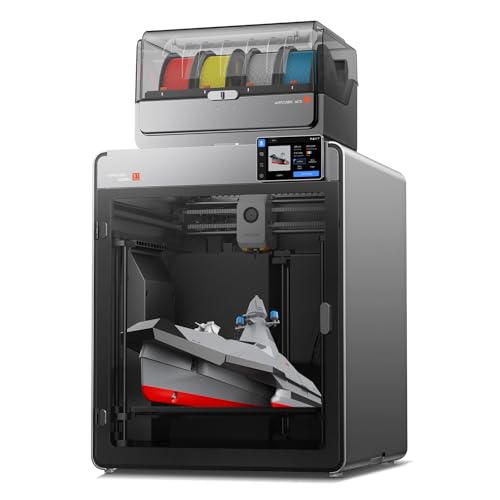
- 350 × 350 × 350 mm build volume
- 65°C heated chamber and 350°C hotend
- 600 mm/s CoreXY printing with auto-leveling
Best For: Large prototypes and advanced engineering materials
Best Automated Multicolor Engineering Printer

- 350 × 350 × 350 mm build volume
- 60°C chamber and 350°C nozzle
- AI cameras and 18 automated sensors
Best For: Automated prototyping with broad material support
Best for Engineering Print Farms

- 400 × 400 × 400 mm build volume
- 700 mm/s CoreXY printing
- WLAN multi-printer control and auto-leveling
Best For: Large prototypes and scaled production workflows
Engineering Multi-Material Powerhouse – Flashforge Creator 5 Pro
For demanding 3d printers for engineering prototypes, the Flashforge Creator 5 Pro emphasizes material flexibility, thermal control, and repeatable extrusion. Its four preloaded toolheads, 320°C hardened nozzle, and 65°C actively heated chamber make it suited to advanced prototype workflows.
Best For: Engineers printing multi-material prototypes and larger parts with demanding engineering filaments.
Pros:
- Four toolheads switch in about seven seconds without repeated filament loading and purging.
- Supports a broad range of materials, including PA-CF, PET-CF, PPA-CF, and PPS-CF.
- Actively heated chamber and hardened nozzle support stronger, flatter engineering prints.
- Flow Dynamics Calibration helps compensate for changing extrusion conditions.
Cons:
- Its advanced features may be more than needed for basic PLA prototyping.
- The printer has a substantial 30.8-pound footprint for a desktop machine.
The Creator 5 Pro stands out when prototype performance and material versatility matter more than a simple entry-level setup. Its controlled chamber and independent toolheads are particularly useful for functional parts and complex support strategies.
Fast Enclosed Workhorse – Bambu Lab P1S
The Bambu Lab P1S is a practical choice among 3d printers for engineering prototypes when speed, automation, and an enclosed build area are priorities. Automatic bed leveling and a 15-minute setup help reduce the routine work between design and first print.
Best For: Fast, user-friendly prototype production with common engineering plastics and an optional multi-material system.
Pros:
- Print speeds reach 500 mm/s with acceleration up to 20,000 mm/s².
- Fully enclosed design improves performance with advanced filaments.
- Automatic bed leveling helps simplify setup and improve print consistency.
- Optional AMS support enables printing with up to 16 colors.
Cons:
- AMS is required for multi-color or multi-material printing.
- Carbon- and glass-fiber-reinforced polymers are not recommended.
- PA and PC are listed as capable rather than ideal materials.
The P1S offers a strong balance of speed and convenience for teams that primarily use PLA, PETG, TPU, ABS, or ASA. It is less suitable when reinforced composite filaments are central to the prototype process.
Rapid Toolchanging Specialist – Snapmaker U1
The Snapmaker U1 is built for efficient 3d printers for engineering prototypes workflows, combining four independent toolheads with a five-second automatic changer. Its CoreXY motion system, smart calibration, and 270 mm cubed build volume support functional parts, mixed materials, and repeatable iteration.
Best For: Workshops and professional creators producing multi-material prototypes with minimal waste and manual intervention.
Pros:
- Four preloaded toolheads enable true multi-color and multi-material printing.
- Five-second tool changes can reduce waste and speed up complex prints.
- Supports materials such as PLA, PVA, TPU, PETG, PCTG, ABS, ASA, PA, and PC.
- Automatic calibration, AI print monitoring, remote control, and a touchscreen simplify operation.
Cons:
- At 57.9 pounds, it is notably heavy for a desktop printer.
- The feature-rich system may require more workflow planning than a basic single-toolhead printer.
The U1 is a compelling option when changing materials efficiently is central to the job. Its combination of toolchanging, calibration, and broad material support makes it especially useful for functional prototypes and small-batch parts.
High-Detail Resin Prototyper – ELEGOO Saturn 3 Ultra
For highly detailed visual or fit-check models, the ELEGOO Saturn 3 Ultra offers a resin-based alternative among 3d printers for engineering prototypes. Its 12K monochrome LCD, 19 × 24 μm XY resolution, and sizable build volume are designed for fine features and multiple models per print.
Best For: Detailed resin prototypes, small components, and presentation models where surface definition is a priority.
Pros:
- 12K resolution and 19 × 24 μm XY resolution support exceptionally fine detail.
- Large build volume accommodates larger models or several smaller parts.
- Wi-Fi file transfer works over both 2.4G and 5G networks.
- Four-point leveling and a laser-engraved build plate support reliable adhesion.
Cons:
- As an MSLA resin printer, it uses a different workflow from enclosed FDM machines.
- Its strengths center on fine detail rather than the broad filament-material selection of the other options.
The Saturn 3 Ultra is best viewed as a detail-first prototyping tool. Choose it for precise visual models and intricate geometry, while selecting an FDM machine when material variety, flexible filaments, or engineering composites are more important.
Best High-Speed Pick – FLASHFORGE Adventurer 5M
For shoppers comparing 3d printers for engineering prototypes, the FLASHFORGE AD5M emphasizes fast iteration, simple setup, and consistent first layers. Its CoreXY motion system, 600mm/s maximum speed, automatic leveling, and 220 x 220 x 220mm build volume make it well suited to quickly testing functional concepts.
Best For: Engineers, makers, and small teams that prioritize rapid prototyping with straightforward operation.
Pros:
- CoreXY design supports speeds up to 600mm/s and acceleration up to 20,000mm/s².
- One-click automatic leveling helps simplify first-layer setup.
- Quick-swap nozzles, filament detection, power recovery, and vibration compensation support efficient printing.
- Supports PLA, PETG, TPU, PLA-CF, and PETG-CF with appropriate nozzles.
Cons:
- The open design is intended for open, well-ventilated environments.
- The 220 x 220 x 220mm build volume may limit larger prototype parts.
- Carbon-fiber materials require the optional 0.6mm nozzle.
The AD5M is a practical choice when prototype turnaround and low-maintenance operation matter more than a large build area or enclosed workspace.
Best Large-Format Pick – Original Prusa XL
Among 3d printers for engineering prototypes, the Original Prusa XL stands out for its large format, precision-focused design, and expandability. This semi-assembled DIY kit includes one toolhead, while the platform can support up to five toolheads for advanced material combinations and low-waste multi-material printing.
Best For: Engineering teams and experienced builders working on larger parts or complex multi-material prototypes.
Pros:
- Large print volume supports projects that exceed the practical space of smaller desktop printers.
- Up to five toolheads enable multi-material printing with minimal-to-zero waste.
- Segmented heatbed and edge-to-edge print precision are useful for large, detailed parts.
- Includes network features, one-click printing, a satin print sheet, and 1kg of Prusament PLA.
Cons:
- This listing is a DIY kit requiring self-assembly.
- Its 62-pound weight and roughly 35.43 x 31.49 x 31.49-inch dimensions demand substantial workspace.
- The listing includes one toolhead; additional toolheads are needed for expanded multi-material capability.
The Prusa XL is the strongest fit here for large, technically ambitious prototypes, provided your workspace, budget, and assembly experience match its scale.
Best Multi-Color Pick – FLASHFORGE AD5X
The FLASHFORGE AD5X combines rapid CoreXY motion with up to four-color printing, making it a flexible option among 3d printers for engineering prototypes. Its 300°C direct-drive extruder, automatic leveling, and 220 x 220 x 220mm build volume support fast concept checks, visual differentiation, and small-batch production.
Best For: Prototype makers who need fast prints, multi-color identification, or flexible nozzle sizing in a compact desktop machine.
Pros:
- Supports up to four colors simultaneously for clearer prototype differentiation.
- CoreXY architecture reaches up to 600mm/s with 20,000mm/s² acceleration.
- 300°C direct-drive extruder, dual-channel cooling, and vibration compensation target consistent print quality.
- Automatic filament handling, power-loss resume, and remote app control simplify operation.
Cons:
- The 220 x 220 x 220mm build volume is better suited to desktop-sized prototypes than large assemblies.
- Multi-color capability adds complexity compared with a single-color workflow.
- Specialized nozzle sizes beyond the included 0.4mm nozzle are optional upgrades.
The AD5X is a compelling compromise for teams that want high-speed prototype cycles plus color-coded or presentation-ready parts without moving to a larger-format printer.
Best Large-Format Engineering Prototyping Printer – Anycubic Kobra S1 Max Combo
For engineers who need to print large housings, fixtures, or full-scale prototypes in one piece, the Anycubic Kobra S1 Max Combo is a strong option among 3d printers for engineering prototypes. Its 350 × 350 × 350 mm build volume, enclosed CoreXY frame, and heated chamber are designed for sizable, demanding prints.
Best For: Engineers and makers producing large prototypes or parts with advanced materials.
Pros:
- 350 × 350 × 350 mm build volume can accommodate large single-piece prototypes.
- 65°C heated chamber and 350°C hotend support materials including ABS, ASA, TPU, and PETG.
- CoreXY construction, 600 mm/s printing, and 49-point auto-leveling support efficient workflows.
Cons:
- Its 77.8-pound weight and large footprint may require substantial workspace.
- The bundled multicolor system adds complexity and may be unnecessary for single-material prototypes.
The Kobra S1 Max Combo stands out when prototype size and material flexibility matter more than a compact setup. Its enclosed, temperature-controlled design is particularly useful for engineers working with warp-prone or higher-temperature filaments.
Best Automated Multicolor Engineering Printer – Creality K2 Plus Combo
The Creality K2 Plus Combo combines a large 350 × 350 × 350 mm build volume with high-speed motion, automated monitoring, and a heated chamber. For teams comparing 3d printers for engineering prototypes, it offers a feature-rich setup for repeatable parts, larger models, and material experimentation.
Best For: Engineering teams that value automation, large prints, and optional multicolor output.
Pros:
- 60°C chamber and 350°C hardened-steel nozzle support materials such as ASA and PPA.
- Dual AI cameras and 18 sensors monitor printing and help optimize extrusion.
- Matrix frame, dual Z-axis motors, and linear rods are designed for stable, precise movement.
Cons:
- At 70.4 pounds, it is not an especially portable machine.
- The CFS multicolor system may be more capability than a single-material engineering workflow requires.
With automated calibration, failure monitoring, and a rigid frame, the K2 Plus Combo is aimed at users who want to reduce hands-on oversight. It is a compelling choice when prototype reliability and material range are priorities.
Best for Engineering Print Farms – Creality Ender 5 Max
The Creality Ender 5 Max is built for oversized parts and higher-throughput workflows. Its 400 × 400 × 400 mm build volume, 700 mm/s CoreXY system, and WLAN multi-printer control make it a practical candidate among 3d printers for engineering prototypes when batch production or print-farm management is important.
Best For: Businesses and design teams producing large prototypes or running multiple printers.
Pros:
- 400 × 400 × 400 mm build volume supports oversized prototypes and batch printing.
- WLAN grouped control is designed for managing multiple printers efficiently.
- 64-point auto-leveling, auto Z-offset, and a dual-gear extruder simplify repeat production.
Cons:
- The 70.4-pound machine requires a dedicated, stable installation area.
- Its large format may be unnecessary for smaller prototype parts.
The Ender 5 Max makes the most sense for users who need volume and throughput rather than a compact desktop printer. Its large build area and network-oriented controls are especially relevant to prototype shops and small print farms.
How We Picked the Best 3d Printers for Engineering Prototypes
We evaluated these printers around the demands of engineering work: repeatable results, practical material support, useful build volume, print speed, maintenance requirements, and workflow features. Enclosures, automatic leveling, direct-drive extrusion, high-temperature components, tool changing, and multi-material systems can make a meaningful difference when producing jigs, housings, brackets, fixtures, and fit-check models.
We also included different printer categories rather than treating one technology as universally best. FDM printers are generally the most versatile choice for functional prototypes, while MSLA printers can deliver finer surface detail for small parts and form studies. Large-format models suit oversized components, but they require more workspace and careful attention to thermal consistency.
Quick Comparison
- Best for versatile prototyping: Enclosed FDM printers with direct-drive extrusion and broad filament compatibility.
- Best for multi-material work: Tool-changing printers that reduce purge waste and support different materials in one build.
- Best for detailed small parts: High-resolution MSLA resin printers.
- Best for large components: Large-format printers with rigid frames, automatic leveling, and stable motion systems.
- Best for speed: CoreXY printers with automatic calibration and reliable high-flow extrusion.
Key Buying Factors for 3d Printers for Engineering Prototypes
Accuracy and Repeatability
Look beyond headline layer height. Frame rigidity, motion design, temperature control, calibration, and slicer profiles all influence whether holes, mating surfaces, and mounting features print consistently. For engineering parts, repeatability is often more important than maximum resolution.
Materials and Thermal Capability
PLA and PETG cover many early prototypes, but nylon, carbon-fiber-filled materials, ABS, and ASA may be preferable for heat, strength, or chemical resistance. Check the nozzle temperature, heated-bed performance, enclosure design, drying options, and whether the extruder is suitable for abrasive filaments.
Build Volume and Part Orientation
Choose enough capacity for the largest likely prototype without buying more machine than your workspace can support. A larger build area can reduce the need to split parts, but it also increases footprint, warm-up time, and the consequences of warping.
Workflow and Maintenance
Automatic leveling, input shaping, filament runout detection, remote monitoring, and dependable first-layer calibration save time across repeated iterations. Tool-changing systems can improve multi-material efficiency, while simpler single-extruder designs may be easier to maintain.
Who Should Buy Which 3d Printers for Engineering Prototypes?
Choose a compact enclosed CoreXY model if you need fast, dependable prototypes for a small workshop or design office. Select a multi-toolhead printer when color changes, soluble supports, or different materials are central to your workflow. A large-format machine is the better fit for vehicle, furniture, tooling, or full-size enclosure components, provided you have adequate ventilation and floor space.
For highly detailed miniature engineering parts, molds, or visual models, an MSLA printer can be worthwhile—but account for resin handling, washing, curing, ventilation, and post-processing. If you are still developing your process, prioritize automatic calibration, strong community support, accessible spare parts, and proven slicer profiles over the fastest advertised print speed.
Finally, budget for essentials such as spare nozzles, build plates, filament storage or drying, resin safety equipment, and measurement tools. The best choice among these 3d Printers for Engineering Prototypes is the one that fits your materials, part sizes, tolerance expectations, and iteration schedule.